
Scientists found that Egyptian mummies emit distinct “woody,” “spicy,” and “sweet” scents, revealing insights into their preservation and social status. Researchers now aim to recreate these scents for museum exhibits.
Have you ever wondered what a mummy smells like? According to research published in the Journal of the American Chemical Society, the scent is described as “woody,” “spicy,” and even “sweet.” Researchers analyzed the volatile compounds emitted by nine mummies spanning nearly 2,000 years of Egyptian history and discovered that these lingering scents can reveal how the bodies were preserved—or even how the individuals once lived—thousands of years ago.
“What truly surprised me was how individual the smells were, which indicated significant differences in the mummification processes and states of preservation,” enthuses Matija Strlič, a co-author of the study.
History stinks — literally! Because most historical objects are carefully preserved and enclosed inside display cases in museums, some people have the misconception that they’re odorless. But their scents can persist, and in the case of ancient Egyptian mummies, conservators describe those smells as pleasant. The ancient Egyptians took good care of their dead because it was believed that careful preparation of the body would allow the soul to successfully transition into the afterlife. The preservation process involved removing moisture and internal organs from the body, and using scented oils, resins, and bitumen (a petroleum product) as embalming agents to impart a pleasant smell.
Analyzing the Scent of Mummies
To delve more deeply into mummies’ purported smells, Strlič and colleagues, including researchers from the Egyptian Museum in Cairo, investigated the scent profiles of nine mummies. Five came from storage, and four are currently on display at the museum. Of the mummies investigated, the oldest came from the New Kingdom, around 1500 BCE, and the most recent from the Byzantine Period, around 300-400 CE.
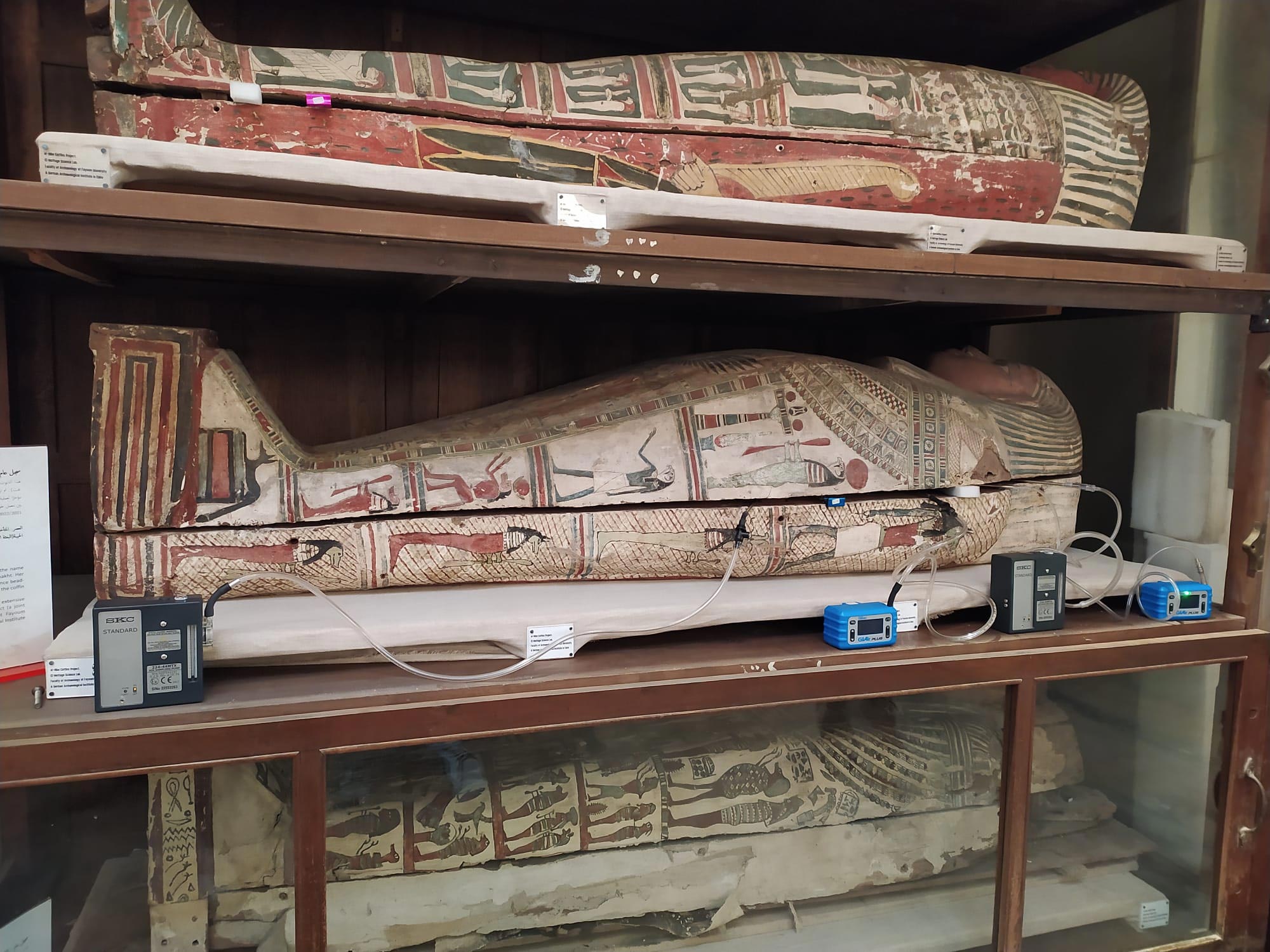
The researchers collected air around the remains by carefully inserting a tube between the base and lid of the coffin. Then they analyzed the samples using gas-chromatography-mass-spectrometry-olfactometry (GC-MS-O) and an eight-member trained sensory panel. They discovered that:
- The most frequent sensory notes describing the smells were “woody,” “spicy” and “sweet,” followed by “incense-like,” “stale” and “rancid.”
- There was no correlation between a mummy’s conservation state and its smell intensity. But the conservation state did reflect the overall composition of smells.
- The mummy with the strongest odor might have been the person with the highest social status in life, reflecting high-quality mummification practices.
- Mummies on display had higher concentrations of compounds carrying a scent, presumably because these compounds accumulate over time in their display cases.
The team classified the identified odor compounds from four possible origins: the mummification process, microbiological activity on the mummy, oils used for deterring pests, or synthetic pesticides used in conservation.
Celia Bembibre, a co-author of the study, adds, “The smells are part of the value of mummified bodies, and this knowledge is not available to museum visitors, who only see them behind display cases.”
The team is now working to reconstruct the smells based on their findings, so they can be presented in museums to enhance visitors’ understanding of mummies.
Reference: “Ancient Egyptian Mummified Bodies: Cross-Disciplinary Analysis of Their Smell” by Emma Paolin, Cecilia Bembibre, Fabiana Di Gianvincenzo, Julio Cesar Torres-Elguera, Randa Deraz, Ida Kraševec, Ahmed Abdellah, Asmaa Ahmed, Irena Kralj Cigić, Abdelrazek Elnaggar, Ali Abdelhalim, Tomasz Sawoszczuk and Matija Strlič, 13 February 2025, Journal of the American Chemical Society.
DOI: 10.1021/jacs.4c15769
The authors acknowledge funding from the Slovenian Research and Innovation Agency as well as the National Science Centre of Poland.
Never miss a breakthrough: Join the SciTechDaily newsletter.
Follow us on Google and Google News.