
Close Menu
    Facebook X (Twitter) Instagram
    SciTechDaily
    • Biology
    • Chemistry
    • Earth
    • Health
    • Physics
    • Science
    • Space
    • Technology
    Facebook X (Twitter) Pinterest YouTube RSS
    SciTechDaily
    Home»Space»X1.2 Event: Decoding the Sun’s Latest Megaflare
    Space

    X1.2 Event: Decoding the Sun’s Latest Megaflare

    By SciTechDaily.comJuly 16, 20241 Comment3 Mins Read
    Facebook Twitter Pinterest Telegram LinkedIn WhatsApp Email Reddit
    Share
    Facebook Twitter LinkedIn Pinterest Telegram Email Reddit
    Solar Flare July 2024
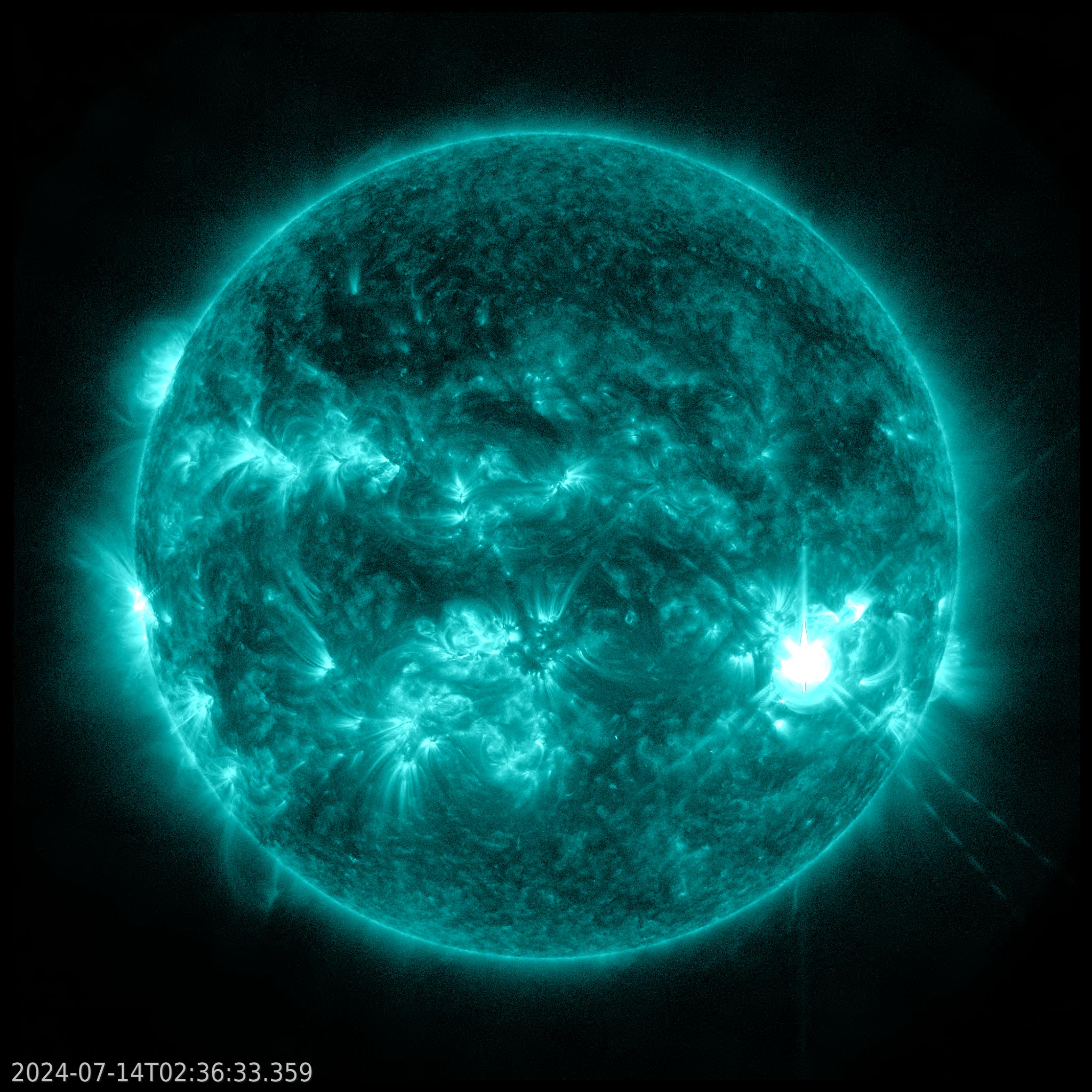
    NASA’s Solar Dynamics Observatory captured this image of a solar flare — seen as the bright flash on the right – on July 13, 2024. The image shows a subset of extreme ultraviolet light that highlights the extremely hot material in flares and which is colorized in teal. Credit: NASA/SDO

    On July 13, 2024, the sun emitted a powerful X1.2 class solar flare, which reached its peak intensity at 10:34 p.m. EDT. It was captured by NASA’s Solar Dynamics Observatory, which continuously monitors the Sun.

    Solar flares are intense bursts of radiation coming from the release of magnetic energy associated with sunspots. Flares are our solar system’s largest explosive events and are seen as bright areas on the sun. Their energy can reach Earth within minutes and cause disturbances to the electromagnetic field.

    The classification of solar flares is based on their brightness in the X-ray wavelengths observed by satellites. These classes are labeled as A, B, C, M, and X, with A being the smallest and X the most intense. Each class has a tenfold increase in energy output than the preceding one. Within each letter class, there is a finer scale from 1 to 9, which provides more details about the flare’s strength. For instance, an X1 flare is the lowest in its class but is still ten times more powerful than an M1 flare.

    X-class flares are major events that can trigger planet-wide radio blackouts and long-lasting radiation storms. Monitoring and understanding solar flares is crucial for anticipating and mitigating their effects on satellite communications, navigation systems, and power grids.
    NASA Solar Dynamics Observatory
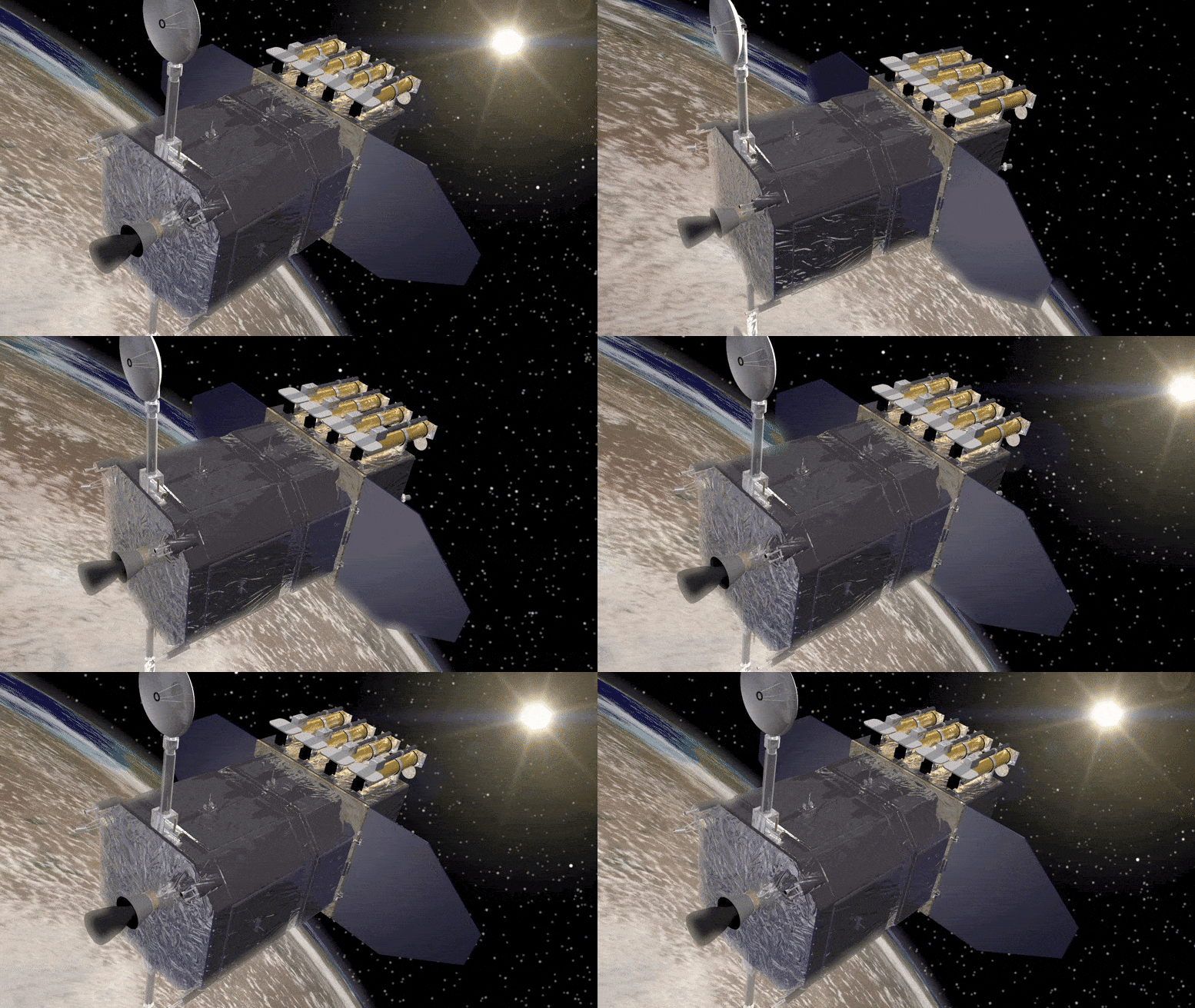
    This animation of the Solar Dynamics Observatory shows it above the earth as it faces toward the Sun. SDO is designed to help us understand the Sun’s influence on Earth and Near-Earth space by studying the solar atmosphere on small scales of space and time and in many wavelengths simultaneously. Credit: NASA/Goddard Space Flight Center Conceptual Image Lab

    NASA’s Solar Dynamics Observatory (SDO) is a mission dedicated to observing the Sun and helping scientists understand its influence on Earth and near-Earth space. Launched on February 11, 2010, SDO is part of NASA’s Living With a Star (LWS) program, which aims to develop the scientific understanding necessary to address those aspects of the connected Sun-Earth system that directly affect life and society.

    SDO’s primary goal is to study the solar atmosphere on small scales of space and time and in many wavelengths simultaneously. The observatory is equipped with a suite of instruments that provide observations leading to a more complete understanding of the solar dynamics that drive variability in the Earth’s environment. These instruments include the Atmospheric Imaging Assembly (AIA), which captures images of the solar atmosphere in multiple wavelengths to link changes in the surface to interior changes. The Helioseismic and Magnetic Imager (HMI) maps the solar magnetic fields and peers beneath the sun’s opaque surface using helioseismology. The Extreme Ultraviolet Variability Experiment (EVE) measures the sun’s ultraviolet output, which is a key driver of space weather.

    By continuously observing the Sun in high resolution and across multiple wavelengths, SDO provides insights into solar activities like solar flares, coronal mass ejections (CMEs), and other phenomena that can have profound impacts on Earth. This ongoing monitoring is crucial for advancing our understanding of the Sun’s complex and dynamic behavior.

    Never miss a breakthrough: Join the SciTechDaily newsletter.
    Follow us on Google and Google News.

    NASA Solar Dynamics Observatory Solar Flares Sun
    Share. Facebook Twitter Pinterest LinkedIn Email Reddit

    Related Articles

    NASA Just Found the Sun’s Secret Warning Before Massive Solar Flares

    Solar Fury Erupts: Sun Rings In the New Year With X1.8 Flare

    Sun Releases a Powerful Burst of Radiation – An X1-Class Solar Flare

    Powerful X-class Solar Flare Erupts From Sun

    NASA’s Solar Dynamics Observatory Spots Burst of Light and Energy on the Sun: A B-Class Flare

    NASA’s Solar Dynamics Observatory Views M-Class Solar Flare

    NASA’s SDO Reveals Images of X4.9-Class Solar Flare

    NASA’s Solar Dynamics Observatory Views Two New Solar Flares

    New Light Shed on the Origins of Extreme Space Storms

    1 Comment

    1. Ali on August 1, 2024 12:16 pm

      Years ago I watched a live shot of the Sun hour by hour..I can’t find it again is it still available somewhere on the Space sites?

      Reply
    Leave A Reply Cancel Reply

    • Facebook
    • Twitter
    • Pinterest
    • YouTube

    Don't Miss a Discovery

    Subscribe for the Latest in Science & Tech!

    Trending News

    Monster Storms on Jupiter Unleash Lightning Beyond Anything on Earth

    Scientists Create “Liquid Gears” That Spin Without Touching

    The Simple Habit That Could Help Prevent Cancer

    Millions Take These IBS Drugs, But a New Study Finds Serious Risks

    Scientists Unlock Hidden Secrets of 2,300-Year-Old Mummies Using Cutting-Edge CT Scanner

    Bread Might Be Making You Gain Weight Even Without Eating More Calories

    Scientists Discover Massive Magma Reservoir Beneath Tuscany

    Europe’s Most Active Volcano Just Got Stranger – Here’s Why Scientists Are Rethinking It

    Follow SciTechDaily
    • Facebook
    • Twitter
    • YouTube
    • Pinterest
    • Newsletter
    • RSS
    SciTech News
    • Biology News
    • Chemistry News
    • Earth News
    • Health News
    • Physics News
    • Science News
    • Space News
    • Technology News
    Recent Posts
    • Simple Blood Test May Predict Alzheimer’s Years Before Brain Scans Show Signs
    • Scientists Say Adding This Unusual Seafood to Your Diet Could Reverse Signs of Aging
    • U.S. Waste Holds $5.7 Billion Worth of Crop Nutrients
    • Scientists Say a Hidden Structure May Exist Inside Earth’s Core
    • Doctors Surprised by the Power of a Simple Drug Against Colon Cancer
    Copyright © 1998 - 2026 SciTechDaily. All Rights Reserved.
    • Science News
    • About
    • Contact
    • Editorial Board
    • Privacy Policy
    • Terms of Use

    Type above and press Enter to search. Press Esc to cancel.