
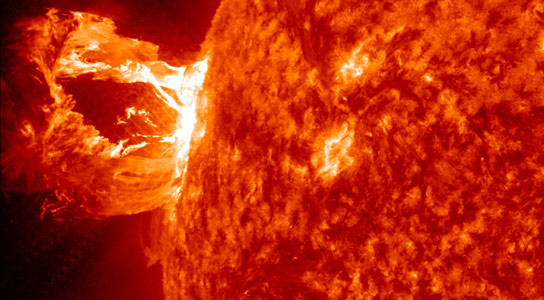
A new ScienceCast video details an intense solar storm that narrowly missed Earth two years ago. If it had hit, researchers say, we could still be picking up the pieces.
Last month (April 8-11), scientists, government officials, emergency planners and others converged on Boulder, Colorado, for NOAA’s Space Weather Workshop—an annual gathering to discuss the perils and probabilities of solar storms.
The current solar cycle is weaker than usual, so you might expect a correspondingly low-key meeting. On the contrary, the halls and meeting rooms were abuzz with excitement about an intense solar storm that narrowly missed Earth.
“If it had hit, we would still be picking up the pieces,” says Daniel Baker of the University of Colorado, who presented a talk entitled The Major Solar Eruptive Event in July 2012: Defining Extreme Space Weather Scenarios.
A new ScienceCast video recounts the near-miss of a solar superstorm in July 2012.
The close shave happened almost two years ago. On July 23, 2012, a plasma cloud or “CME” rocketed away from the sun as fast as 3,000 km/s (4,800 mi/s), more than four times faster than a typical eruption. The storm tore through Earth’s orbit, but fortunately Earth wasn’t there. Instead it hit the STEREO-A spacecraft. Researchers have been analyzing the data ever since, and they have concluded that the storm was one of the strongest in recorded history. “It might have been stronger than the Carrington Event itself,” says Baker.
The Carrington Event of September 1859 was a series of powerful CMEs that hit Earth head-on, sparking Northern Lights as far south as Tahiti. Intense geomagnetic storms caused global telegraph lines to spark, setting fire to some telegraph offices and disabling the ‘Victorian Internet.” A similar storm today could have a catastrophic effect on modern power grids and telecommunication networks. According to a study by the National Academy of Sciences, the total economic impact could exceed $2 trillion or 20 times greater than the costs of Hurricane Katrina. Multi-ton transformers fried by such a storm could take years to repair and impact national security.
A recent paper in Nature Communications authored by UC Berkeley space physicist Janet G. Luhmann and former postdoc Ying D. Liu describes what gave the July 2012 storm Carrington-like potency. For one thing, the CME was actually two CMEs separated by only 10 to 15 minutes. This double storm cloud traveled through a region of space that had been cleared out by another CME only four days earlier. As a result, the CMEs were not decelerated as much as usual by their transit through the interplanetary medium.
Had the eruption occurred just one week earlier, the blast site would have been facing Earth, rather than off to the side, so it was a relatively narrow escape.
When the Carrington Event enveloped Earth in the 19th century, technologies of the day were hardly sensitive to electromagnetic disturbances. Modern society, on the other hand, is deeply dependent on sun-sensitive technologies such as GPS, satellite communications and the internet.
“The effect of such a storm on our modern technologies would be tremendous,” says Luhmann.
During informal discussions at the workshop, Nat Gopalswamy of the Goddard Space Flight Center noted that “without NASA’s STEREO probes, we might never have known the severity of the 2012 superstorm. This shows the value of having ‘space weather buoys’ located all around the sun.”
It also highlights the potency of the sun even during so-called “quiet times.” Many observers have noted that the current solar cycle is weak, perhaps the weakest in 100 years. Clearly, even a weak solar cycle can produce a very strong storm.
Says Baker, “We need to be prepared.”
References:
“A major solar eruptive event in July 2012: Defining extreme space weather scenarios” by D. N. Baker, X. Li, A. Pulkkinen, C. M. Ngwira, M. L. Mays, A. B. Galvin and K. D. C. Simunac, 19 September 2013, Space Weather.
DOI: 10.1002/swe.20097
“Observations of an extreme storm in interplanetary space caused by successive coronal mass ejections” by Ying D. Liu, Janet G. Luhmann, Primož Kajdič, Emilia K.J. Kilpua, Noé Lugaz, Nariaki V. Nitta, Christian Möstl, Benoit Lavraud, Stuart D. Bale, Charles J. Farrugia and Antoinette B. Galvin, 18 March 2014, Nature Communications.
DOI: 10.1038/ncomms4481
Never miss a breakthrough: Join the SciTechDaily newsletter.
Follow us on Google and Google News.
1 Comment
Perhaps we have to be more alert during quiet sun periods. The sun may have a constant output of energy but it is released either as a series of small, defusing eruptions or is blocked by some unknown mechanism until there is a massive outburst.