
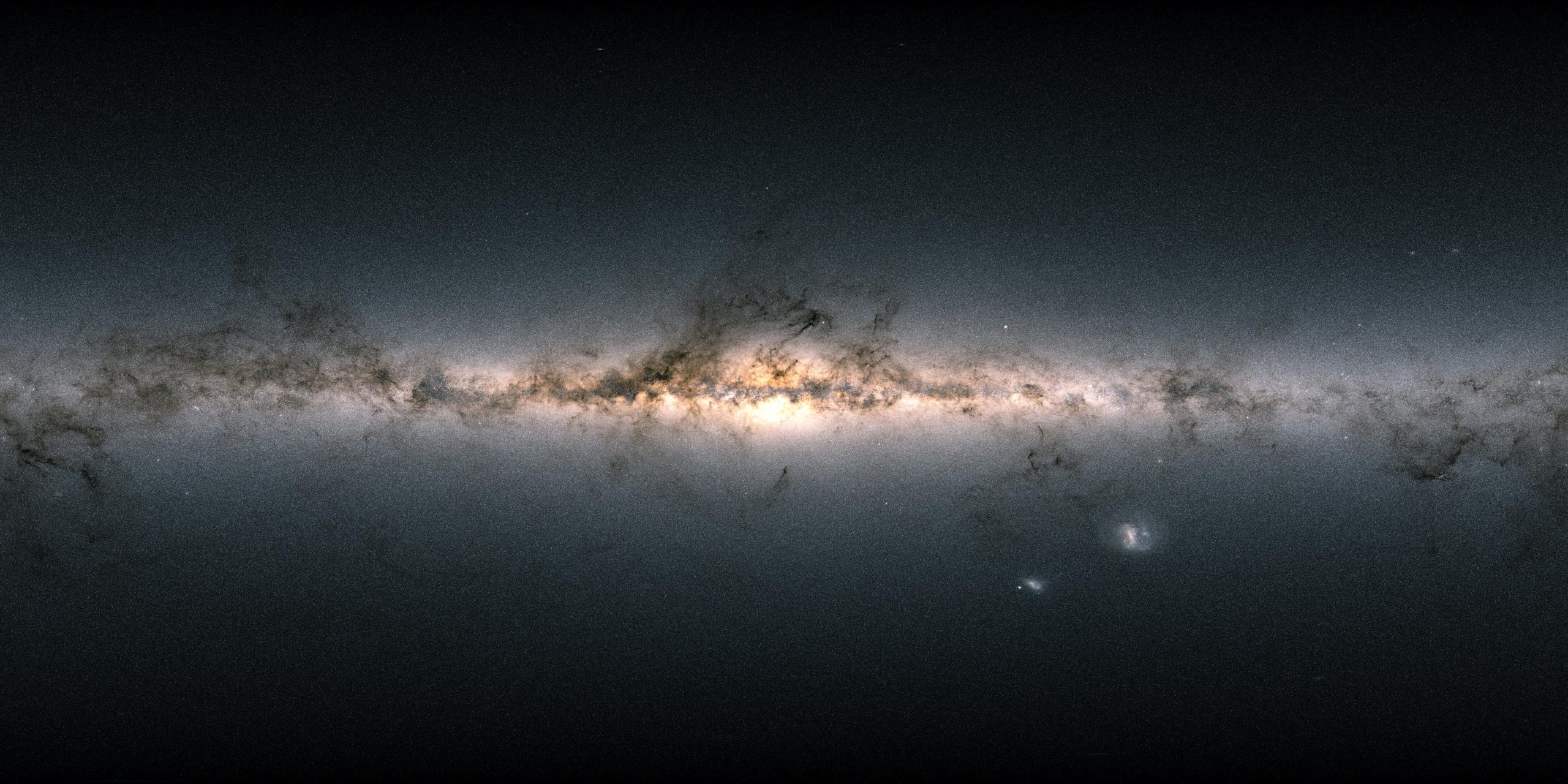
New research from the SAGA Survey, comparing the Milky Way with 101 similar galaxies, unveils how our galaxy differs significantly in aspects like satellite systems and star formation patterns. These differences are crucial for understanding the broader mechanics of galaxy formation and the mysterious role of dark matter.
Astronomers often use the Milky Way as a benchmark for studying how galaxies form and evolve. Being inside it gives scientists a unique advantage, allowing them to study it in extraordinary detail with advanced telescopes. By observing it across different wavelengths, they can uncover insights into its stellar population, gas dynamics, and other features that are harder to discern in distant galaxies.
Unique Insights from the SAGA Survey
Yet, recent research examining 101 galaxies similar in mass to the Milky Way reveals just how different our galaxy is from its cosmic peers.
A key method for understanding anything is to compare it to others in its category, a concept we learn early in school. Surveys are invaluable tools for making these comparisons, and astronomical surveys have provided a wealth of foundational data. Notable examples include the Sloan Digital Sky Survey (SDSS), the Two Micron All Sky Survey (2MASS), and ESA’s Gaia mission.
Adding to this list is the Satellites Around Galactic Analogs (SAGA) Survey. Its third data release underpins three new studies, each focusing on different aspects of 101 galaxies similar to the Milky Way. These studies provide fresh insights into how our galaxy stacks up against its counterparts.
- The SAGA Survey. III. A Census of 101 Satellite Systems around Milky Way–mass Galaxies
- The SAGA Survey. IV. The Star Formation Properties of 101 Satellite Systems around Milky Way–mass Galaxies
- The SAGA Survey. V. Modeling Satellite Systems around Milky Way–Mass Galaxies with Updated UniverseMachine
Understanding Dark Matter Through Satellite Galaxies
Research shows that galaxies form inside gigantic haloes of dark matter, the elusive substance that doesn’t interact with light. 85% of the Universe’s matter is mysterious dark matter, while only 15% is normal or baryonic matter, the type that makes up planets, stars, and galaxies. Though we can’t see these massive haloes, astronomers can observe their effects. Their gravity draws normal together to create galaxies and stars.
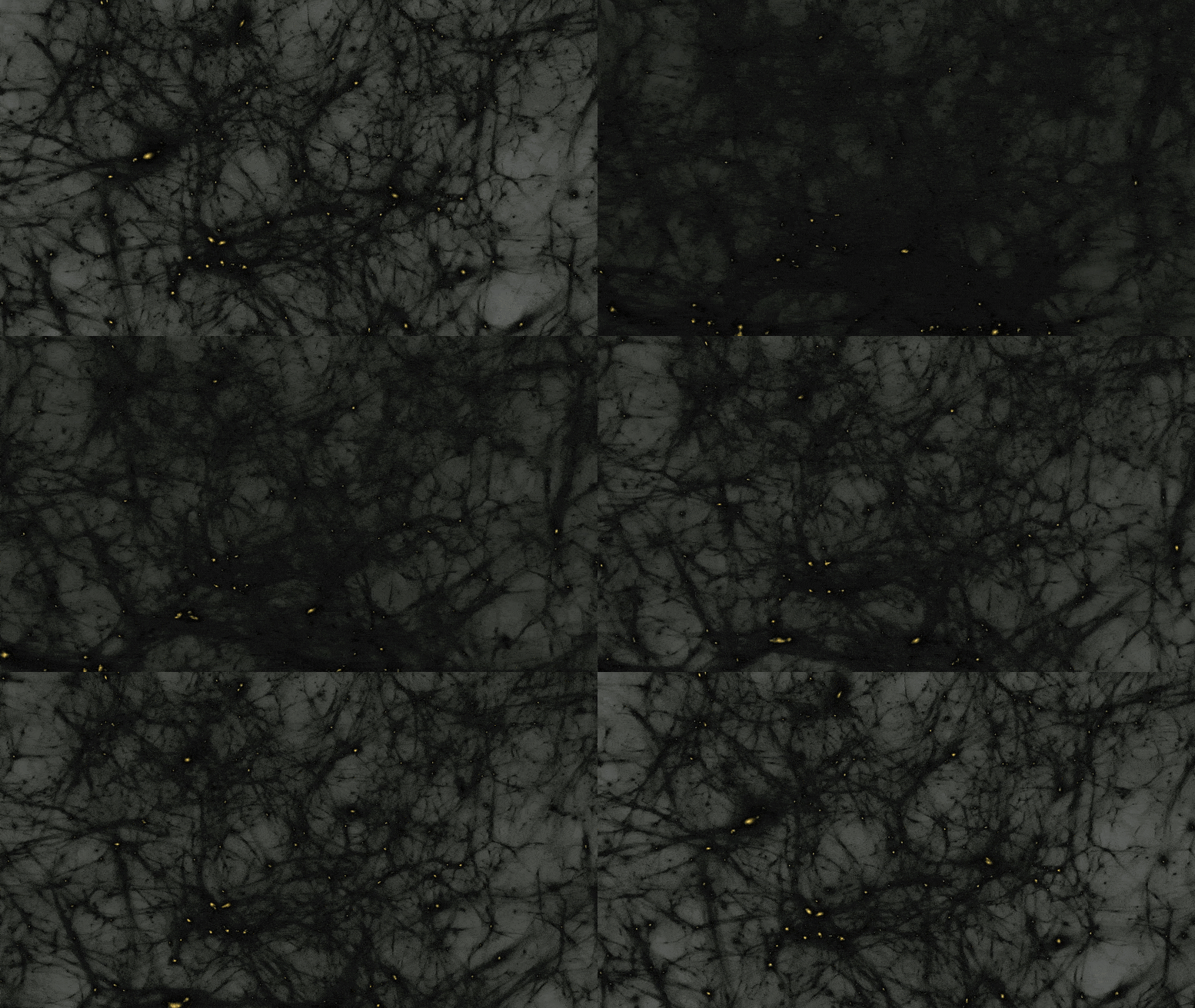
SAGA is aimed at understanding how dark matter haloes work. It examines low-mass satellite galaxies around galaxies similar in mass to the Milky Way. These satellites can be captured and drawn into the dark matter haloes of larger galaxies. SAGA has found several hundred of these satellite galaxies orbiting 101 Milky Way-mass galaxies.
Diverse Findings in Galactic Comparisons
“The Milky Way has been an incredible physics laboratory, including for the physics of galaxy formation and the physics of dark matter,” said Risa Wechsler, the Humanities and Sciences Professor and professor of physics in the School of Humanities and Sciences. Wechsler is also the co-founder of the SAGA Survey. “But the Milky Way is only one system and may not be typical of how other galaxies formed. That’s why it’s critical to find similar galaxies and compare them.”
The comparison between the Milky Way and the 101 others revealed some significant differences.
The Surprising Results of the SAGA Survey
“Our results show that we cannot constrain models of galaxy formation just to the Milky Way,” said Wechsler, who is also professor of particle physics and astrophysics at the SLAC National Accelerator Laboratory. “We have to look at that full distribution of similar galaxies across the universe.”
The SAGA Survey’s third data release includes 378 satellites found in 101 MW-mass systems, and the first paper focuses on the satellites. Only a painstaking search was able to uncover them. Four of them belong to the Milky Way, including the well-known Large and Small Magellanic Clouds.
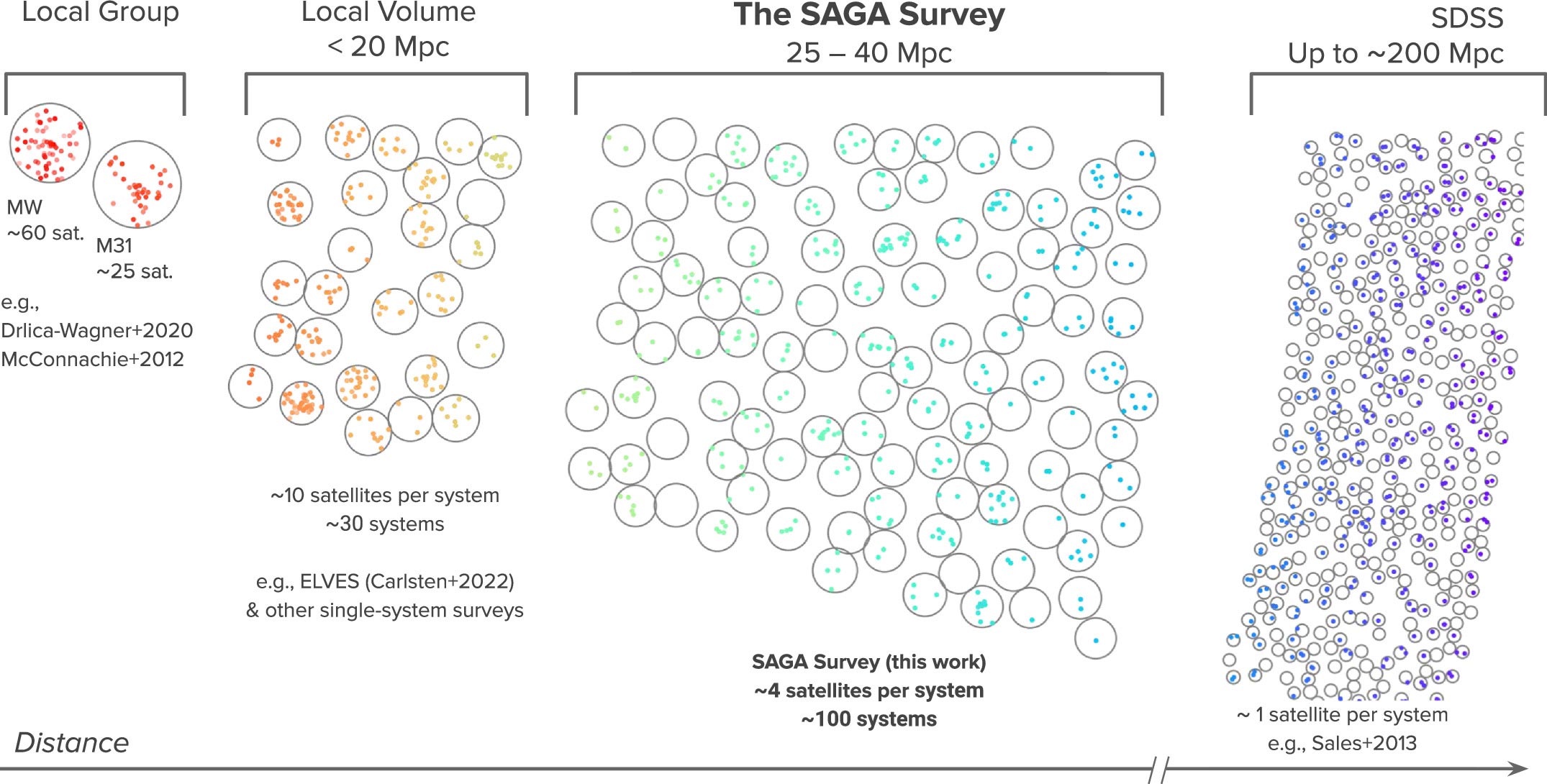
“There’s a reason no one ever tried this before,” Wechsler said. “It’s a really ambitious project. We had to use clever techniques to sort those 378 orbiting galaxies from thousands of objects in the background. It’s a real needle-in-the-haystack problem.”
SAGA found that the number of satellites per galaxy ranges from zero to 13. According to the first paper, the mass of the most massive satellite is a strong predictor of the abundance of satellites. “One-third of the SAGA systems contain LMC-mass satellites, and they tend to have more satellites than the MW,” the paper states. The Milky Way is an outlier in this regard, which is one reason it’s atypical.
Exploring the Quenching of Star Formation
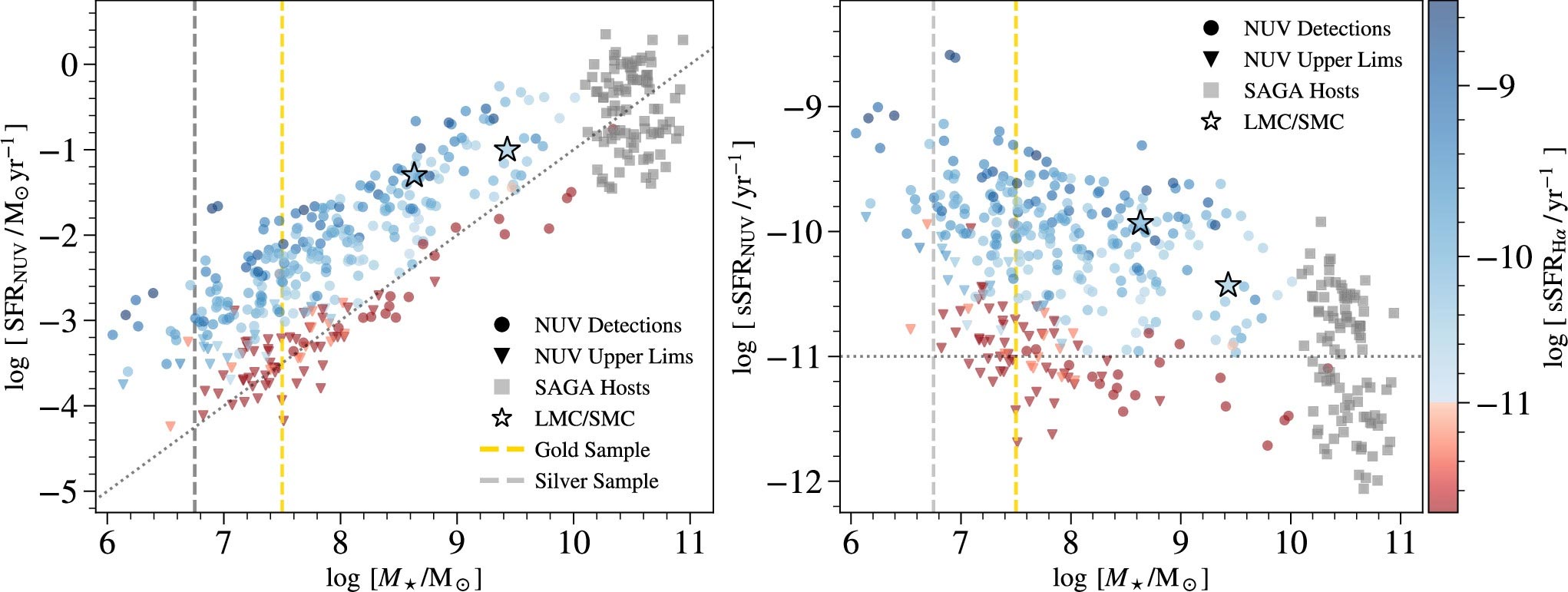
The second study focuses on star formation in the satellites. The star formation rate (SFR) is an important metric in understanding galaxy evolution. The research shows that star formation is still active in the satellite galaxies, but the closer they are to the host, the slower their SFR. Is it possible that the greater pull of the dark matter halo close to the galaxy is quenching star formation?
“Our results suggest that lower-mass satellites and satellites inside 100 kpc are more efficiently quenched in a Milky Way–like environment, with these processes acting sufficiently slowly to preserve a population of star-forming satellites at all stellar masses and projected radii,” the second paper states.
However, in the Milky Way’s satellites, only the Magellanic Clouds are still forming stars, with radial distance playing a role. “Now we have a puzzle,” Wechsler said. “What in the Milky Way caused these small, lower-mass satellites to have their star formation quenched? Perhaps, unlike a typical host galaxy, the Milky Way has a unique combination of older satellites that have ceased star formation and newer, active ones – the LMC and SMC – that only recently fell into the Milky Way’s dark matter halo.”
This is another reason that our galaxy is atypical.
What about the smaller dark matter haloes around the satellite galaxies? What role do they play?
“To me, the frontier is figuring out what dark matter is doing on scales smaller than the Milky Way, like with the smaller dark matter halos that surround these little satellites,” Wechsler said.
The Future of Galactic Research
The third paper compares SAGA’s third data release with computer simulations. The authors developed a new model for quenching in galaxies with less-than-or-equal-to 109 solar masses. Their model is constrained by the SAGA data on the 101 galaxies, and the researchers then compared it to isolated field galaxies from the Sloan Digital Sky Survey.
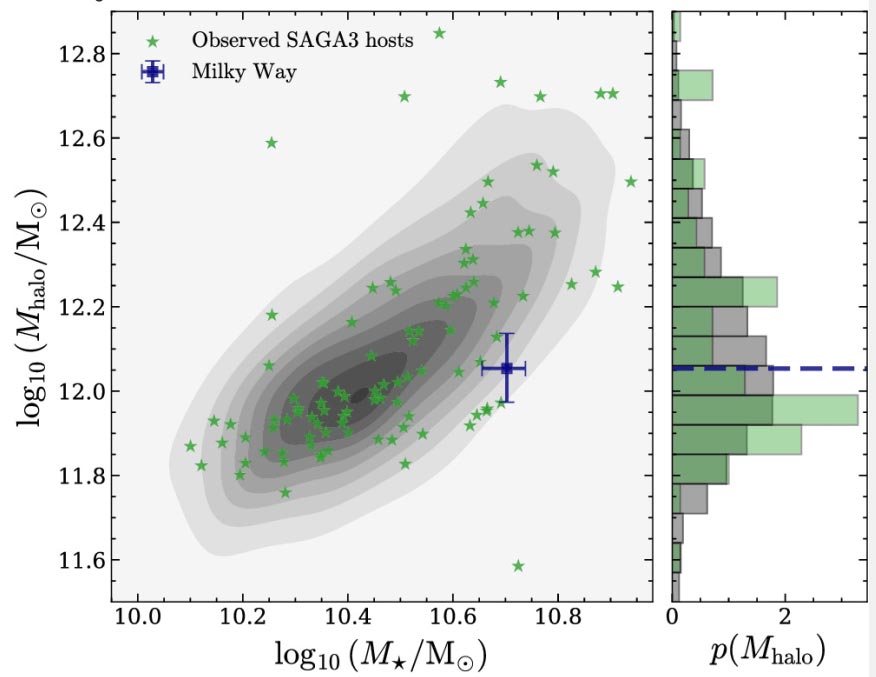
The model successfully reproduced the stellar mass function of the satellites, their average SFRs, and the quenched fractions in the satellites. It also maintained the SFR in more isolated satellite galaxies and observed enhanced quenching in closer satellites.
The model needs more testing with observations, and the authors point out that spectroscopic surveys are a logical next step. Those surveys can hopefully answer questions about the role internal feedback plays in the lower-mass satellites, about their mass and gas accretion and the influence dark matter has on them, as well as gas processes specific to the satellites.
“SAGA provides a benchmark to advance our understanding of the universe through the detailed study of satellite galaxies in systems beyond the Milky Way,” Wechsler said. “Although we finished our initial goal of mapping bright satellites in 101 host galaxies, there’s a lot more work to do.”
Adapted from an article originally published on Universe Today.
Explore Further:
- Milky Way Mysteries: Astronomers Reveal Its Unique Place in the Cosmos
- Scientists Reveal the Milky Way Is a Cosmic Outlier
References:
- “The SAGA Survey. III. A Census of 101 Satellite Systems around Milky Way–mass Galaxies” by Yao-Yuan Mao, Marla Geha, Risa H. Wechsler, Yasmeen Asali, Yunchong Wang, Erin Kado-Fong, Nitya Kallivayalil, Ethan O. Nadler, Erik J. Tollerud, Benjamin Weiner, Mithi A. C. de los Reyes and John F. Wu, 18 November 2024, The Astrophysical Journal.
DOI: 10.3847/1538-4357/ad64c4 - “The SAGA Survey. IV. The Star Formation Properties of 101 Satellite Systems around Milky Way–mass Galaxies” by Marla Geha, Yao-Yuan Mao, Risa H. Wechsler, Yasmeen Asali, Erin Kado-Fong, Nitya Kallivayalil, Ethan O. Nadler, Erik J. Tollerud, Benjamin Weiner, Mithi A. C. de los Reyes, Yunchong Wang and John F. Wu, 18 November 2024, The Astrophysical Journal.
DOI: 10.3847/1538-4357/ad61e7 - “The SAGA Survey. V. Modeling Satellite Systems around Milky Way–Mass Galaxies with Updated UniverseMachine” by Yunchong Wang, Ethan O. Nadler, Yao-Yuan Mao, Risa H. Wechsler, Tom Abel, Peter Behroozi, Marla Geha, Yasmeen Asali, Mithi A. C. de los Reyes, Erin Kado-Fong, Nitya Kallivayalil, Erik J. Tollerud, Benjamin Weiner and John F. Wu, 18 November 2024, The Astrophysical Journal.
DOI: 10.3847/1538-4357/ad7f4c
Never miss a breakthrough: Join the SciTechDaily newsletter.
Follow us on Google and Google News.
3 Comments
Yes that centuries old disease and illusion that we are somehow special will never leave us. Right ?
How about one planet on orbit, alternate empty
This article already includes the seeds of another possible explanation: It isn’t quenching, but exhaustion. Proximity to the halo increases SFR and exhausts the available gases more quickly.
Maybe stellar surveys within the satellites for age of populations, and/or detection of gases being drawn off by the central galaxy? Though the article does say many of the satellites were difficult to find in the first place.