
Close Menu
    Facebook X (Twitter) Instagram
    SciTechDaily
    • Biology
    • Chemistry
    • Earth
    • Health
    • Physics
    • Science
    • Space
    • Technology
    Facebook X (Twitter) Pinterest YouTube RSS
    SciTechDaily
    Home»Space»Hubble Captures a New Image of Comet ISON
    Space

    Hubble Captures a New Image of Comet ISON

    By Hubble Space TelescopeOctober 23, 2013No Comments2 Mins Read
    Facebook Twitter Pinterest Telegram LinkedIn WhatsApp Email Reddit
    Share
    Facebook Twitter LinkedIn Pinterest Telegram Email Reddit
    New Hubble Image of Comet ISON
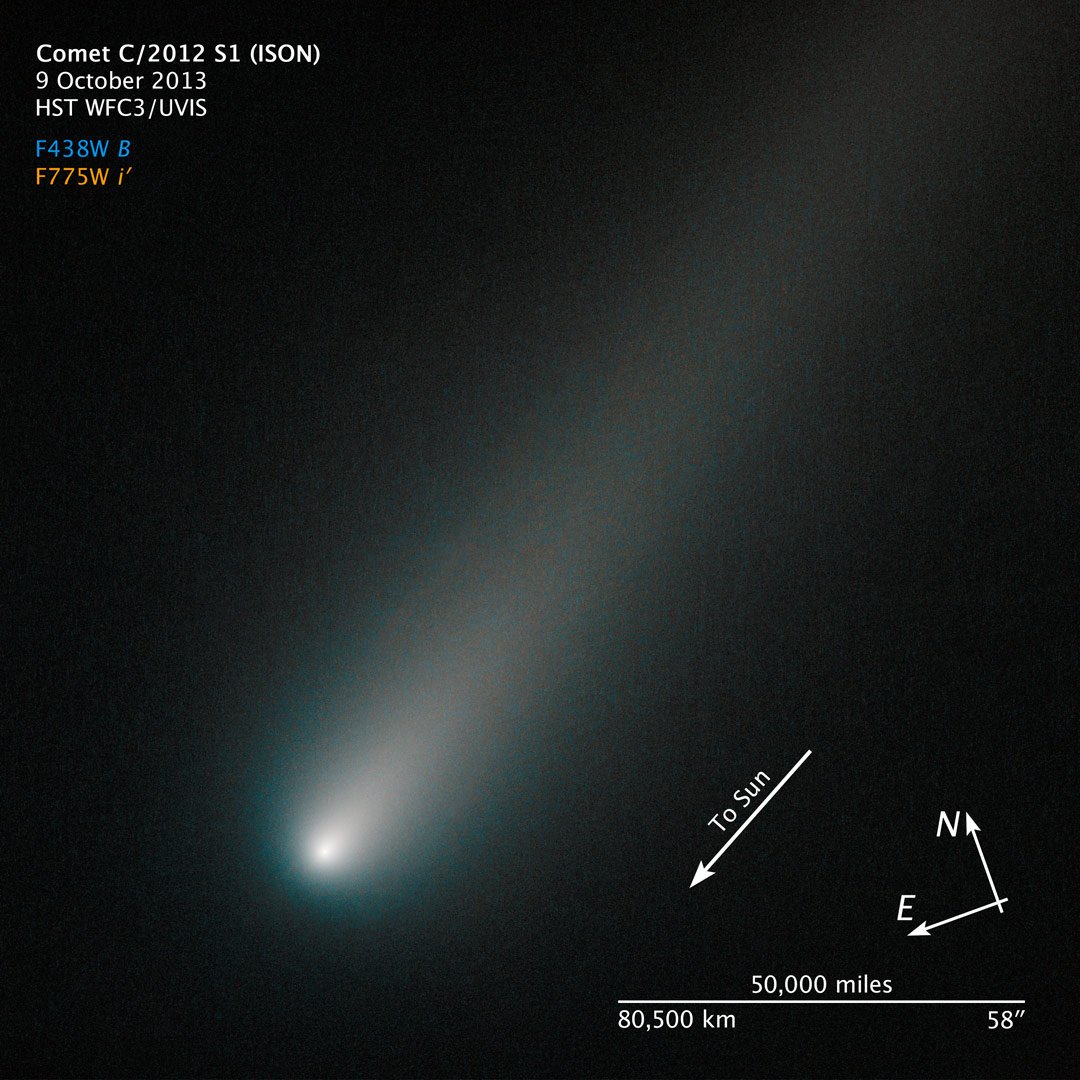
    A new image of the sunward plunging Comet ISON taken by NASA’s Hubble Space Telescope on October 9, 2013, suggests that the comet is intact despite some predictions that the fragile icy nucleus might disintegrate as the Sun warms it. The comet will pass closest to the Sun on November 28. Credit: NASA, ESA, and Z. Levay (STScI/AURA)

    NASA’s Hubble Space Telescope captured a new image of Comet ISON on October 9, 2013.

    This new NASA/ESA Hubble Space Telescope picture shows C/2012 S1, better known as Comet ISON, a high-profile celestial visitor to the Solar System. Hubble has already snapped this comet twice this year, but for some time it was temporarily blocked from view by the Sun. It was spotted again in August 2013, and this new image shows the comet as it appeared in our skies in early October.

    ISON will be brightest in our skies in late November, just before and after it hurtles past the Sun. As it gets brighter, it may even become visible as a naked-eye object, before it fades throughout December — the month of its closest approach to Earth. Depending on its fate as it passes close to the Sun, it could become spectacular or, on the contrary, it could completely disintegrate. Many observatories, as well as several ESA and NASA missions, aim to observe this icy visitor over the coming months.

    In this Hubble image, taken on 9 October 2013, the comet’s solid nucleus is unresolved because it is so small. If it had broken apart — a possibility as the Sun slowly warms it up during its approach — Hubble would have likely seen evidence for multiple fragments instead.

    Never miss a breakthrough: Join the SciTechDaily newsletter.
    Follow us on Google and Google News.

    Astronomy Comet Hubble Space Telescope NASA
    Share. Facebook Twitter Pinterest LinkedIn Email Reddit

    Related Articles

    NASA’s Hubble Accidentally Witnesses a Comet Shattering in Space

    Hubble Reveals a Rare Interstellar Comet Racing at 130,000 MPH Through Our Solar System

    Spectacular Disintegration of Comet ATLAS Captured by Hubble Space Telescope

    Hubble Watches Comet ATLAS Disintegrate – Identified Months Ago by Planetary Defense System

    Mysterious Visitor From the Depths of Space Swings Past Sun

    First Confirmed Interstellar Comet Observed by Hubble [Video]

    Hubble Reveals Multiple Jets Sprouting from Comet C/2013 A1

    Time-Lapse Video Captures Comet ISON Heading Toward the Sun

    Hubble Captures Close-Up View of Comet ISON

    Leave A Reply Cancel Reply

    • Facebook
    • Twitter
    • Pinterest
    • YouTube

    Don't Miss a Discovery

    Subscribe for the Latest in Science & Tech!

    Trending News

    A Long-Held Idea About Alzheimer’s Tau May Be Wrong

    Your Favorite Scented Cleaner Could Be Filling the Air With Invisible Pollution

    New Study Reveals a Major Shift Behind Rising ADHD and Autism Diagnoses

    New Treatment Cuts “Bad” Cholesterol in Half for a Full Year

    Astronomers Expected More Tiny Worlds Beyond Neptune – Webb Found Something Else

    Scientists Discover New Compound That Burns Fat Without Killing Your Appetite

    Mount Vesuvius Buried These Scrolls for 2,000 Years – Now Scientists May Read Them

    The Asteroid That Killed the Dinosaurs Was Stranger Than We Thought

    Follow SciTechDaily
    • Facebook
    • Twitter
    • YouTube
    • Pinterest
    • Newsletter
    • RSS
    SciTech News
    • Biology News
    • Chemistry News
    • Earth News
    • Health News
    • Physics News
    • Science News
    • Space News
    • Technology News
    Recent Posts
    • Henry VIII’s Lost Castle May Still Be Hiding in Plain Sight
    • Medieval Manuscripts Reveal a 3,500-Year-Old Viral Secret Hidden in Parchment
    • Scientists Discover Canada’s First Dinosaur Tracks From a Rarely Documented Cretaceous Age
    • Astronomers Just Caught a Giant Planet in the Act of Forming
    • NASA Planned for 10 Years. The Roman Space Telescope May Keep Going for 22
    Copyright © 1998 - 2026 SciTechDaily. All Rights Reserved.
    • Science News
    • About
    • Contact
    • Editorial Board
    • Privacy Policy
    • Terms of Use

    Type above and press Enter to search. Press Esc to cancel.