
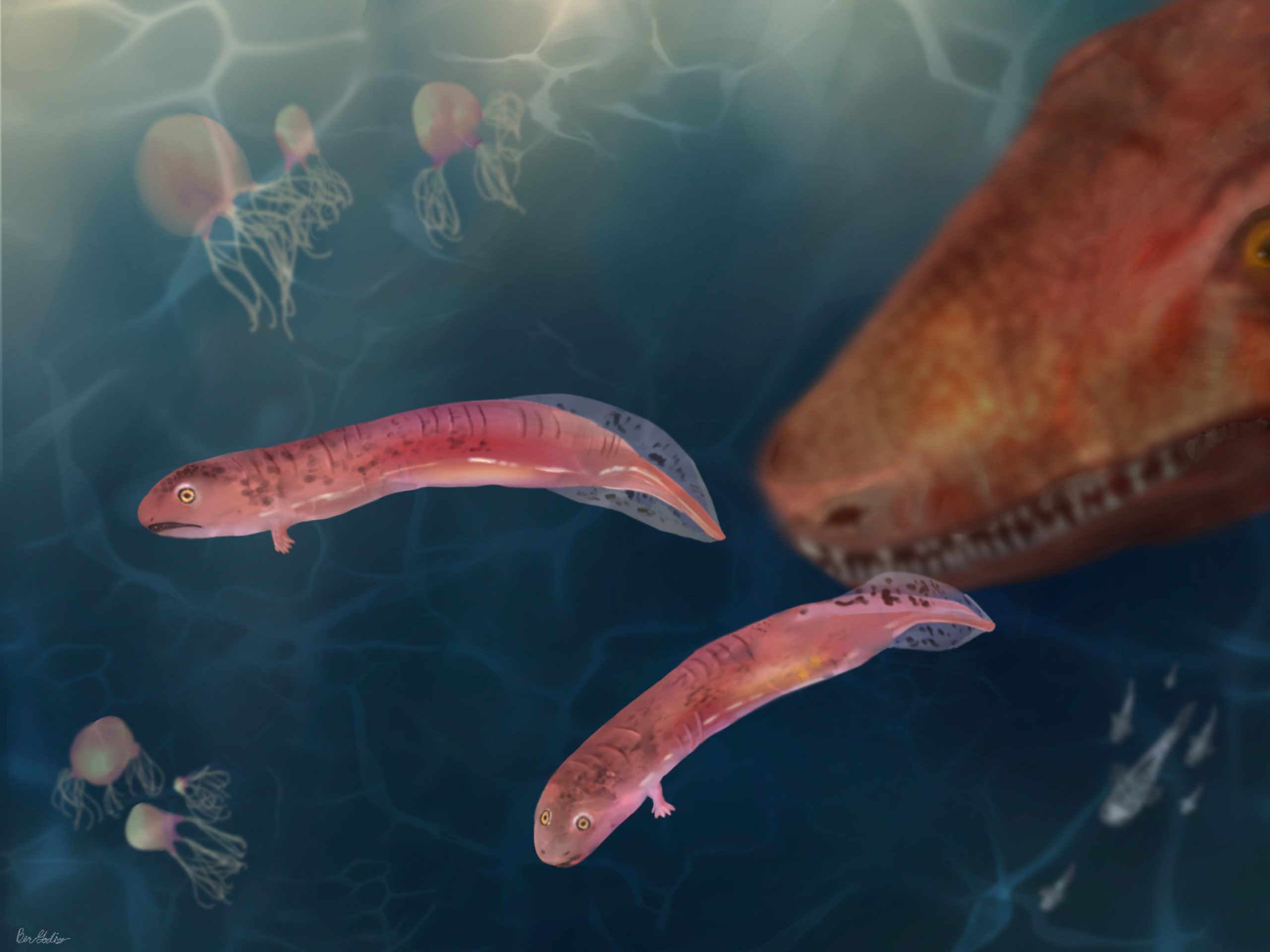
Fossils of young tetrapods suggest that the common ancestors of amphibians, reptiles and mammals did not evolve from animals with tadpole-like larvae, as scientists once thought.
The first animals to move from water onto land may not have grown up the way scientists long assumed. For decades, the standard picture was that early tetrapods, the ancient four-limbed animals that gave rise to today’s mammals, birds, reptiles, and amphibians, developed much like modern amphibians. They were thought to hatch from eggs, pass through a tadpole stage, and then transform into adult bodies.
New fossil evidence is now challenging that idea. In a study published in Science, researchers describe fossilized baby early tetrapods that do not show the tadpole-style metamorphosis scientists expected. The finding suggests that the first vertebrates to live on land were less like modern amphibians than previously believed, reshaping a major part of the story of how animals conquered land.
“When a lot of us were in high school, we were taught this simplified story of evolution: that some fish evolved into amphibians, and some of those amphibians evolved into reptiles, and some of those reptiles evolved into mammals. And our study shows that this basic underlying premise, that the first four-legged vertebrates grew up like amphibians, is wrong,” says Jason Pardo, a research associate at the Field Museum and the study’s co-lead author.
Mazon Creek preserved tiny clues
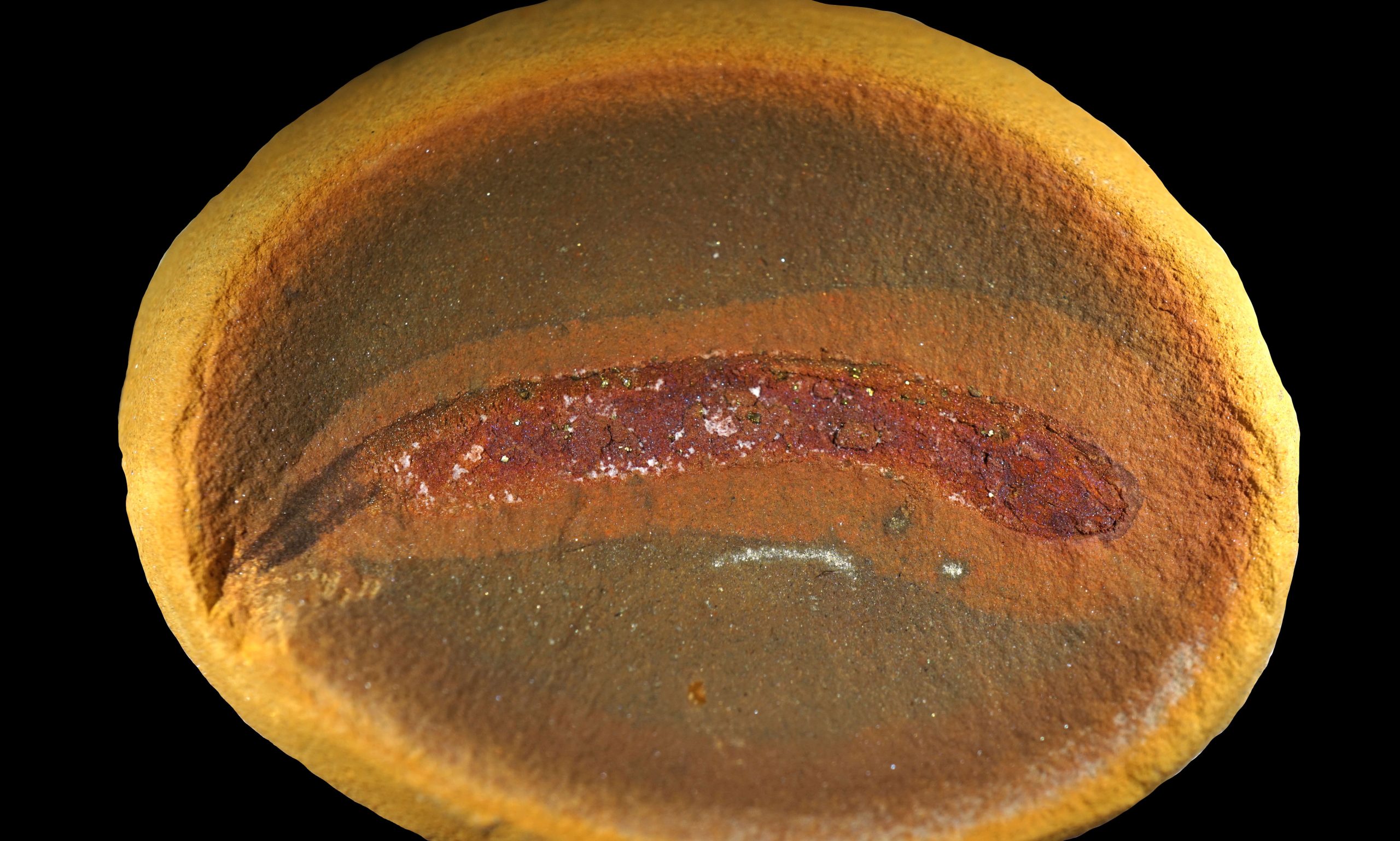
The discovery depended on fossils from Mazon Creek, a site about an hour southwest of Chicago that is known for preserving unusually delicate remains. That level of preservation is especially important for baby animals, soft tissues, and small developmental features that are rarely captured in the fossil record.
“This is the first time we’ve had these early, early hatchling animals. This discovery is really a testament to the power of Mazon Creek, the site where these fossils came from,” says Arjan Mann, the Field Museum’s Assistant Curator of Early Tetrapods and the study’s other co-lead author. “It’s an hour’s drive southwest of Chicago, and it’s one of the best fossil sites in the world, especially for soft tissues and delicate little fossils like these baby tetrapods. Mazon Creek fossils are time capsules that capture the impossible.”
The study examined dozens of Mazon Creek fossils connected to the evolutionary transition from fish to four-limbed animals. Two of the most important specimens are baby embolomeres, an ancient group of crocodile-like tetrapods that lived in rivers, lakes, and swamps from 350 to 280 million years ago. Adults could grow longer than 10 feet, but the Mazon Creek specimens were only a few centimeters long.
“I first saw the baby embolomere fossil about ten years ago, when I was working on my PhD,” says Mann. “It’s in the collections at the Field Museum, and the curator of tetrapods at the time, John Bolt, pulled it out of a drawer and showed it to me when I was visiting. At the time, it hadn’t yet been identified as an embolomere, but I was really drawn to it, and John loaned me the fossil to study.”
Mann and Pardo, who were both PhD students in Canada at the time, spent years trying to identify the unusual fossil. “We had so many conversations over the past decade about what the heck this thing was,” says Mann. “Every night, we’d go back and forth saying, what’s this feature? What could this thing be?” Eventually, analysis with scanning electron microscopy at the Canadian Museum of Nature confirmed that the fossil was an embolomere. That answer raised a new question about how these early animals developed.
Tadpoles were not the template
The baby embolomere did grow limbs as it developed, but it lacked the key tadpole features scientists expected to see in an early tetrapod. Most notably, it did not have the frilly external gills associated with amphibian tadpoles.
The same pattern appeared in another smaller embolomere examined by the team, as well as in other species of fossil baby tetrapod relatives. Some young animals did change substantially as they matured, but those changes did not match true amphibian metamorphosis.
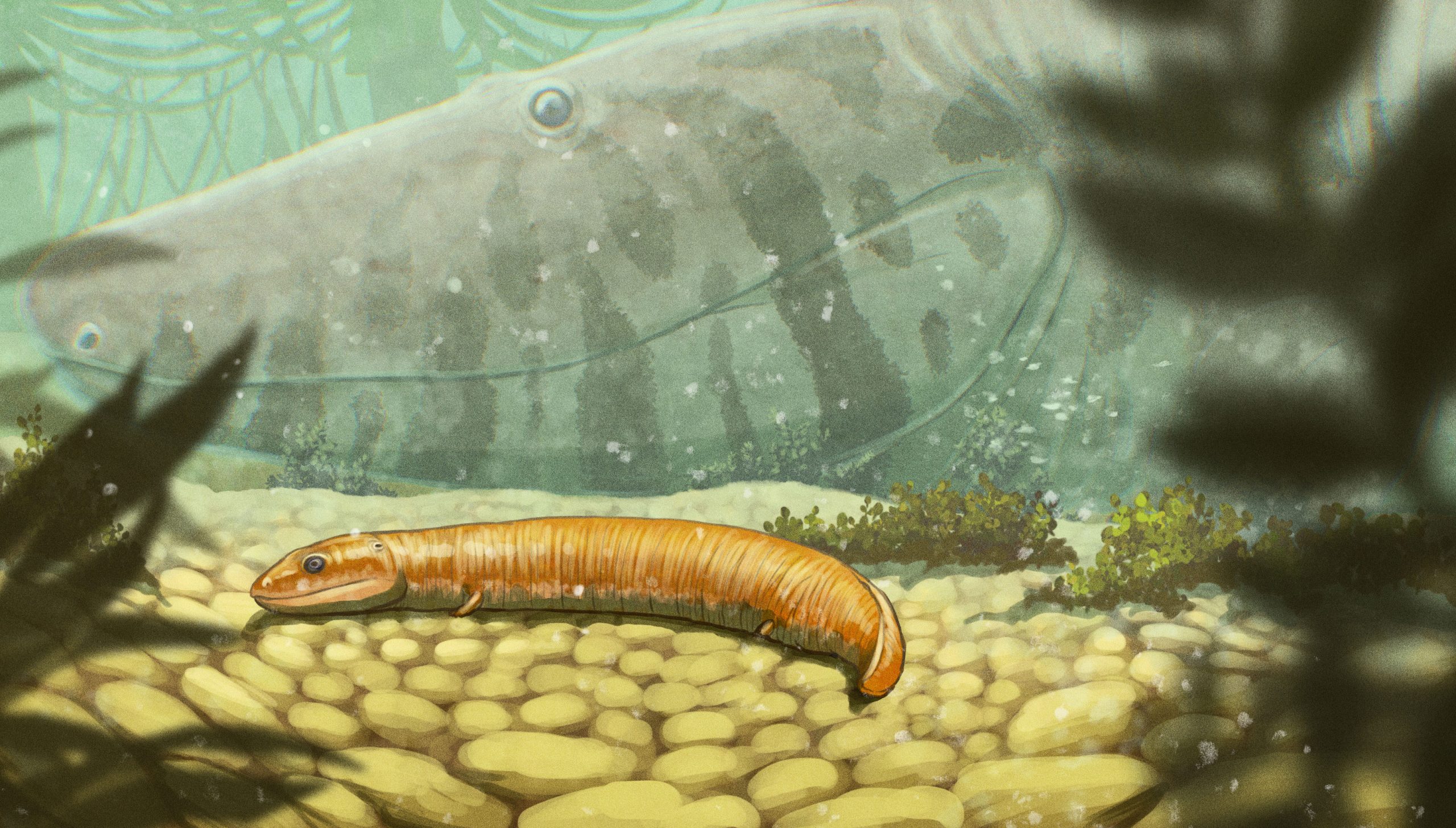
“We looked at a number of different species that represent different lineages in the transition from fish to tetrapods, and what we found is that none of them have anything that looks remotely like a tadpole. And if you don’t have a tadpole, then you don’t have a metamorphosis,” says Pardo. “These early tetrapods’ life cycles are more like ours, or like those of fish, than they are like amphibians.”
If embolomeres and other early tetrapods did not have a tadpole stage or true amphibian metamorphosis, then a long-standing assumption about vertebrate evolution needs to be revised. The widely accepted idea that reptiles and mammals evolved from amphibian-like animals becomes less accurate than previously thought.
“The story was that metamorphosis is the tool by which animals made the transition from fossil to land. That story doesn’t work anymore, it’s dust in the wind,” says Pardo.
Citizen scientists changed the record
Mann says the discovery also reflects the value of collaboration between museums, foundations, local fossil collectors, volunteers, and citizen scientists. The fossils in the study were not the result of a single lab effort, but of many people helping preserve and study rare specimens from Mazon Creek.
“Every single specimen in this paper was a joint effort with the Earth Science Club of Northern Illinois, the Lauer Foundation for Paleontology, Science and Education, and the Field Museum. We could not have done this without the help of lots of scientists, including citizen scientists and volunteers,” says Mann. “People like Paul Demkovich, Ben Riegler, Rich Rock, and Tom Testa allowed us to study specimens that they found, and these specimens have changed the course of our understanding of how tetrapods evolved. This is a monumental discovery, and it could not have happened without citizen science.”
Reference: “Direct development of stem tetrapods across the fin-to-limb transition” by Jason D. Pardo and Arjan Mann, 18 June 2026, Science.
DOI: 10.1126/science.aeb7635
Never miss a breakthrough: Join the SciTechDaily newsletter.
Follow us on Google and Google News.