
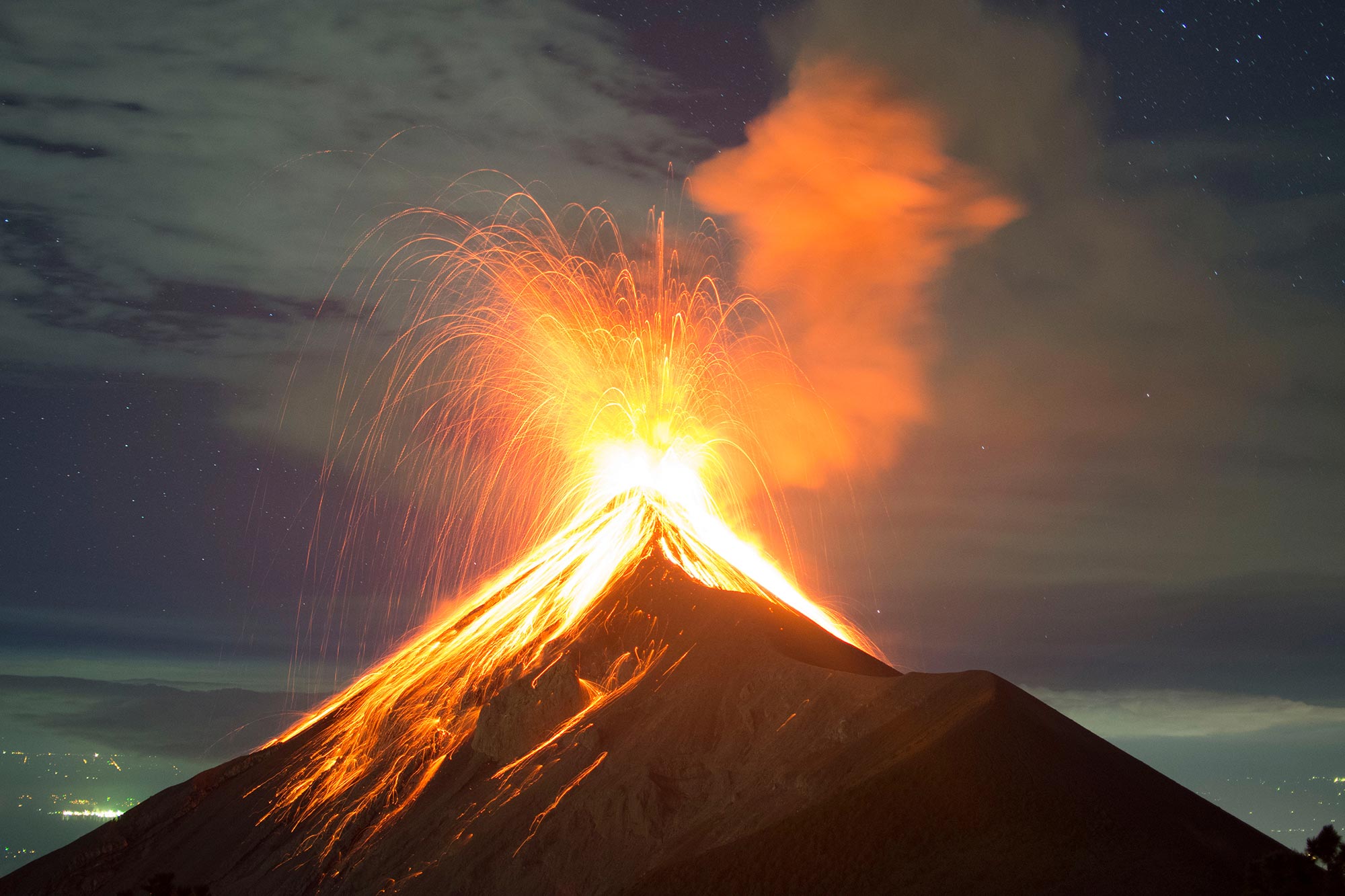
A new seismic detection method reveals faint ground signals that precede volcanic eruptions, offering earlier and simpler warnings.
Getting reliable eruption warnings to the right people, fast enough to matter, is still one of the hardest problems in hazard science.
A new study in Nature Communications describes a deceptively simple idea from the Institut de Physique du Globe de Paris (IPGP) and the GFZ Helmholtz Centre for Geosciences: instead of relying on dense networks of instruments, their method called “Jerk” can work with measurements from a single broadband seismometer.
The key is sensitivity to motions so small they sit far below what most people imagine as “an earthquake.” The system watches for tiny shifts tied to magma pushing its way underground, and it does this continuously in real time. When the researchers ran the approach for ten years at a volcanological observatory on La Réunion, it flagged 92 % of the 24 eruptions recorded between 2014 and 2023, with alerts arriving anywhere from minutes to eight hours before magma reached the surface. Some alarms did not end in an eruption, yet 14 % of warnings were still meaningful because they captured magma movement that stalled before breaking through.
Why that matters goes beyond this one volcano. Many dangerous volcanoes have limited monitoring, and even well-equipped sites can be overwhelmed by noisy signals that are hard to interpret quickly. A tool that can extract useful early information from minimal hardware could widen access to eruption forecasting, especially where budgets, terrain, or infrastructure make large sensor networks unrealistic.
Signals before volcanic eruptions
Volcanoes often change their behavior before erupting. Seismic activity can shift, the ground can deform, and gas flow or gas composition can vary. The problem is not a lack of clues.
The challenge is turning those clues into a dependable forecast of whether an eruption is coming and what it might look like, including its timing, duration, and strength, without creating costly false alarms that erode public trust.
New method for real-time detection of extremely subtle ground movements
Many forecasting efforts lean on probabilistic strategies that search for statistical relationships in large datasets. The team led by Dr. François Beauducel, working with Dr. Philippe Jousset in Potsdam, took a more direct route aimed at automation. Their “Jerk” approach focuses on extremely subtle ground motions linked to deep magma injections, using a signal type that is easy to miss unless you know exactly what to look for.
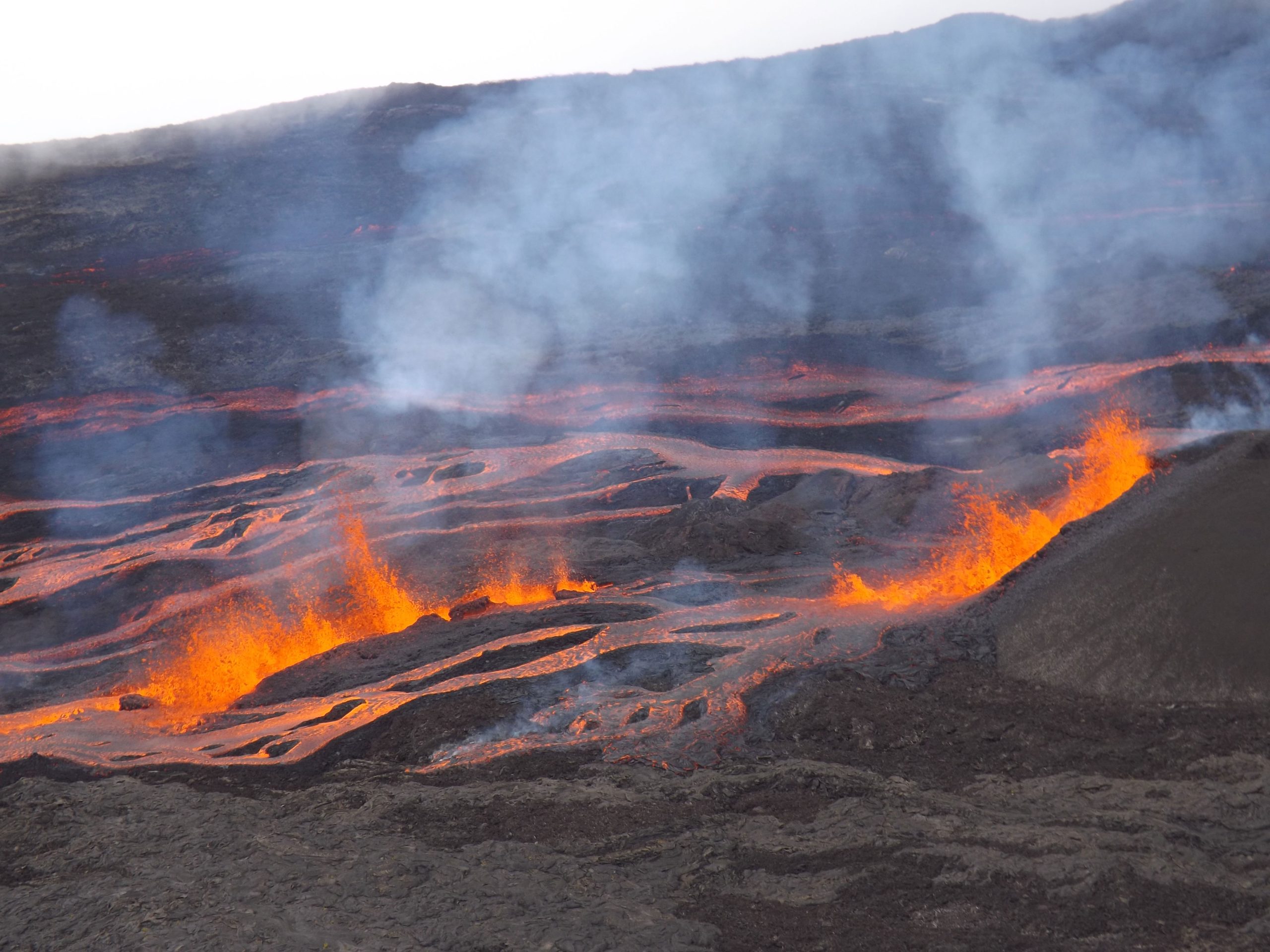
These “Jerk” signals show up as very low frequency transients i.e. impulse-like transition or settling signals observed in horizontal ground motion, both in acceleration and tilt. The authors argue they likely reflect dynamic rock fracturing as magma forces open pathways below the surface.
The signals are extraordinarily small, on the order of a few nanometers per second cubed (nm/s3), which helps explain why a single very broadband seismometer is essential, since it can track both slow tilting and faint accelerations.
To make the system practical for round-the-clock use, the researchers added dedicated processing steps, i.e., including correction for Earth tides, so the daily rhythmic flexing of the planet does not masquerade as volcanic unrest. The result is an automatic warning that triggers when the characteristic signal rises above a threshold, turning an otherwise invisible rumble of magma movement into a clear, time-stamped alert.
Ten-year time series of automatically collected data on La Réunion
In April 2014, the tool was implemented at the Piton de la Fournaise volcanological observatory, run by the Institut de Physique du Globe de Paris (IPGP) of the Université Cité Paris (OVPF-IPGP, Reunion Island) as a fully automated module of the WebObs system, using data from a broadband seismological station of the global Geoscope network located 8 km from the summit of the volcano (Rivière de l’Est). On June 20, 2014, a first alert was sent 1 hour and 2 minutes before the start of an eruption.
For more than 10 years, this Jerk signal detection and analysis system operated continuously, issuing automatic alerts for 92% of the 24 eruptions that occurred between 2014 and 2023. Warning times vary from a few minutes to 8.5 hours before the magma reaches the surface.
As Piton de la Fournaise is a heavily instrumented and monitored volcano, conditions here are almost laboratory-like. The data from the jerk tool could be validated using numerous other warning signs from the wide range of complementary observation data: they confirmed that a magmatic intrusion had actually taken place and that there was therefore a high probability of an eruption. The method was also tested a posteriori on data from 24 old eruptions between 1998 and 2010, showing that the Jerk alert works systematically.
“The great originality of this work lies in the fact that the Jerk method was tested and validated in real time in an automatic and unsupervised manner for more than 10 years, and not in post-processing of data as is the case in the vast majority of studies of eruptive precursors published in the literature,” explains Dr. Philippe Jousset, co-author of the study and scientist in GFZ-Section 2.2 Geophysical Imaging.
Reporting and significance of false positive events
The system, however, sometimes produced “false positives” – clear alerts but not followed by eruptions. This occurred in 14 % of the cases where the alarm was raised. However, they all turned out to be real magma intrusions or “aborted eruptions,” an interpretation consolidated by all the other observables such as seismicity, deformation, and analyses of volcanic gases. “In addition to the effectiveness of the Jerk alert for eruptions, the tool proves to be a perfect and unequivocal detector of magmatic intrusions,” resumes Philippe Jousset.
This was also the case during the last seismic crisis at Piton de la Fournaise on December 5, 2025: associated with low deformations and gas anomalies, a small Jerk signal was emitted (only 0.1 nm/s3), confirming that a magma intrusion had indeed taken place.
Outlook: Use on Mount Etna and on poorly instrumented volcanoes
In principle, the researchers believe that, following the more than ten-year real-time run and successful evaluation on La Réunion, the Jerk tool could be used as a simple and effective method of early warning of volcanic eruptions on other volcanoes that are less well instrumented.
At the same time, the scientists want to further evaluate their method and, in particular, test it on other active volcanoes, starting with Etna (Italy) where the project “POS4dyke” aiming at detecting the Jerk signal will use a new network of broadband seismometers from the GIPP Geophysical Instrumental Pool of Potsdam. The deployment should begin in 2026, in collaboration with the INGV (Italy), and will be supported by the project SAFAtor, which researches the use of optic fiber cables for earthquake and volcanic eruption early warning.
Reference: “Jerk, a promising tool for early warning of volcanic eruptions” by François Beauducel, Geneviève Roult, Valérie Ferrazzini, Aline Peltier, Philippe Jousset, Patrice Boissier and Nicolas Villeneuve, 17 December 2025, Nature Communications.
DOI: 10.1038/s41467-025-66256-z
Never miss a breakthrough: Join the SciTechDaily newsletter.
Follow us on Google and Google News.
1 Comment
The ‘false-positives’ are a definitional problem. It appears that the approach does an excellent job of detecting the movement of magma. The issue is the unstated assumption that moving magma will result in an eruption. There are many things that can prevent magma from reaching the surface. False-negatives are a greater risk to safety than false-positives.