

A mysterious, hard-to-grow gut bacterium keeps showing up in healthy people worldwide—and it may be quietly protecting our microbiomes.
Researchers at the University of Cambridge have identified a little-known group of gut bacteria that consistently appears in healthy people around the world. The bacteria, known as CAG-170, was found in unusually high levels in people without chronic illness, based on a large international analysis of gut microbiomes.
CAG-170 is unusual because scientists know it only through its genetic signature. Most of these bacteria have never been successfully grown in a laboratory, meaning they have largely escaped detailed study until now.
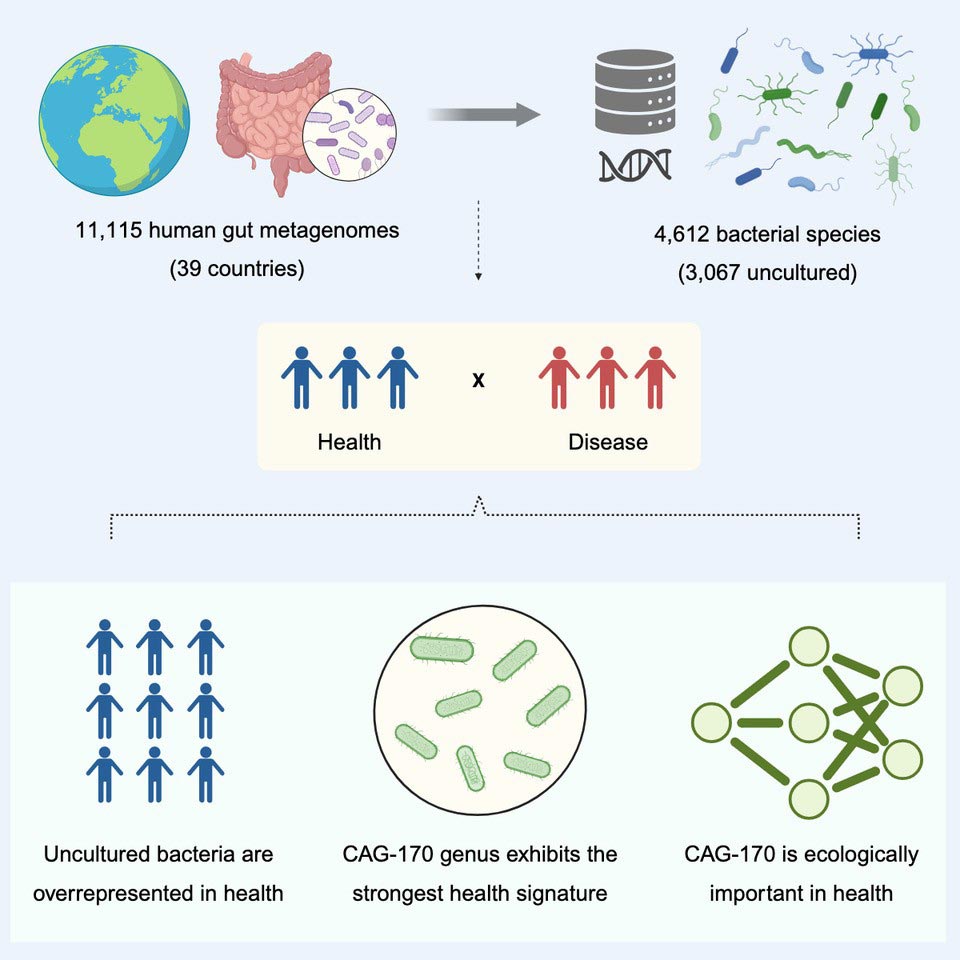
To track it down, the research team used advanced computational methods to search for CAG-170’s genetic fingerprint in gut microbiome samples from more than 11,000 people across 39 countries.
Strong Links to Health Across Populations
The results showed a clear pattern. Healthy individuals consistently had higher levels of CAG-170 than people living with conditions such as inflammatory bowel disease, obesity, and chronic fatigue syndrome.
When the researchers examined the genes carried by CAG-170, they found signs that these bacteria can produce large amounts of Vitamin B12. They also carry enzymes capable of breaking down many different carbohydrates, sugars, and fibers found in the human diet.
The team believes the Vitamin B12 produced by CAG-170 most likely benefits other gut microbes rather than directly nourishing the human host. This suggests CAG-170 may help support the broader gut ecosystem by feeding beneficial bacteria.
Taken together, the findings suggest that CAG-170 could eventually serve as a marker of gut microbiome health. They also raise the possibility of developing future probiotics designed specifically to support healthy levels of these bacteria.
Dr. Alexandre Almeida, from the University of Cambridge’s Department of Veterinary Medicine and lead author of the study, said: “Our work has revealed that CAG-170 bacteria – part of the ‘hidden microbiome’ – appear to be key players in human health, likely by helping us to digest the main components of our food and keeping the whole microbiome running smoothly.”
He added: “We looked at the gut microbes of thousands of people across 39 countries and 13 different diseases including Crohn’s and obesity. We consistently found that people with these diseases had lower levels of CAG-170 bacteria in their gut.”
The study is published today (February 9) in the journal Cell Host & Microbe.
Mapping the Hidden Microbiome
The new research builds on Almeida’s earlier effort to create a detailed reference library of microbial genomes found in the human gut. This resource, called the ‘Unified Human Gastrointestinal Genome catalog’, brings together genetic data from across the gut microbiome.
To build the catalog, Almeida used a technique known as ‘metagenomics’, which involves analyzing all microbial genomes in the gut at once and then separating them into individual species.
This work uncovered more than 4,600 bacterial species living in the human gut, including over 3,000 that had never been identified there before. These findings highlighted how much of the gut microbiome had remained hidden from science.
The catalog provides reference genomes for each species, including CAG-170. These reference genomes act like genetic fingerprints, allowing scientists to detect specific bacteria in other gut samples.
“Our earlier work revealed that around two-thirds of the species in our gut microbiome were previously unknown. No-one knew what they were doing there – and now we’ve found that some of these are a fundamental and underappreciated component of human health,” said Almeida.
Three Independent Lines of Evidence
The researchers examined more than 11,000 gut microbiome samples from people living primarily in Europe, North America, and Asia. The dataset included both healthy individuals and people diagnosed with 13 different diseases, including Crohn’s disease, colorectal cancer, Parkinson’s disease, and multiple sclerosis.
By comparing these samples against the Unified Human Gastrointestinal Genome catalog, the team found that CAG-170 stood out as the hidden microbiome group most strongly associated with good health. This relationship held true across different countries and populations.
In a second analysis, the researchers examined the complete gut microbiomes of more than 6,000 healthy people. They looked for species most likely to help stabilize the gut ecosystem. Once again, CAG-170 emerged as the group most consistently linked to a healthy microbiome.
The third analysis focused on people with dysbiosis, a condition in which the gut microbiome is out of balance. Lower levels of CAG-170 were associated with a higher risk of dysbiosis. This imbalance has been linked to long-term conditions such as irritable bowel syndrome, rheumatoid arthritis, and anxiety and depression.
New Paths Toward Future Therapies
The human gut microbiome is made up of billions of bacteria representing roughly 4,600 different species. While the exact mix varies from person to person, the overall role of the microbiome is the same: to help the body function properly.
Scientists hope that by better defining what a healthy gut microbiome looks like, they can understand how it changes in disease and find ways to restore balance. Approaches such as targeted probiotics are one possible path forward, and the new findings bring that goal closer.
“The probiotic industry hasn’t really kept up with gut microbiome research – people are still using the same probiotic species that were being used decades ago. We’re now discovering new groups of bacteria like CAG-170 with important links to our health, and probiotics aimed at supporting them could have a much greater health benefit,” said Almeida.
Until now, much of gut microbiome research has focused on bacteria that can be easily grown and studied in the lab. Most CAG-170 bacteria do not fall into that category. Researchers will now need to find ways to culture and study them in order to turn these discoveries into potential new treatments.
Reference: “Meta-analysis of the uncultured gut microbiome across 11,115 global metagenomes reveals a candidate signature of health” by Ana C. da Silva, Jacob Lapkin, Qi Yin, Efrat Muller and Alexandre Almeida, 9 February 2026, Cell Host & Microbe.
DOI: 10.1016/j.chom.2026.01.013
Never miss a breakthrough: Join the SciTechDaily newsletter.
Follow us on Google and Google News.