
Close Menu
    Facebook X (Twitter) Instagram
    SciTechDaily
    • Biology
    • Chemistry
    • Earth
    • Health
    • Physics
    • Science
    • Space
    • Technology
    Facebook X (Twitter) Pinterest YouTube RSS
    SciTechDaily
    Home»Space»A Peek Inside a Transforming Star Factory: Hubble’s Breathtaking View
    Space

    A Peek Inside a Transforming Star Factory: Hubble’s Breathtaking View

    By ESA/HubbleJune 17, 2024No Comments3 Mins Read
    Facebook Twitter Pinterest Telegram LinkedIn WhatsApp Email Reddit
    Share
    Facebook Twitter LinkedIn Pinterest Telegram Email Reddit
    Hubbble RCW 7
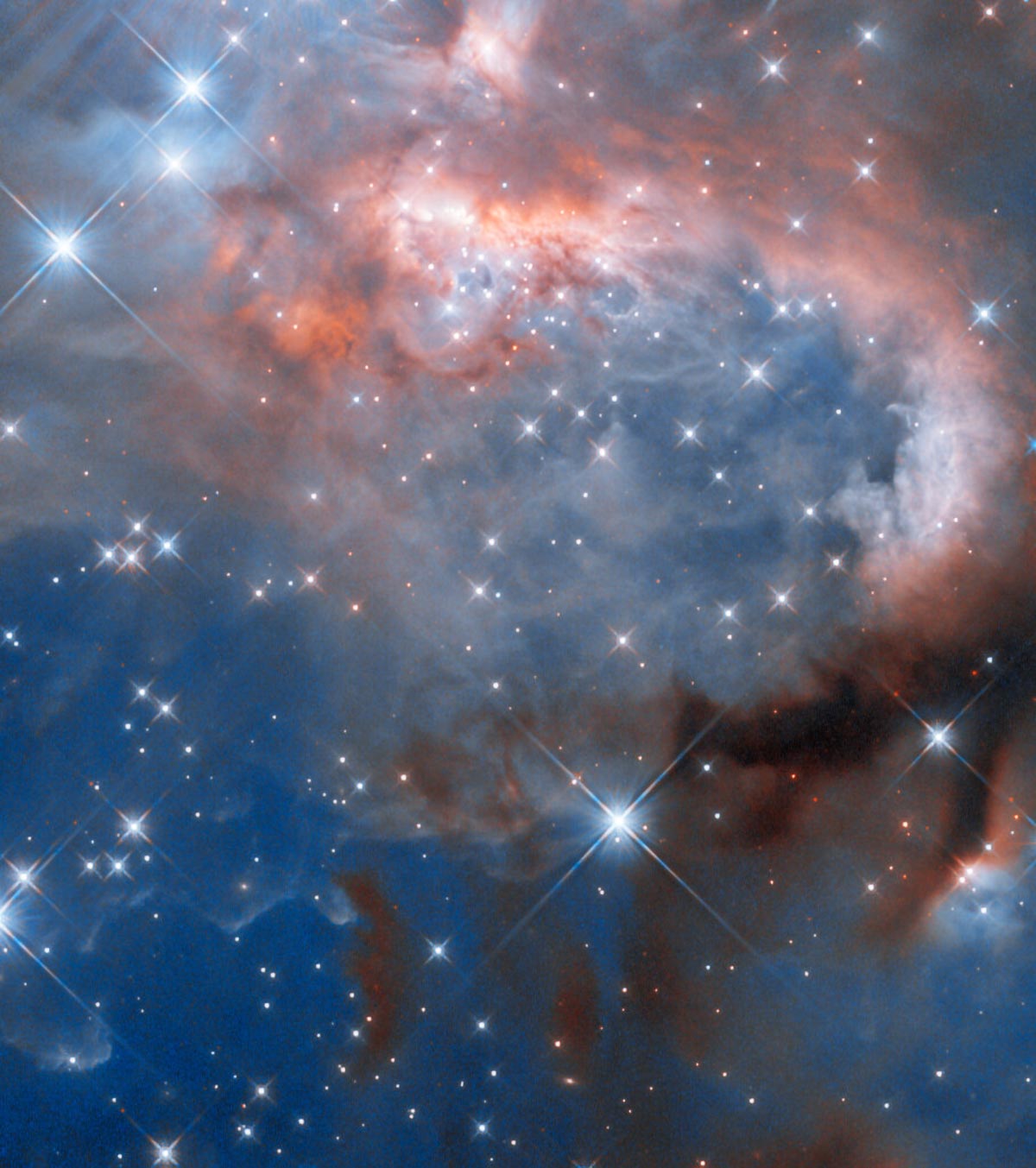
    The RCW 7 nebula, featured in this Hubble Space Telescope image, illustrates the transformation of a molecular cloud into an H II region, marked by the emergence of massive protostars. These stars emit ultraviolet light and stellar winds that shape the nebula, with Hubble capturing this process in near-infrared light, revealing the lifecycle of stars and their impact on the surrounding cloud. Credit: ESA/Hubble & NASA, J. Tan (Chalmers University & University of Virginia)

    Hubble’s image of RCW 7 reveals massive protostars in the Puppis constellation transforming a molecular cloud into a glowing H II region, showcasing the birth and evolution of stars.

    A visually striking collection of interstellar gas and dust is the focus of this stunning Hubble Space Telescope image. Named RCW 7, the nebula is located just over 5,300 light-years away from Earth in the constellation Puppis.

    Formation of Stars in Nebulae

    Nebulae are areas of space brimming with the raw material needed to form new stars. Under the influence of gravity, parts of these molecular clouds collapse until they coalesce into protostars, surrounded by spinning discs of leftover gas and dust. In the case of RCW 7, the protostars forming here are particularly massive, giving off strongly ionizing radiation and fierce stellar winds that have transformed it into what is known as an H II region.

    The Role of H II Regions

    H II regions are filled with hydrogen ions — where H I refers to a normal hydrogen atom, H II is hydrogen that has lost its electron. The ultraviolet radiation from the massive protostars excites the hydrogen, causing it to emit light and giving this nebula its soft pinkish glow.

    Here the Hubble Space Telescope is studying a particular massive protostellar binary named IRAS 07299-1651, still in its glowing cocoon of gas in the curling clouds towards the top of the nebula. To expose this star and its siblings, this image was captured using the Wide Field Camera 3 (WFC3) in near-infrared light.

    The massive protostars here are brightest in ultraviolet light, but they emit plenty of infrared light which can pass through much of the gas and dust around them and be seen by Hubble. Many of the other, larger-looking stars in this image are not part of the nebula, but sit between it and our Solar System.

    The Lifecycle of a Molecular Cloud

    The creation of an H II region marks the beginning of the end for a molecular cloud. Over only a few million years, the radiation and winds from the massive stars gradually disperse the gas — even more so as the most massive stars come to the end of their lives in supernova explosions. Only a fraction of the gas will be incorporated into new stars in this nebula, with the rest being spread throughout the galaxy to eventually form new molecular clouds.

    Reference: “Dynamics of a massive binary at birth” by Yichen Zhang, Jonathan C. Tan, Kei E. I. Tanaka, James M. De Buizer, Mengyao Liu, Maria T. Beltrán, Kaitlin Kratter, Diego Mardones and Guido Garay, 18 March 2019, Nature Astronomy.
    DOI: 10.1038/s41550-019-0718-y

    Never miss a breakthrough: Join the SciTechDaily newsletter.
    Follow us on Google and Google News.

    Astronomy Astrophysics European Space Agency Hubble Space Telescope
    Share. Facebook Twitter Pinterest LinkedIn Email Reddit

    Related Articles

    Hubble Captures a Dangerous Dance Over 100 Million Light-Years From Earth

    Hubble Captures the Final Acts of a Monster Star

    Hubble Find Surprises Astronomers: White Dwarfs Can Still Undergo Stable Thermonuclear Activity

    First Evidence of Water Vapor at Jupiter’s Moon Ganymede – May Hold More Water Than All of Earth’s Oceans

    Our Giant Universe: Hubble Spots Massive Galaxy Cluster With a Wealth of Exciting Possibilities

    Tantrums of a Baby Star: Herbig-Haro Objects

    Unexpected Discovery: Hubble Space Telescope Uncovers Concentration of Small Black Holes

    “Unprecedented” – Unusual Planetary Nebula Fades Mere Decades After It Arrived

    Hubble Captures Unprecedented Fading of Stingray Nebula – “This Is Very, Very Dramatic, and Very Weird”

    Leave A Reply Cancel Reply

    • Facebook
    • Twitter
    • Pinterest
    • YouTube

    Don't Miss a Discovery

    Subscribe for the Latest in Science & Tech!

    Trending News

    Your Blood Pressure Reading Could Be Wrong Because of One Simple Mistake

    Astronomers Stunned by Ancient Galaxy With No Spin

    Physicists May Be on the Verge of Discovering “New Physics” at CERN

    Scientists Solve 320-Million-Year Mystery of Reptile Skin Armor

    Scientists Say This Daily Walking Habit May Be the Secret to Keeping Weight Off After Dieting

    New Therapy Rewires the Brain To Restore Joy in Depression Patients

    Giant Squid Detected off Western Australia in Stunning Deep-Sea Discovery

    Popular Sugar-Free Sweetener Linked to Liver Disease, Study Warns

    Follow SciTechDaily
    • Facebook
    • Twitter
    • YouTube
    • Pinterest
    • Newsletter
    • RSS
    SciTech News
    • Biology News
    • Chemistry News
    • Earth News
    • Health News
    • Physics News
    • Science News
    • Space News
    • Technology News
    Recent Posts
    • Hidden Warm Water Beneath Antarctica Could Rapidly Raise Global Sea Levels
    • Scientists Revive Ancient Chemistry Trick To Engineer Next-Generation Glass
    • Scientists Use AI To Supercharge Ultrafast Laser Simulations by More Than 250x
    • Scientists Just Found a Surprising Way To Destroy “Forever Chemicals”
    • Popular Supplement Ingredient Linked to Shorter Lifespan in Men
    Copyright © 1998 - 2026 SciTechDaily. All Rights Reserved.
    • Science News
    • About
    • Contact
    • Editorial Board
    • Privacy Policy
    • Terms of Use

    Type above and press Enter to search. Press Esc to cancel.