
Mysterious archaeological objects like Neolithic stone balls, Roman dodecahedra, and Romano-British cosmetic grinders fascinate experts and amateurs alike. The original uses of these items—from ceremonial tools to everyday items—continue to be subjects of speculation and research, reflecting the complexities of ancient life.
Archaeologists are often described as “stumped” or “baffled” by their discoveries. But, in reality, specialists have a good grasp of what most historical objects were created for. But there are a few exceptions to this rule.
The following list is a selection of intriguing mystery objects. They’re a great example of why digging up the past continues to hold great fascination for professionals and public alike.
1. Neolithic Stone Balls
The elaborately carved stone balls found predominantly in Scotland and dating from the later Neolithic period (circa BC3200-2500) are one such mystery.
Over 425 balls have been found. They are generally the size of a cricket ball and made from a wide variety of stones. Their surfaces are sculpted, sometimes into raised circular discs and sometimes with deep incisions defining knobs and lobes in high relief. Decoration takes the form of spirals or concentric shapes, echoing those found on pottery and monumental stones of the era.

Some have been found in burials, others in settlements. They are rarely, if ever, identical, and most are found alone, so don’t seem to have been part of a set. Some appear to have been heavily handled during their lifetime.
The original use of these stone balls has been a source of much debate, right back to their earliest discovery in the 19th century. Many were chance finds or circulated with little provenance in art collections, and have rarely been found in an archaeological context.
Were they missiles for deterring predators and pests? Weapons of war? Toys? Or perhaps measuring weights, household ornaments, mnemonic devices, ball bearings to move megaliths or holders for yarn? The answer still escapes us.

2. Roman Dodecahedra
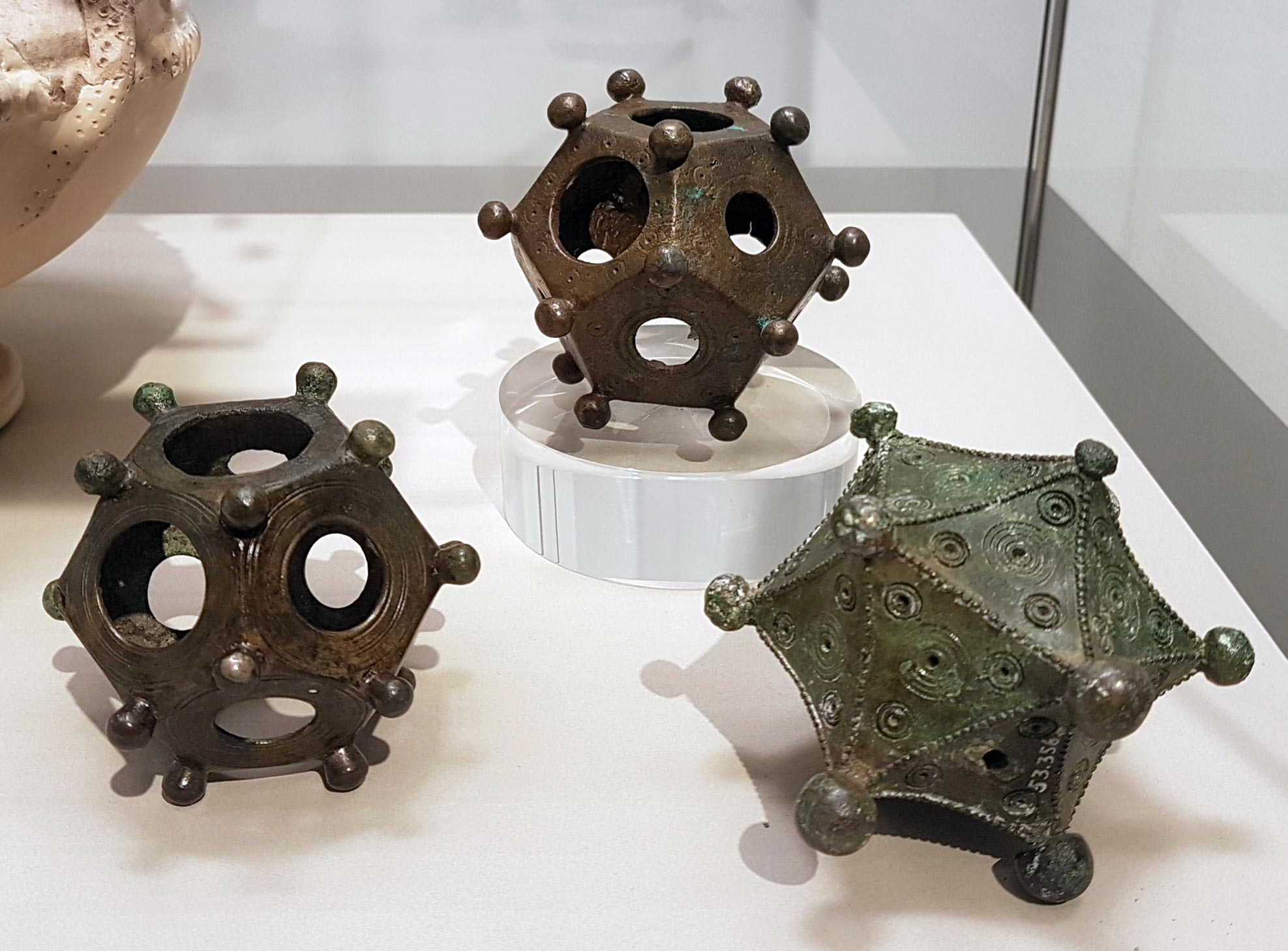
These intriguing objects have recently made headlines, with a new find from Norton Disney in Lincolnshire prompting much discussion as to their function.
Dodecahedra date from the Roman period in Britain (43-410AD). About 130 have been found across the north-west provinces of the former Roman empire, each finely crafted from copper alloy.
No representations of these objects are known in ancient art or literature. They do not conform to a standard size and rarely show use-wear which could hint at their purpose. Although armchair experts will tell you their granny used one to knit gloves, archaeologists are undecided on their intended use.

3. Neolithic Chalk Drums
In 1889, three carved cylinders of chalk were discovered in a child’s grave in Folkton, north Yorkshire. The Folkton Chalk Drums have geometric decoration and what appear to be eyes, noses and eyebrows. A fourth, undecorated drum was found at Lavant in west Sussex in 1993. Another, highly ornate, example was excavated at Burton Agnes in east Yorkshire in 2015.
The Burton Agnes drum was buried with a chalk ball, a bone pin and the remains of three children – one of whom was dated to BC3005-2890.
The motifs on the drums are part of an aesthetic tradition also found on the Neolithic stone balls. Despite their name, chalk drums are unlikely to have been played as musical instruments and do not show wear associated with percussive use.
Some researchers have connected their circumferences with a standardized measure of length known as the “long foot”. Some think they were references in stone to perishable containers such as lidded wooden jars or baskets. Others have tried to link the geometric markings to astronomical observations. But their presence in the graves of carefully buried children seems to suggest a more sensitive explanation.

4. Bronze Age “Lock-Rings”
The bronze age was a time of exceptional gold-working. Highly decorative personal ornaments were crafted from gold sheet and wire. These small penannular (open) rings date from the late bronze age (circa BC1000-800) and are found in Ireland, Britain, and parts of France.
Frequently unearthed in matching pairs, they can be plain or have delicate, geometric engravings.
Recent interpretations have suggested they could have been nose rings, earrings or hair ornaments. None of these explanations is terribly satisfactory, as various elements of their design would make the rings difficult or uncomfortable to wear.
What we need is context – like the recent discoveries at Boncuklu Tarla, in Turkey, of burials with facial jewelry found close to skulls.

5. Romano-British Cosmetic Grinders
Cosmetic grinders are small copper alloy kits made in two parts. One half is the “mortar” (a long and curving grooved receptacle) and the other is the “pestle” (either rod-like and pointed, or arched into a “rocker” shape). They often have loops for suspension and human or animal-shaped terminals.
Waterbirds and bovids are common decorative motifs that also feature on other Romano-British containers such as cups and buckets. Phallic symbolism on some sets has prompted an association with fertility.
Cosmetic sets are typically British, and rarely found on mainland Europe. They date from the late Iron Age to early Roman period (circa BC100-200AD) and are well distributed across the landscape.
Use-wear analysis has shown these objects were rubbed together with a lateral grinding action. They may have been superseded by the flat marble palettes used across the Roman empire, although these worked in a fundamentally different way, using a metal scoop or stone tool to mix ingredients together in a circular motion.
The mystery here is not the function, but what substance was being prepared. Suggestions have included medicines, aphrodisiacs, cosmetics, and narcotics. The contents of a mortar have never successfully been analyzed. This is an occasion where amateur finders can be of great help to archaeologists, by resisting the urge to clean cosmetic mortars and instead bringing them forward to be examined.
Written by Natasha Harlow, Honorary Research Fellow, Department of Classics and Archaeology, University of Nottingham.
Adapted from an article originally published in The Conversation.
Never miss a breakthrough: Join the SciTechDaily newsletter.
Follow us on Google and Google News.