
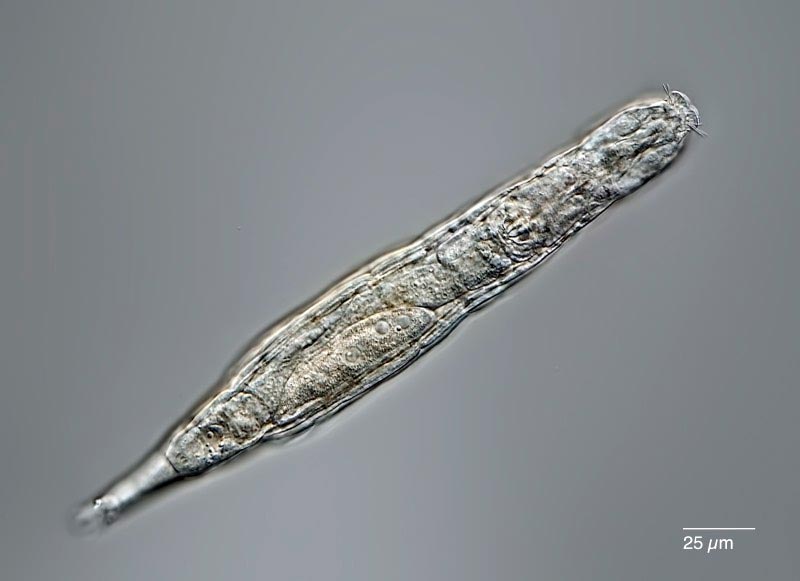
Scientists revived a 24,000-year-old microscopic rotifer from Siberian permafrost that could still reproduce, revealing insights into how multicellular life can survive in suspended animation for millennia.
Bdelloid rotifers are multicellular animals so small you need a microscope to see them. Despite their size, they’re known for being tough, capable of surviving through drying, freezing, starvation, and low oxygen. Now, researchers reporting in the journal Current Biology today (June 7, 2021) have found that not only can they withstand being frozen, but they can also persist for at least 24,000 years in the Siberian permafrost and survive.
“Our report is the hardest proof as of today that multicellular animals could withstand tens of thousands of years in cryptobiosis, the state of almost completely arrested metabolism,” says Stas Malavin of the Soil Cryology Laboratory at the Institute of Physicochemical and Biological Problems in Soil Science in Pushchino, Russia.
The Soil Cryology Lab specializes in isolating microscopic organisms from the ancient permafrost in Siberia. To collect samples, they use a drilling rig in some of the most remote Arctic locations.
They’ve previously identified many single-celled microbes. There also has been a report of a 30,000-year-old nematode worm. Mosses and some plants also have been regenerated after many thousands of years trapped in the ice. Now, the team adds rotifers to the list of organisms with a remarkable ability to survive, seemingly indefinitely, in a state of suspended animation beneath the frozen landscape.
Dating and Reviving Ancient Rotifers
Rotifers had been reported to survive up to 10 years when frozen, based on earlier evidence. In the new study, the researchers used radiocarbon dating to determine that the rotifers they recovered from the permafrost were about 24,000 years old.
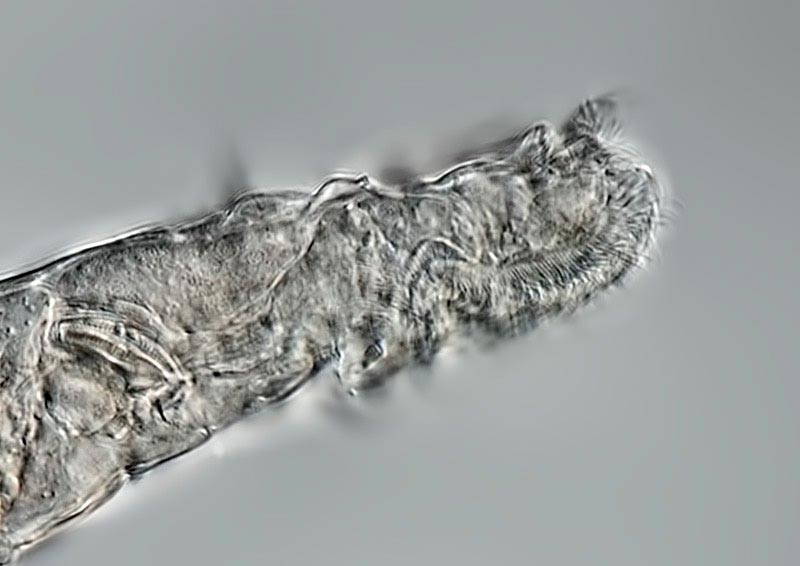
Once thawed, the rotifer, which belongs to the genus Adineta, was able to reproduce in a clonal process known as parthenogenesis. To follow the process of freezing and recovery of the ancient rotifer, the researchers froze and then thawed dozens of rotifers in the lab.
Frozen Without Damage: Ice Crystal Defense
The studies showed the rotifers could withstand the formation of ice crystals that happen during slow freezing. It suggests they have some mechanism to shield their cells and organs from harm at exceedingly low temperatures.
“The takeaway is that a multicellular organism can be frozen and stored as such for thousands of years and then return back to life — a dream of many fiction writers,” Malavin says. “Of course, the more complex the organism, the trickier it is to preserve it alive frozen and, for mammals, it’s not currently possible. Yet, moving from a single-celled organism to an organism with a gut and brain, though microscopic, is a big step forward.”
It’s not yet clear what it takes to survive on ice for even a few years and whether the leap to thousands makes much difference, he says. That’s a question that requires further study. The researchers say they’ll continue exploring Arctic samples in search of other organisms capable of such long-term cryptobiosis.
Ultimately, they want to learn more about the biological mechanisms that allow the rotifers to survive. The hope is that insights from these tiny animals will offer clues as to how better to cryo-preserve the cells, tissues, and organs of other animals, including humans.
Reference: “A Living Bdelloid Rotifer Recovered from 20,000 Year Old Arctic Permafrost” by Lyubov Shmakova, Stas Malavin, Nataliia Iakovenko, Tatiana Vishnivetskaya, Daniel Shain, Michael Plewka and Elizaveta Rivkina, 7 June 2021, Current Biology.
DOI: 10.1016/j.cub.2021.04.077
This work was supported by Russian Foundation for Basic Research, the National Science Foundation, and the U.S. Department of Energy, Office of Science, Office of Biological and Environmental Research, Genomic Science Program.
Never miss a breakthrough: Join the SciTechDaily newsletter.
Follow us on Google and Google News.