
A newly published study pokes holes in widely accepted theory that connects biodiversity abundance with a reduced disease risk for humans, finding that the links between biodiversity and disease prevalence are variable and dependent on the disease system, local ecology and probably human social context.
More than three quarters of new, emerging or re-emerging human diseases are caused by pathogens from animals, according to the World Health Organization.
But a widely accepted theory of risk reduction for these pathogens – one of the most important ideas in disease ecology – is likely wrong, according to a new study co-authored by Stanford Woods Institute for the Environment Senior Fellow James Holland Jones and former Woods-affiliated ecologist Dan Salkeld.
The dilution effect theorizes that disease risk for humans decreases as the variety of species in an area increases. For example, it postulates that a tick has a higher chance of infecting a human with Lyme disease if the tick has previously had few animal host options beyond white-footed mice, which are carriers of Lyme disease-causing bacteria.
If many other animal hosts had been available to the tick, the tick’s likelihood of being infected and spreading that infection to a human host would go down, according to the theory.
If true, the dilution effect would mean that conservation and public health agendas could be united in a common purpose: to protect biodiversity and guard against disease risk. “However, its importance to the field or the beauty of the idea do not guarantee that it is actually scientifically correct,” Jones said.
In the first study to formally assess the dilution effect, Jones, Salkeld and California Department of Public Health researcher Kerry Padgett tested the hypothesis through a meta-analysis of studies that evaluate links between host biodiversity and disease risk for disease agents that infect humans.
The analysis, published in the journal Ecology Letters, allowed the researchers to pool estimates from studies and test for any bias against publishing studies with “negative results” that contradict the dilution effect.
The analysis found “very weak support, at best” for the dilution effect. Instead, the researchers found that the links between biodiversity and disease prevalence are variable and dependent on the disease system, local ecology and probably human social context.
The role of individual host species and their interactions with other hosts, vectors and pathogens are more influential in determining local disease risk, the analysis found.
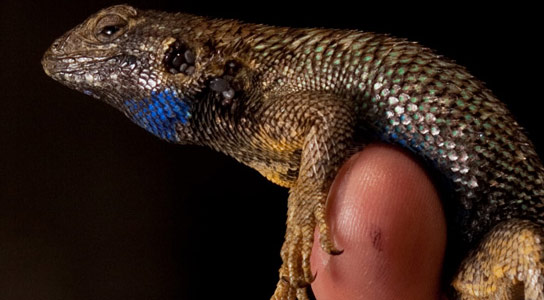
“Lyme disease biology in the Northeast is obviously going to differ in its ecology from Lyme disease in California,” Salkeld said. “In the Northeast, they have longer winters and abundant tick hosts. In California, we have milder weather and lots of Western fence lizards (a favored tick host) that harbor ticks but do not transmit the Lyme disease bacterium.”
So, these lizards should be considered unique in any study of disease risk within their habitat. Or, as Salked put it, “All animals are equal, but some animals are more equal than others.”
Broadly advocating for the preservation of biodiversity and natural ecosystems to reduce disease risk is “an oversimplification of disease ecology and epidemiology,” the study’s authors write, adding that more effective control of “zoonotic diseases” (those transmitted from animals to humans) may require more detailed understanding of how pathogens are transmitted.
Specifically, Jones, Salkeld and Padgett recommend that researchers focus more on how disease risk relates to species characteristics and ecological mechanisms. They also urge scientists to report data on both prevalence and density of infection in host animals, and to better establish specific causal links between measures of disease risk (such as infection rates in host animals) and rates of infection in local human populations.
For their meta-analysis, the researchers were able to find only 13 published studies and three unpublished data sets examining relationships between biodiversity and animal-to-human disease risk. This kind of investigation is “still in its infancy,” the authors note. “Given the limited data available, conclusions regarding the biodiversity-disease relationship should be regarded with caution.”
Still, Jones said, “I am very confident in saying that real progress in this field will come from understanding ecological mechanisms. We need to turn to elucidating these rather than wasting time arguing that simple species richness will always save the day for zoonotic disease risk.”
Reference: “A meta-analysis suggesting that the relationship between biodiversity and risk of zoonotic pathogen transmission is idiosyncratic” by Daniel J Salkeld, Kerry A Padgett and James Holland Jones, 11 March 2013, Ecology Letters.
DOI: 10.1111/ele.12101
Never miss a breakthrough: Join the SciTechDaily newsletter.
Follow us on Google and Google News.