

Scientists have identified Uncus dzaugisi, the oldest ecdysozoan fossil from the Precambrian period, confirming long-held assumptions about the ancient origins of this major animal group.
Discovered in South Australia, this fossil links the molecular data predictions to the physical fossil record, enhancing our understanding of ecdysozoan evolution and the diversity of life forms during the Ediacaran period.
Every species has a history, including the millions of insects, arachnids, and nematode worms that belong to a major animal group known as the Ecdysozoa.
Discovery of the Oldest Ecdysozoan
For years, details about the earliest origins of this group have remained a mystery. Now, a research team led by the University of California, Riverside has uncovered the oldest known ecdysozoan fossil, dating back to the Precambrian period. This fossil, a tiny worm-like creature named Uncus dzaugisi, measures just a few centimeters in length. The groundbreaking discovery is detailed in a paper published today (November 18) in Current Biology.
“Scientists have hypothesized for decades that this group must be older than the Cambrian, but until now its origins have remained enigmatic,” said Mary Droser, a distinguished professor of geology at UC Riverside and lead author of the study. “This discovery reconciles a major gap between predictions based on molecular data and the lack of described ecdysozoans prior to the rich Cambrian fossils record and adds to our understanding of the evolution of animal life.”

Ecdysozoans’ Role in Animal Diversity
The ecdysozoans are the largest and most species-rich animal group on Earth, encompassing more than half of all animals. Characterized by their cuticle — a tough external skeleton that is periodically shed — the group comprises three subgroups: nematodes, which are microscopic worms; arthropods, which include insects, spiders, and crustaceans; and scalidophora, an eclectic group of small, scaly marine creatures.
“Like many modern-day animal groups, ecdysozoans were prevalent in the Cambrian fossil record and we can see evidence of all three subgroups right at the beginning of this period, about 540 million years ago,” said Ian Hughes, a graduate student in marine biology at Harvard University and the paper’s first author. “We know they didn’t just appear out of nowhere, and so the ancestors of all ecdysozoans must have been present during the preceding Ediacaran period.”
DNA-based analyses, used to predict the age of animal groups by comparing them with their closest living relatives, have corroborated this hypothesis. Yet ecdysozoan fossil animals have remained hidden among scores of animal fossils paleontologists have discovered from the Ediacaran Period.
Fossil Hunting at Nilpena
Ediacaran animals, which lived 635-538 million years ago, were ocean dwellers; their remains preserved as cast-like impressions on the seabed that later hardened to rock. Hughes said uncovering them is a labor-intensive, delicate process that involves peeling back rock layers, flipping them over, dusting them off, and piecing them back together to get “a really nice snapshot of the sea floor.”
This excavation process has only been done at Nilpena Ediacara National Park in South Australia, a site Droser and her team have been working at for 25 years that is known for its beautifully preserved Ediacaran fossils.
“Nilpena is perhaps the best fossil site for understanding early animal evolution in the world because the fossils occur during a period of heightened diversity and we are able to excavate extensive layers of rock that preserve these snapshots,” said Scott Evans, an assistant professor of Earth-Life interactions at Florida State University and co-author of the study. “The layer where we found Uncus is particularly exciting because the sediment grains are so small that we really see all the details of the fossils preserved there.”
The Discovery of Uncus: A Worm-Like Fossil
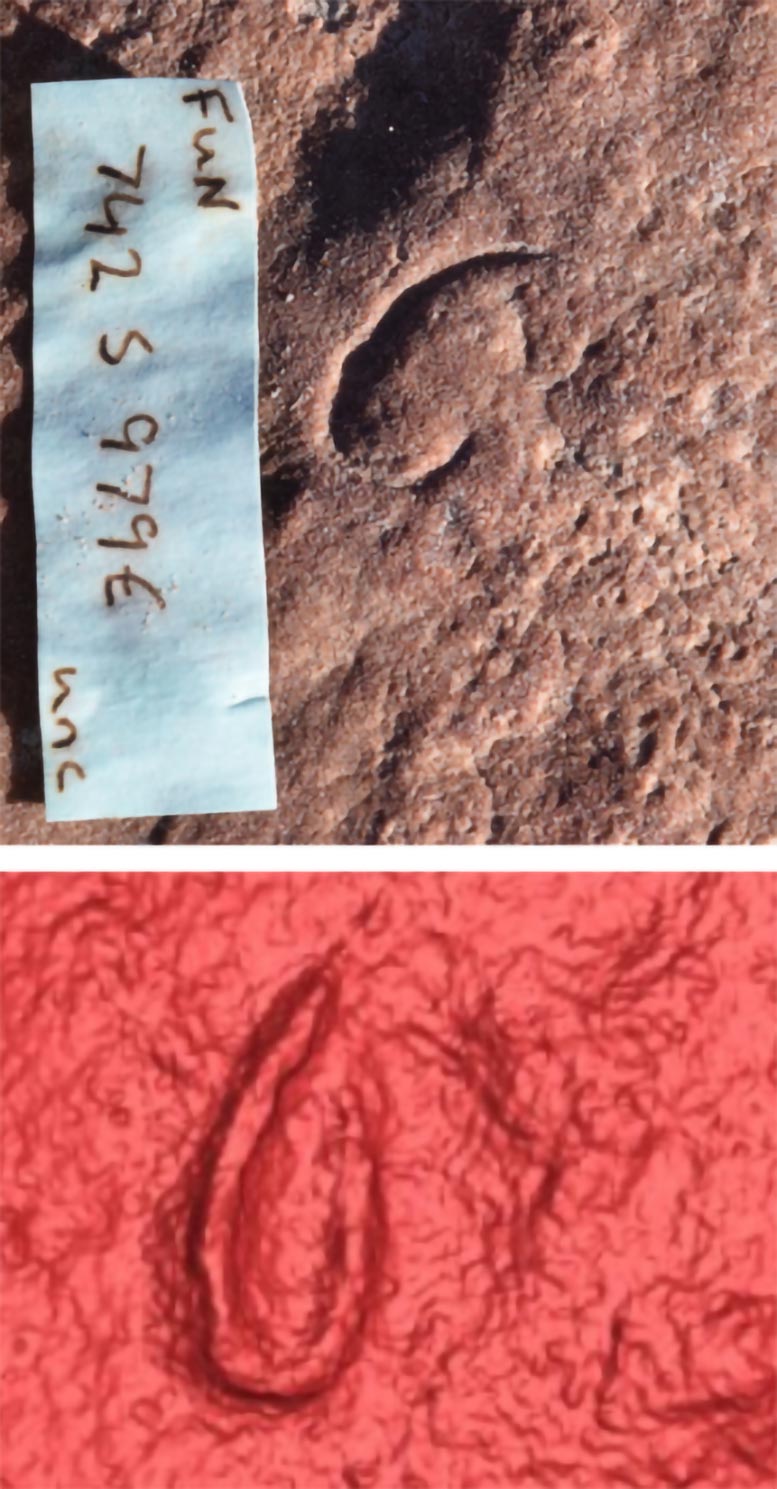
While the team didn’t set out to find an early ecdysozoan during their 2018 excavation, they were drawn to a mysterious worm-like impression that they dubbed “fishhook.”
“Sometimes we make dramatic discoveries and sometimes we excavate an entire bed and say ‘hmmm, I’ve been looking at that thing, what do you think?’” Hughes said. “That’s what happened here. We had all sort of noticed this fishhook squiggle on the rock. It was pretty prominent because it was really, really deep.”
Key Traits of the Newly Found Fossil
After seeing more of the worm-like squiggles the team paid closer attention, taking note of fishhook’s characteristics.
“Because it was deep, we knew it wasn’t smooshed easily so it must have had a pretty rigid body,” Hughes said. Other defining characteristics include its distinct curvature and the fact that it could move around — seen by trace fossils in the surrounding area. Paul De Ley, an associate professor of nematology at UCR, confirmed its fit as an early nematode and ruled out other worm types.
“At this point we knew this was a new fossil animal and it belong to the Ecdysozoa,” Hughes said.
Significance of Uncus in Evolutionary History
The team called the new animal Uncus, which means “hook” in Latin, noting in the paper its similarities to modern-day nematodes. Hughes said the team was excited to find evidence of what scientists had long predicted; that ecdysozoans existed in the Ediacaran Period.
“It’s also really important for our understanding of what these early animal groups would have looked like and their lifestyle, especially as the ecdysozoans would really come to dominate the marine ecosystem in the Cambrian,” he said.
Reference: “An Ediacaran bilaterian with an ecdysozoan affinity from South Australia” by Ian V. Hughes, Scott D. Evans and Mary L. Droser, 18 November 2024, Current Biology.
DOI: 10.1016/j.cub.2024.10.030
Funding for the research came from NASA.
Never miss a breakthrough: Join the SciTechDaily newsletter.
Follow us on Google and Google News.
1 Comment
Love science such mysteries n neverending findings from so long ago .amazing how far we have come yet we haven’t found but a little in this vast world on earth n in the heavens under the sea n in ourselves .thx u for sharing all u know .cuz knowledge is key .