
Chimpanzee experiments suggest early humans were likely fascinated by crystals because of their unique transparency and geometric shapes.
Archaeologists have repeatedly uncovered crystals at ancient sites alongside the remains of early humans. Some of these finds date back 780,000 years, yet the stones show no signs of being used as tools, weapons, or jewelry.
If our ancestors weren’t using them, why were they collecting them at all?
A recent study published in Frontiers in Psychology explored this mystery. Researchers in Spain examined which physical characteristics of crystals might have attracted early humans. To investigate this idea, they conducted experiments with chimpanzees, one of the two great ape species most closely related to humans, to see which properties of crystals might naturally capture their attention.
Chimpanzees Tested for Crystal Attraction
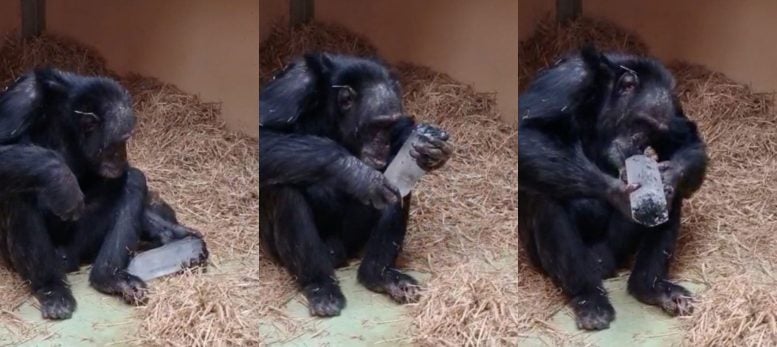
“We show that enculturated chimpanzees can distinguish crystals from other stones,” said lead author Prof Juan Manuel García-Ruiz, an Ikerbasque Research Professor on crystallography at the Donostia International Physics Center in San Sebastián. “We were pleasantly surprised by how strong and seemingly natural the chimpanzees’ attraction to crystals was. This suggests that sensitivity to such objects may have deep evolutionary roots.”
Humans and chimpanzees split from a common ancestor between six and seven million years ago, which means they still share many genetic and behavioral traits. To test whether an interest in crystals might be one of them, the researchers gave two groups of enculturated chimpanzees from the Rainfer Foundation access to crystals. The first group included Manuela, Guillermo, Yvan, Yaki, and Toti, while the second group included Gombe, Lulú, Pascual, and Sandy.
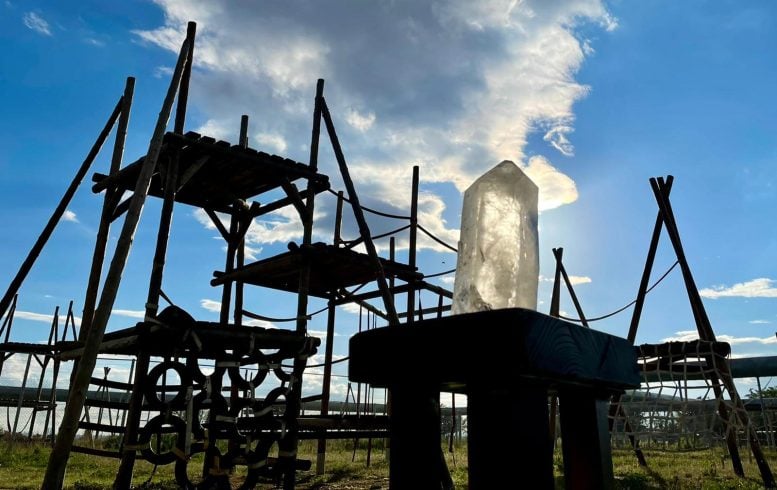
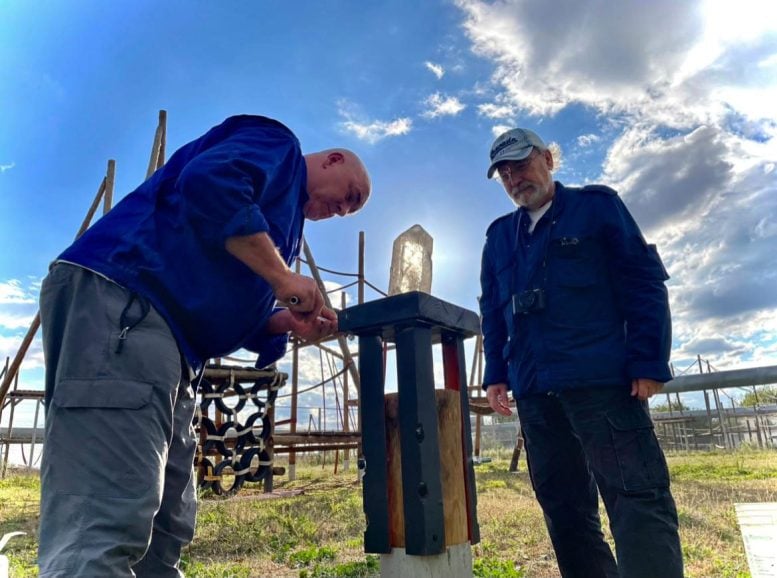
In the first experiment, scientists placed a large crystal, referred to as the monolith, on a platform next to a regular rock of roughly the same size. Both objects initially caught the chimps’ attention, but the animals soon showed a clear preference for the crystal and ignored the rock. After removing the crystal from the platform, the chimps carefully examined it, turning and tilting it to observe it from different angles. One chimp named Yvan eventually picked it up and carried it directly to the dormitories.
Chimpanzees Show Strong Interest in Crystals
The researchers noticed that interest was strongest shortly after the chimps encountered the crystal and gradually declined over time. Humans often show a similar pattern as the novelty of an object fades. Caretakers later had difficulty retrieving the crystal from the enclosure and ultimately had to trade it for favorite treats such as bananas and yogurt.

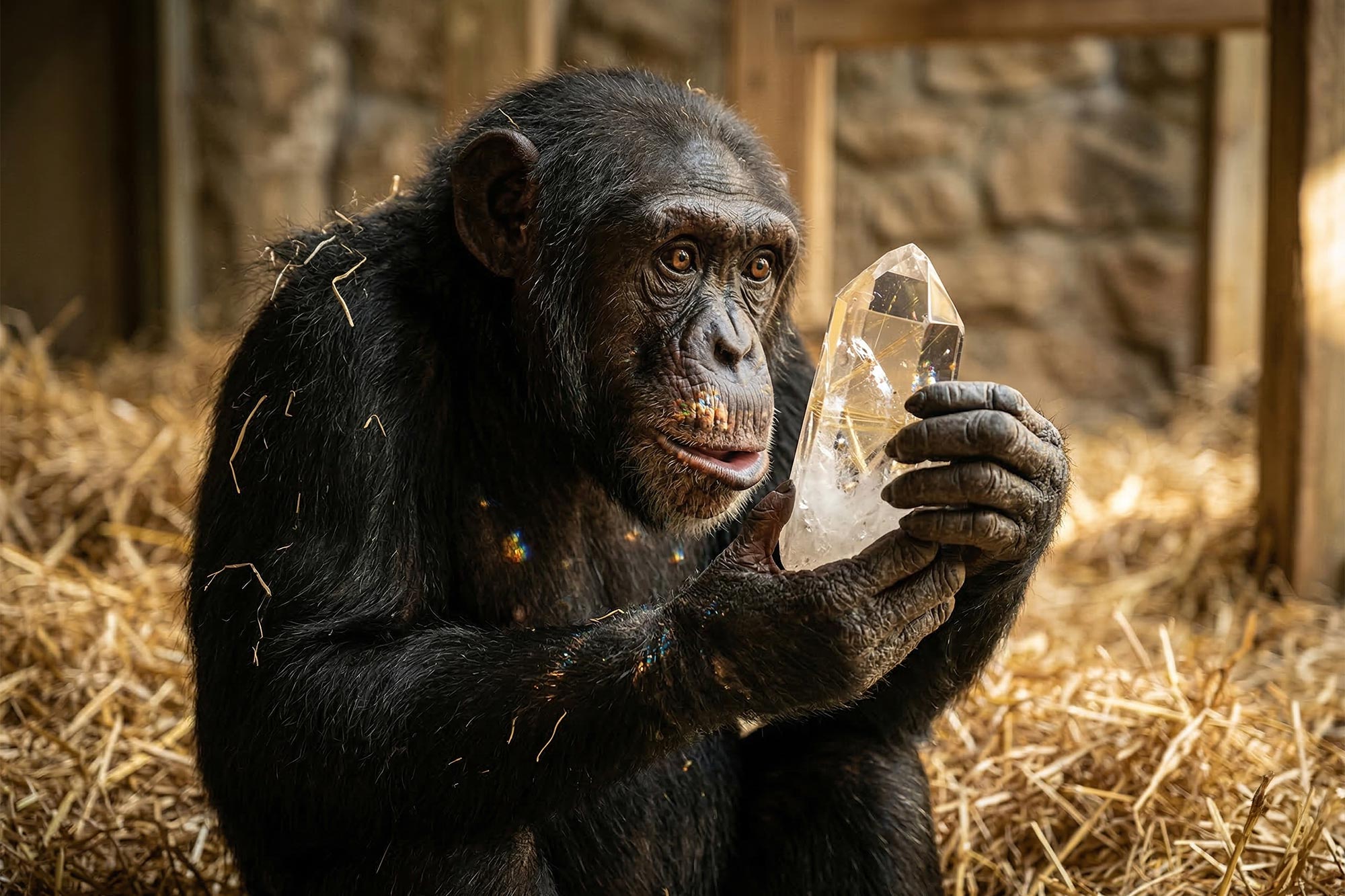
“The chimpanzees began to study the crystals’ transparency with extreme curiosity, holding them up to eye level and looking through them,” García-Ruiz said. Chimps continued examining the crystals repeatedly for hours.
In a second experiment, the chimps were presented with a pile of 20 rounded pebbles mixed with smaller quartz crystals. The quartz crystals were similar in size to those collected by ancient hominins. Within seconds, the chimps successfully identified and selected the crystals from the pile. When additional crystal types such as pyrite and calcite, which have different shapes from quartz, were added to the mix, the animals still recognized and selected the crystal stones.
One chimp named Sandy carried both pebbles and crystals in her mouth to a wooden platform and sorted them there. “She separated the three crystal types, which themselves differed in transparency, symmetry, and luster, from all the pebbles. This ability to recognize crystals despite their differences amazed us,” García-Ruiz said. Chimps rarely use their mouths to transport objects, so the researchers suggest this behavior may have been a way of hiding the crystals, which could indicate that the animals treated them as valuable.
What the Experiments Reveal About Crystal Recognition
The researchers did not analyze whether certain chimps were more interested in the crystals or attempted to claim them more strongly than others. They note that future research should consider differences in chimp personalities.
“There are Don Quixotes and Sanchos: idealists and pragmatists. Some may find the transparency of crystals fascinating, while others are interested in their smell and whether they’re edible,” García-Ruiz pointed out.
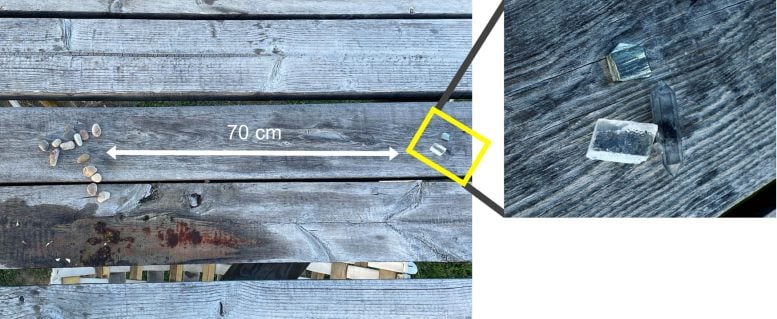
Another limitation is that the chimpanzees involved in the study are accustomed to interacting with humans and are familiar with objects that do not normally appear in the wild. The researchers suggest that similar experiments should eventually be carried out with less enculturated species, ideally wild apes.
Transparency and Shape: Why Crystals Fascinate
Observations from the experiments highlighted two features that seemed especially appealing to the chimps: transparency and geometric shape. These same properties may have attracted early humans to crystals as well.
Most natural forms in the environments where our ancestors lived, including clouds, trees, mountains, animals, and rivers, are dominated by curves and branching shapes. Objects with straight edges and flat surfaces are rare in nature.
Crystals are unique because they are the only natural polyhedral, meaning the only natural solids made up of many flat surfaces. When early humans tried to interpret and understand their surroundings, their attention may have been drawn to patterns and shapes that looked very different from the rest of the natural world.
“Our work helps explain our fascination with crystals and contributes to the understanding of the evolutionary roots of aesthetics and worldview,” concluded García-Ruiz. “We now know that we’ve had crystals in our minds for at least six million years.”
Reference: “On the origin of our fascination with crystals” by Juan Manuel García-Ruiz, Tomás de la Rosa, Irene Delval and Guillermo Bustelo, 12 January 2026, Frontiers in Psychology.
DOI: 10.3389/fpsyg.2026.1633599
Never miss a breakthrough: Join the SciTechDaily newsletter.
Follow us on Google and Google News.
7 Comments
Seriously still trying to say we’re related to primates. There’s less and less evidence the further we go back. Your literally using a child’s imagination to say were the same because they have thumbs. This is hog wash!
We are a species of ape called Homo sapiens.
So, we are primates.
We are also mammals.
And vertebrates.
And Eukariotes.
You not understanding how taxonomy works is not the same as it being hogwash.
It is the same as you not actually knowing anything about it though.
🙂
You’re funny : )
Now we know why diamonds are a girl’s best friend…
We are one chromosome different from Chimps. Maybe lightening struck. The Alpha male showed up to find his girl-friend with a hairless baby and blue eyes and did a double take. – After all, he KNEW she was faithful.
But – Oh Well…
Fascination with stones, crystals and bright shiny objects is known in several species such as birds. Some birds collect stones for nesting material, others for courtship, some for aiding in grinding food. Could this behavior of choosing the ‘right’ stones for a certain purpose have developed from some creatures requiring gastroliths?
Then what early purpose for stone gathering could have developed into this fascination in mammals?
Who doesn’t like sparkly, shiny things.