
Close Menu
    Facebook X (Twitter) Instagram
    SciTechDaily
    • Biology
    • Chemistry
    • Earth
    • Health
    • Physics
    • Science
    • Space
    • Technology
    Facebook X (Twitter) Pinterest YouTube RSS
    SciTechDaily
    Home»Space»Cosmic Firestorm: Sun Unleashes Powerful X3.9 Solar Flare
    Space

    Cosmic Firestorm: Sun Unleashes Powerful X3.9 Solar Flare

    By NASAMay 12, 2024No Comments3 Mins Read
    Facebook Twitter Pinterest Telegram LinkedIn WhatsApp Email Reddit
    Share
    Facebook Twitter LinkedIn Pinterest Telegram Email Reddit
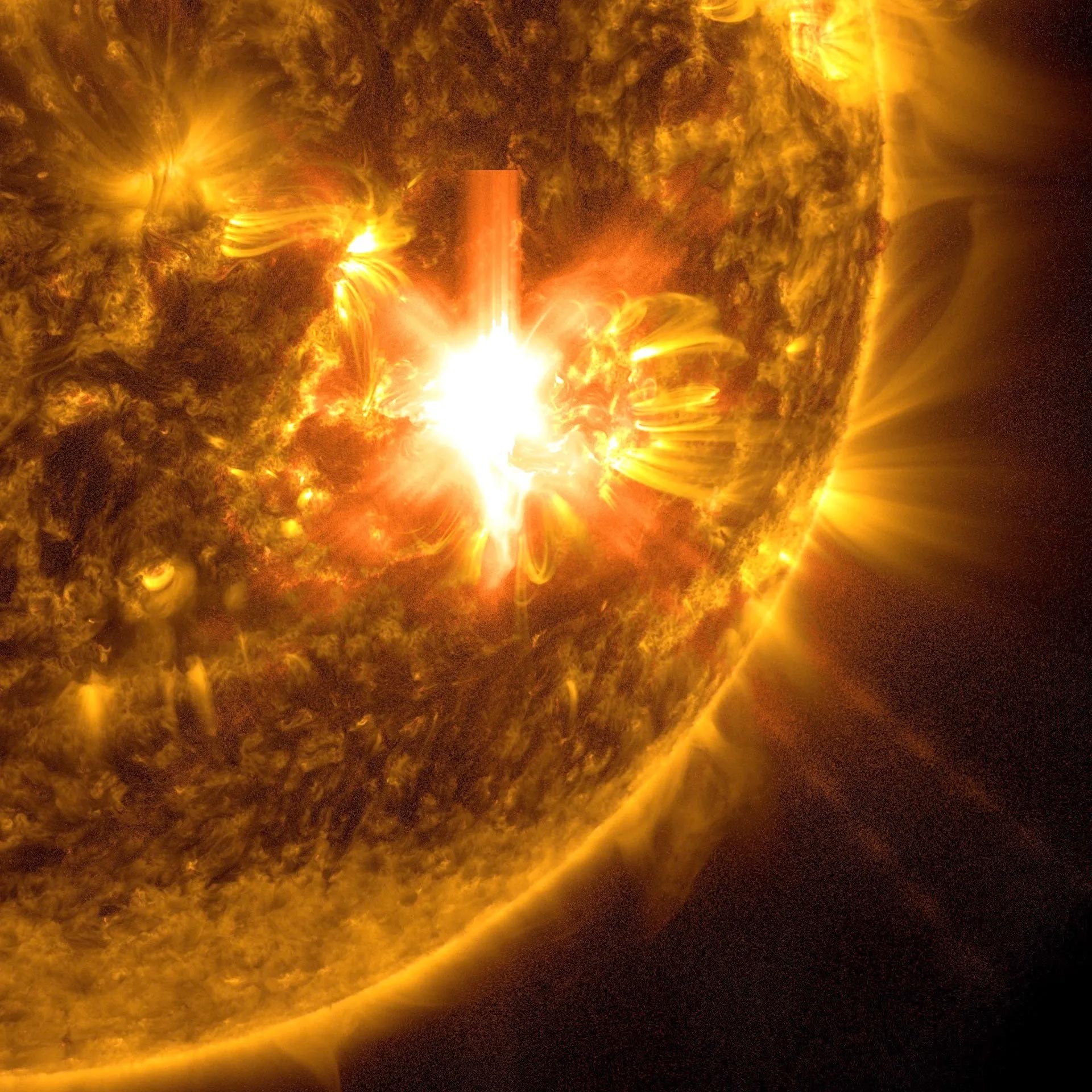
    NASA Solar Dynamics Observatory May 10 2024 Solar Flare
    NASA’s Solar Dynamics Observatory captured this image of a solar flare – as seen in the bright flash toward the middle of the image – on May 10, 2024. The image shows a subset of extreme ultraviolet light that highlights the extremely hot material in flares and which is colorized in gold. Credit: NASA/SDO

    The Sun emitted a powerful solar flare, peaking at 2:54 a.m. ET on May 10, 2024. NASA’s Solar Dynamics Observatory, which watches the Sun constantly, captured an image of the event. This flare is classified as an X3.9 flare. X-class denotes the most intense flares, while the number provides more information about its strength. There have been numerous X-class flares in recent days, and NASA observed 82 intense flares between May 3 and May 9, 2024.

    Solar flares are sudden and intense bursts of radiation emitted from the Sun’s atmosphere, specifically from regions where the magnetic field is very strong and complex. These flares are a manifestation of the release of magnetic energy and can last from minutes to hours. The energy released during a solar flare is primarily in the form of electromagnetic radiation, which includes radio waves, ultraviolet light, x-rays, and gamma rays.

    The intensity and potential impact of solar flares on Earth are categorized using a classification system developed by the National Oceanic and Atmospheric Administration (NOAA). Flares are rated based on their X-ray brightness in the wavelength range of 1 to 8 Angstroms, as detected by the GOES (Geostationary Operational Environmental Satellite) spacecraft.

    The classes are defined as follows:

    • X-class flares: These are the most intense flares. They can cause radio blackouts on Earth and long-lasting radiation storms in the upper atmosphere. The numerical suffix provides more details on their strength, with an X2 being twice as intense as an X1, an X3 being three times as intense, and so on.
    • M-class flares: These are medium-sized flares that can cause brief radio blackouts that affect Earth’s polar regions. Minor radiation storms might follow an M-class flare.
    • C-class flares: These are small flares with few noticeable consequences on Earth.
    • B-class and A-class flares: These are even smaller with minimal or no effect on Earth.

    The classification system is logarithmic, so each letter represents a tenfold increase in energy output, making X-class flares ten times more powerful than M-class flares and a hundred times more powerful than C-class flares. This system helps scientists and relevant authorities predict the potential impacts of solar activity and prepare for any disruptions they might cause, especially to communications and navigation systems on Earth.

    Never miss a breakthrough: Join the SciTechDaily newsletter.
    Follow us on Google and Google News.

    NASA Solar Dynamics Observatory Solar Flares Sun
    Share. Facebook Twitter Pinterest LinkedIn Email Reddit

    Related Articles

    NASA Just Found the Sun’s Secret Warning Before Massive Solar Flares

    Solar Fury Erupts: Sun Rings In the New Year With X1.8 Flare

    Sun Releases a Powerful Burst of Radiation – An X1-Class Solar Flare

    Powerful X-class Solar Flare Erupts From Sun

    NASA’s Solar Dynamics Observatory Spots Burst of Light and Energy on the Sun: A B-Class Flare

    NASA’s Solar Dynamics Observatory Views M-Class Solar Flare

    NASA’s SDO Reveals Images of X4.9-Class Solar Flare

    NASA’s Solar Dynamics Observatory Views Two New Solar Flares

    New Light Shed on the Origins of Extreme Space Storms

    Leave A Reply Cancel Reply

    • Facebook
    • Twitter
    • Pinterest
    • YouTube

    Don't Miss a Discovery

    Subscribe for the Latest in Science & Tech!

    Trending News

    Millions Take These IBS Drugs, But a New Study Finds Serious Risks

    Scientists Unlock Hidden Secrets of 2,300-Year-Old Mummies Using Cutting-Edge CT Scanner

    Bread Might Be Making You Gain Weight Even Without Eating More Calories

    Scientists Discover Massive Magma Reservoir Beneath Tuscany

    Europe’s Most Active Volcano Just Got Stranger – Here’s Why Scientists Are Rethinking It

    Alzheimer’s Symptoms May Start Outside the Brain, Study Finds

    Millions Take This Popular Supplement – Scientists Discover a Concerning Link to Heart Failure

    The Universe Is Expanding Too Fast and Scientists Can’t Explain Why

    Follow SciTechDaily
    • Facebook
    • Twitter
    • YouTube
    • Pinterest
    • Newsletter
    • RSS
    SciTech News
    • Biology News
    • Chemistry News
    • Earth News
    • Health News
    • Physics News
    • Science News
    • Space News
    • Technology News
    Recent Posts
    • U.S. Waste Holds $5.7 Billion Worth of Crop Nutrients
    • Scientists Say a Hidden Structure May Exist Inside Earth’s Core
    • Doctors Surprised by the Power of a Simple Drug Against Colon Cancer
    • Why Popular Diabetes Drugs Like Ozempic Don’t Work for Everyone: The “Genetic Glitch”
    • Scientists Create Improved Insulin Cells That Reverse Diabetes in Mice
    Copyright © 1998 - 2026 SciTechDaily. All Rights Reserved.
    • Science News
    • About
    • Contact
    • Editorial Board
    • Privacy Policy
    • Terms of Use

    Type above and press Enter to search. Press Esc to cancel.