
The Herschel Telescope and the Dawn Spacecraft have observed the release of water vapor from Ceres and the Dawn Spacecraft has discovered water ice in Ceres’ polar region.
The American Dawn space probe has been orbiting the asteroid Ceres between Mars and Jupiter since March 2015. Thanks to the two identical onboard cameras from the Max Planck Institute for Solar System Research (MPS), the Framing Cameras, the dwarf planet has been almost completely mapped. In a current study, a team headed by scientists from the MPS reports on Ceres’ most northerly regions, where the Göttingen cameras have performed a very special feat: they have succeeded in taking photos of water ice deposits in places ruled by almost eternal darkness.
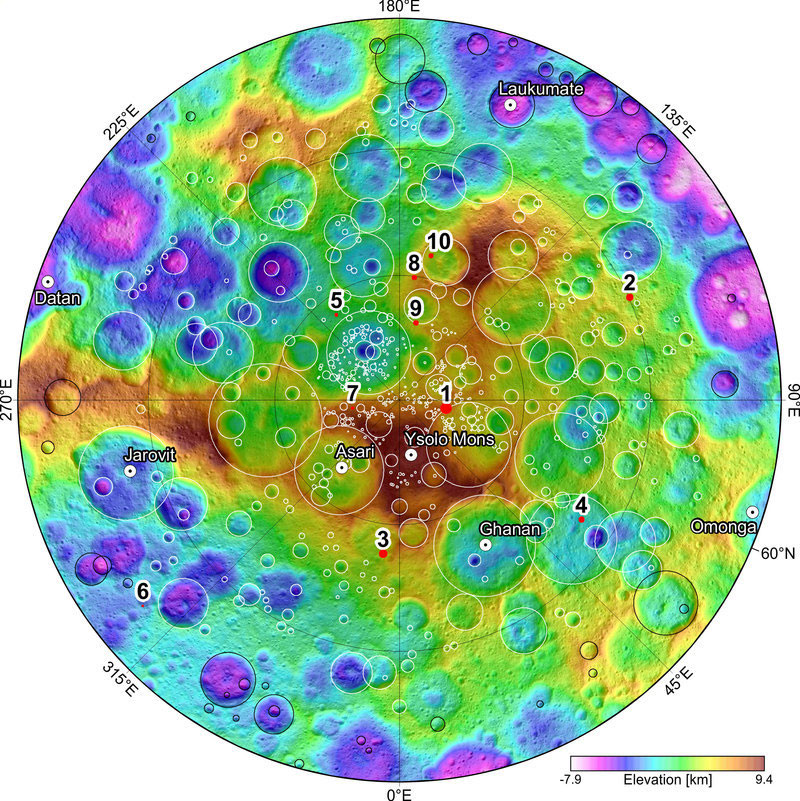
Thomas Platz is the lead author of the study now published in Nature Astronomy, a new specialist journal. “Using our cameras, we looked at the craters in the region near the north pole between 65 and 90 degrees north. Some of these craters are at least partially in eternal darkness which means they are never reached by sunlight. The reason for this is that Ceres’ rotational axis has an angle of inclination of only 4.028 degrees,” explains the member of the Framing Camera team at the MPS. The small axial inclination means the Sun never rises far above the horizon in the sky above Ceres’ polar regions. This in turn means that obstacles such as crater walls cast long shadows; considerable areas of the polar region are even shrouded in eternal night. Although sunlight never falls directly onto these locations, tiny amounts of scattered light do reach them, reflected from directly illuminated crater walls in the vicinity, for example. The camera can use this weak light and explore the darkness. This is how it came across several bright deposits – water ice.
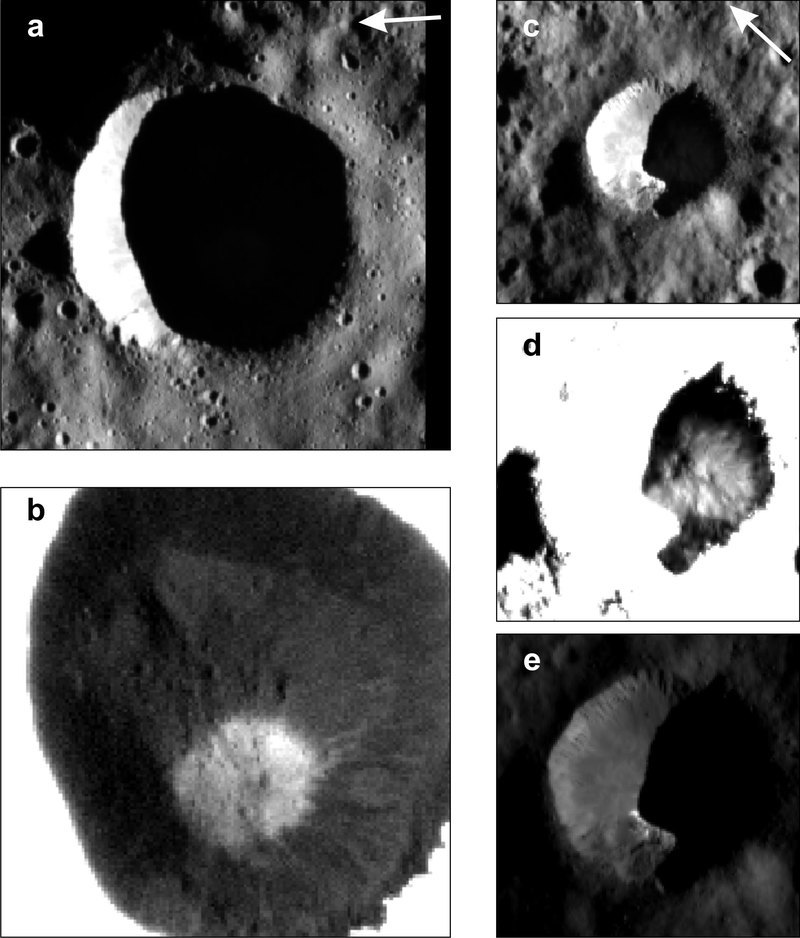
Hunting for ice deposits is hard work: of the 634 identified craters with permanent dark areas, ten craters with conspicuously bright spots in their interior were found in the images of the Framing Cameras. A comparatively young crater, still unnamed but provisionally called Number 2, plays a special role here; it lies 69.9 degrees north and has a diameter of 3.8 kilometers (2.4 miles). The bright deposits there extend beyond the permanent darkness right into the area which is sometimes illuminated by direct sunlight. “This offers the opportunity to analyze the light reflected from there with Dawn’s VIR (Visible and IR Spectrometer) onboard instrument, which was supplied by the Italian space agency,” explains Andreas Nathues, who heads the Framing Camera experiment at the MPS. “We can clearly see the spectral signature of water ice, but were unable to find other frozen gases.” The scientists assume that the other bright deposits are also made mainly of water ice.
Scientists have long thought that Ceres’ interior contains large amounts of ice because its density is so low – 2.1621 grams per cubic centimeter. This is now the second time that water has been found directly on the surface. The current results join measurements from the Herschel telescope operated by the European Space Agency ESA, which measured water vapor close to Ceres in 2014. In December 2015, moreover, Max Planck researchers in Göttingen used the Framing Cameras to record patches of mist over two craters close to the equator, likewise an indication of water in vapor form.
Deposits of ice on parts of Ceres’ surface that experience direct sunlight are found to be unstable over long, geological periods of time. The dwarf planet has no atmosphere and thus the ice sublimates in a relatively short period of time once it reaches the surface. This means it passes directly from ice to the gaseous state. At places which are permanently in darkness, and thus extremely cold, where the temperatures fall below minus 163 degrees Celsius (minus 261 degrees Fahrenheit), ice can survive for a very long time.
“We know ice deposits exist in the polar regions of our Moon and the planet Mercury, both of which have no atmosphere either. These ice deposits can be explained as the result of external events such as the impacts of comets,” says Nathues. “The craters near Ceres’ poles, however, contain ice which is probably indigenous to Ceres, i.e. it originates mainly from Ceres itself,” explains Platz. As the co-authors of the study of the Free University of Berlin have been able to show in a simulation, the impact which originally created the Oxo crater, for example, could have blasted away icy rock which exists below the surface and hurled it as far as the polar regions.
Reference: “Surface Water-Ice Deposits in the Northern Shadowed Regions of Ceres” by T. Platz, A. Nathues, N. Schorghofer, F. Preusker, E. Mazarico, S. E. Schröder, S. Byrne, T. Kneissl, N. Schmedemann, J.-P. Combe, M. Schäfer, G. S. Thangjam, M. Hoffmann, P. Gutierrez-Marques, M. E. Landis, W. Dietrich, J. Ripken, K.-D. Matz and C. T. Russell, 15 December 2016, Nature Astronomy.
DOI: 10.1038/s41550-016-0007
Never miss a breakthrough: Join the SciTechDaily newsletter.
Follow us on Google and Google News.