
Close Menu
    Facebook X (Twitter) Instagram
    SciTechDaily
    • Biology
    • Chemistry
    • Earth
    • Health
    • Physics
    • Science
    • Space
    • Technology
    Facebook X (Twitter) Pinterest YouTube RSS
    SciTechDaily
    Home»Space»Death by Dust: Game Over for NASA’s InSight Mars Lander?
    Space

    Death by Dust: Game Over for NASA’s InSight Mars Lander?

    By SciTechDailyDecember 20, 20222 Comments2 Mins Read
    Facebook Twitter Pinterest Telegram LinkedIn WhatsApp Email Reddit
    Share
    Facebook Twitter LinkedIn Pinterest Telegram Email Reddit
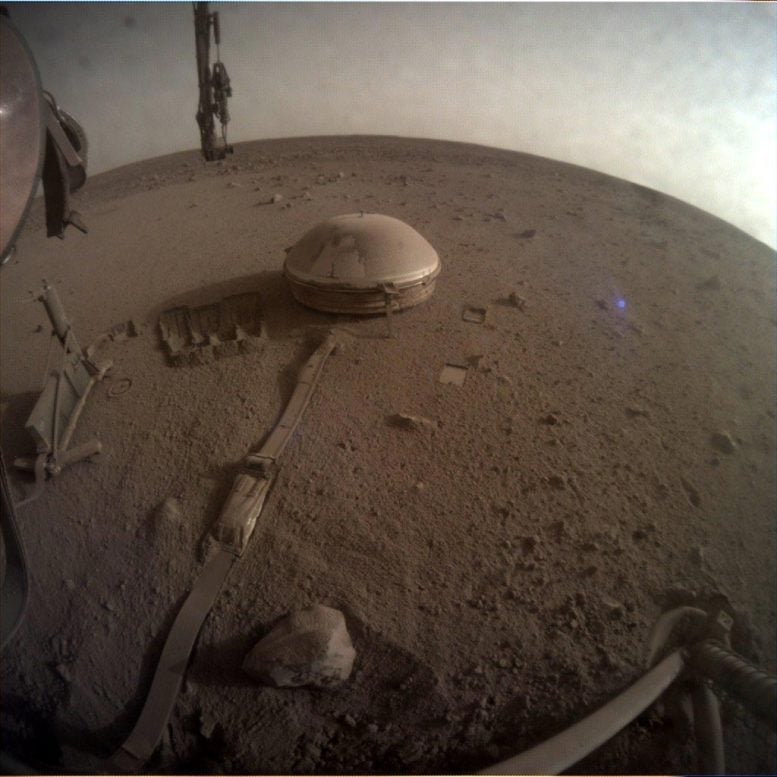
    NASA Insight Last Image
    NASA InSight Mars Lander’s last image? Credit: NASA/JPL-Caltech

    Mars InSight ends its mission after groundbreaking work on marsquakes and planetary structure.

    We have known for a while that the end was near for NASA’s Mars InSight lander, as the spacecraft’s power supply continued to dwindle from windblown dust accumulating on its solar panels. Now, it seems that day has come. The NASA InSight Twitter account’s latest message revealed what might be the last image sent from the spacecraft, as Insight revealed its “power’s really low.”

    My power’s really low, so this may be the last image I can send. Don’t worry about me though: my time here has been both productive and serene. If I can keep talking to my mission team, I will – but I’ll be signing off here soon. Thanks for staying with me. pic.twitter.com/wkYKww15kQ

    — NASA InSight (@NASAInSight) December 19, 2022

    This was followed by a Tweet from the NASA JPL Twitter handle that reported that on December 18, the InSight Mars Lander “did not respond to communications from Earth.”

    Update on @NASAInSight: On Dec. 18, the Mars lander did not respond to communications from Earth. Power has been declining for months, as expected, and this may mean the end of operations for the spacecraft. The team will try again to contact InSight. https://t.co/PsDaWokb9Z pic.twitter.com/ZVACs9EgmB

    — NASA JPL (@NASAJPL) December 20, 2022

    NASA’s Mars Interior Exploration using Seismic Investigations, Geodesy and Heat Transport (InSight) mission launched on May 5, 2018, from Vandenberg Air Force Base, California. After a 300-million-mile (480-million-kilometer) journey to Mars, InSIght touched down on the Red Planet near the equator on the western side of a flat, smooth expanse of lava called Elysium Planitia on November 26.

    The mission’s science goals were to uncover how a rocky body forms and evolves to become a planet by investigating the interior structure and composition of Mars and to determine the rate of Martian tectonic activity and meteorite impacts. InSIght achieved its primary science goals in its first Martian year (~2 Earth years), and NASA extended its mission to focus on producing a long-duration, high-quality seismic dataset.

    During its time on Mars, InSight’s seismometer felt multiple meteor impacts, detected more than 1,300 marsquakes, and shed new light on the Red Planet’s interior:

    • InSight Mars Lander Detects Stunning Meteoroid Impact on Red Planet
    • Listen to Space Rocks Crash Into Mars
    • Subsurface Water On Mars Defies Expectations
    • NASA’s InSight Records Monster Quake on Mars
    • Insight Lander Uses Wind-Induced Vibrations To Reveal the Red Planet’s Subsurface Layers
    • InSight Mars Lander Detects Three Big Marsquakes
    • Interior of Mars Revealed by InSight’s Seismic Observations
    • More Than 500 Marsquakes Detected by InSight Lander in First Year
    • InSight Detects Two Sizable Quakes on Mars
    • InSight Takes Deep Mars Measurements: Reveals Boundaries From Crust to Core
    • Mysterious Magnetic Pulsations Detected at Martian Surface Around Midnight
    • Eerie Sounds on Mars Picked Up by NASA’s InSight Lander

    Never miss a breakthrough: Join the SciTechDaily newsletter.
    Follow us on Google and Google News.

    Mars NASA NASA InSight Lander Popular
    Share. Facebook Twitter Pinterest LinkedIn Email Reddit

    Related Articles

    Mars Is Spinning Faster: NASA’s InSight Uncovers Surprising Acceleration

    “Dead Bus” – NASA Retires InSight Mars Lander Mission After 4 Years on Red Planet

    The End Is Nigh: NASA Prepares To Say “Farewell” to History-Making Mars InSight Lander

    NASA’s InSight Mars Lander Detects Stunning Meteoroid Impact on Red Planet

    Still Alive! NASA’s InSight Lander Waits Out Martian Dust Storm

    Listen to Space Rocks Crash Into Mars – Recorded by NASA’s InSight Lander

    New Life: NASA’s InSight Mars Lander Gets a Few Extra Weeks of Science Operations

    Days Are Numbered: Power Levels Diminishing for NASA’s Marsquake Hunting InSight Lander

    NASA’s InSight Records Monster Quake on Mars – The Largest Ever Detected on Another Planet

    2 Comments

    1. tim on December 20, 2022 7:12 am

      plastic film like formula one cameras use might have some use in that sort of situation
      to move the dust

      Reply
    2. William Readling on December 21, 2022 12:02 pm

      Bifacial PV panels can be installed vertically, yet still collect a fair amount of light, with less of a peak near noon. Dust does not collect as quickly on vertical surfaces.

      Reply
    Leave A Reply Cancel Reply

    • Facebook
    • Twitter
    • Pinterest
    • YouTube

    Don't Miss a Discovery

    Subscribe for the Latest in Science & Tech!

    Trending News

    Scientists Warn That This Common Pet Fish Can Wreck Entire Ecosystems

    Scientists Make Breakthrough in Turning Plastic Trash Into Clean Fuel Using Sunlight

    This Popular Supplement May Interfere With Cancer Treatment, Scientists Warn

    Scientists Finally Solved One of Water’s Biggest Mysteries

    Could This New Weight-Loss Pill Disrupt the Entire Market? Here’s What You Should Know About Orforglipron

    Earth’s Crust Is Tearing Open in Africa, and It Could Form a New Ocean

    Breakthrough Bowel Cancer Trial Leaves Patients Cancer-Free for Nearly 3 Years

    Natural Compound Shows Powerful Potential Against Rheumatoid Arthritis

    Follow SciTechDaily
    • Facebook
    • Twitter
    • YouTube
    • Pinterest
    • Newsletter
    • RSS
    SciTech News
    • Biology News
    • Chemistry News
    • Earth News
    • Health News
    • Physics News
    • Science News
    • Space News
    • Technology News
    Recent Posts
    • Kratom Use Explodes in the US, With Life-Changing Consequences
    • Scientists Uncover Fatal Weakness in “Zombie Cells” Linked to Cancer
    • World-First Study Reveals Human Hearts Can Regenerate After a Heart Attack
    • Why Your Dreams Feel So Real Sometimes and So Strange Other Times
    • Scientists Debunk 100-Year-Old Belief About Brain Cells, Rewriting Textbooks
    Copyright © 1998 - 2026 SciTechDaily. All Rights Reserved.
    • Science News
    • About
    • Contact
    • Editorial Board
    • Privacy Policy
    • Terms of Use

    Type above and press Enter to search. Press Esc to cancel.