
Close Menu
    Facebook X (Twitter) Instagram
    SciTechDaily
    • Biology
    • Chemistry
    • Earth
    • Health
    • Physics
    • Science
    • Space
    • Technology
    Facebook X (Twitter) Pinterest YouTube RSS
    SciTechDaily
    Home»Space»Defying the Sun: NASA’s OSIRIS-APEX Survives Another Fiery Encounter
    Space

    Defying the Sun: NASA’s OSIRIS-APEX Survives Another Fiery Encounter

    By NASAJanuary 24, 2025No Comments3 Mins Read
    Facebook Twitter Pinterest Telegram LinkedIn WhatsApp Email Reddit
    Share
    Facebook Twitter LinkedIn Pinterest Telegram Email Reddit
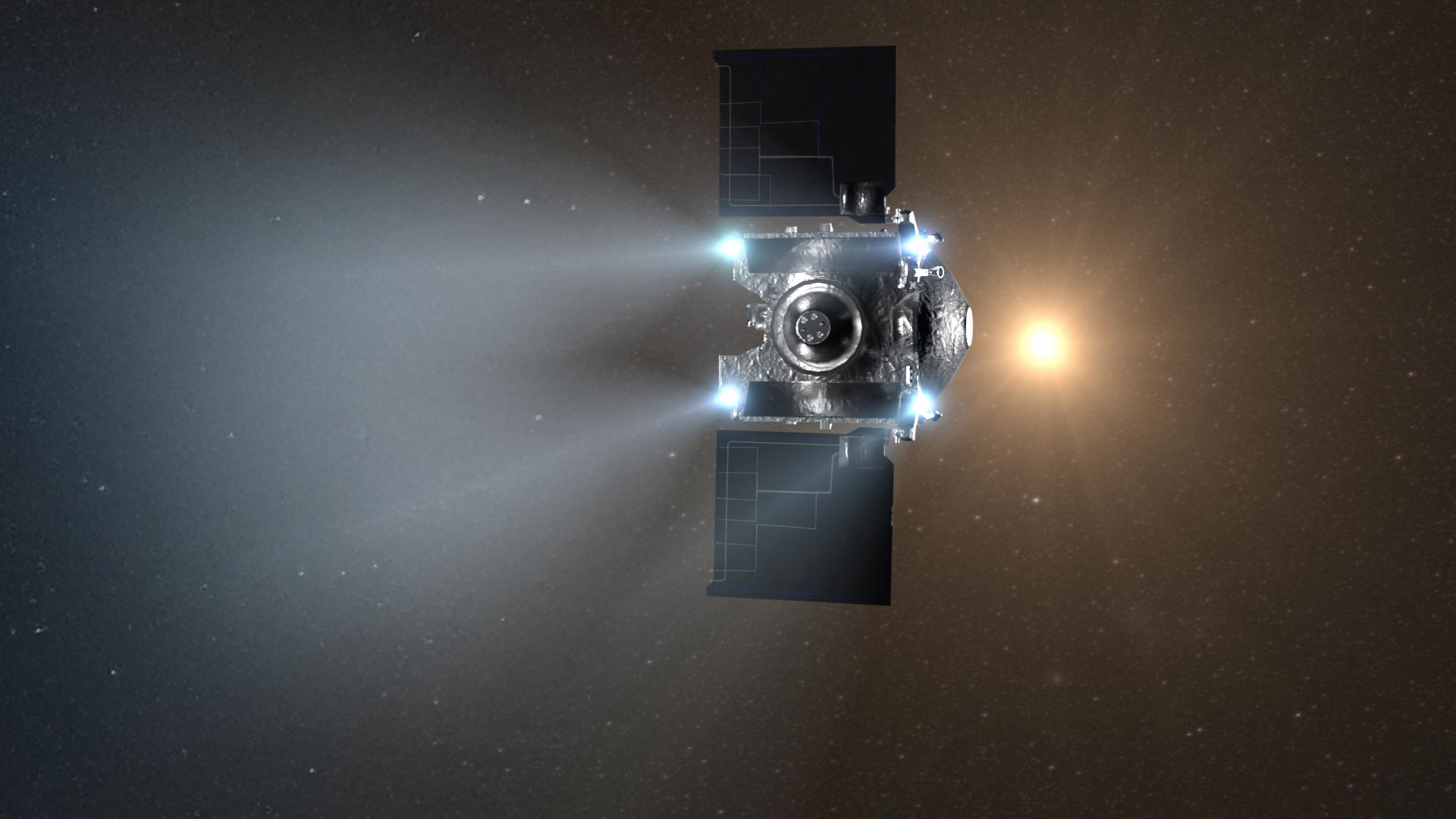
    OSIRIS-APEX Sun
    OSIRIS-APEX, in a bold close solar encounter, successfully navigated intense heat and communication blackouts. It remains on track for its crucial rendezvous with asteroid Apophis. Credit: NASA’s Goddard Space Flight Center/CI Lab, edited

    Surpassing expectations, NASA’s OSIRIS-APEX endured a near-Sun passage, outperforming its heat tolerances and remaining intact. As it journeys towards a historic meeting with asteroid Apophis, it has more fiery trials to face, testing its durability and ingenuity.

    NASA’s OSIRIS-APEX (Origins, Spectral Interpretation, Resource Identification, and Security – Apophis Explorer) spacecraft successfully withstood intense heat last fall as it traveled within 46.5 million miles of the Sun — between the orbits of Mercury and Venus — exceeding its original heat tolerance limits.

    On January 23, the mission team completed a thorough review of the data collected during this close solar approach. “There were no surprises, and the spacecraft is operating well,” reported Mike Moreau, deputy project manager for OSIRIS-APEX at NASA’s Goddard Space Flight Center in Greenbelt, Maryland.

    Surviving the Sun’s Proximity

    As planned, on September 2, 2024, OSIRIS-APEX reached perihelion, the point in its orbit closest to the Sun. The spacecraft’s journey to asteroid Apophis requires it to travel much closer to the Sun than it was initially designed to withstand. To protect its sensitive components, engineers oriented the spacecraft in a special configuration from August 1 to October 13. This setup used one of its solar arrays as a heat shield, ensuring critical systems remained within safe temperature limits.

    While in perihelion configuration, communication with the spacecraft is only possible through one of the spacecraft’s low-gain antennas, thus only very limited data is available to monitor its systems. During this most recent perihelion, there was also a period of several days when no communications were possible while the spacecraft was on the other side of the Sun from Earth.

    Health Check and Future Passages

    On October 13, the spacecraft exited the perihelion configuration and methodically returned to full operating status, allowing flight engineers to downlink and analyze spacecraft telemetry and assess the health of the system. In November 2024, the spacecraft executed routine checkouts of instrumentation on the spacecraft. OSIRIS-APEX appears to be healthy after the second of six close perihelion passages on its six-year journey to rendezvous with asteroid Apophis.

    OSIRIS-APEX successfully passed through its first perihelion earlier in 2024. To reach asteroid Apophis in 2029, the spacecraft must survive four more close encounters with the Sun, the next of which will occur in May 2025.

    Never miss a breakthrough: Join the SciTechDaily newsletter.
    Follow us on Google and Google News.

    NASA OSIRIS-APEX Sun
    Share. Facebook Twitter Pinterest LinkedIn Email Reddit

    Related Articles

    See the Sun’s Hidden Halo in 3D: NASA’s PUNCH Mission Captures First Light

    NASA’s Spacecraft That Touched the Sun Just Won Aerospace’s Biggest Prize

    NASA’s Parker Solar Probe: The Fastest Spacecraft Ever Just Skimmed the Sun at 430,000 MPH

    NASA’s Parker Probe Just Flew Through Solar Fire at 430,000 MPH

    NASA’s PUNCH Mission: Tracking Solar Storms With an 8,000-Mile Virtual Telescope

    Watch Live: NASA Is Launching a Space Telescope That Could Rewrite the Universe’s Origin Story

    NASA’s PUNCH Is About to Capture Solar Storms Like Never Before

    Massive Solar Storm Unleashes Mysterious New Radiation Belts

    NASA Just Found the Sun’s Secret Warning Before Massive Solar Flares

    Leave A Reply Cancel Reply

    • Facebook
    • Twitter
    • Pinterest
    • YouTube

    Don't Miss a Discovery

    Subscribe for the Latest in Science & Tech!

    Trending News

    New Research Shows Vitamin B12 May Hold the Key to Healthy Aging

    These Simple Daily Habits Can Quickly Improve Blood Pressure and Heart Risk Factors

    A Common Nutrient May Play a Surprising Role in Anxiety

    Doing This After 9 p.m. Could Double Your Risk of Gut Issues

    Scientists Discover How Coffee Impacts Memory, Mood, and Gut Health

    Why Did the Neanderthals Disappear? Scientists Reveal Humans Had a Hidden Advantage

    Physicists Propose Strange Experiment Where Time Goes Quantum

    Magnesium Magic: New Drug Melts Fat Even on a High-Fat, High-Sugar Diet

    Follow SciTechDaily
    • Facebook
    • Twitter
    • YouTube
    • Pinterest
    • Newsletter
    • RSS
    SciTech News
    • Biology News
    • Chemistry News
    • Earth News
    • Health News
    • Physics News
    • Science News
    • Space News
    • Technology News
    Recent Posts
    • This New Memory Technology Could Make Devices Last Months on One Charge
    • Scientists Turn Cancer’s Own Bacteria Against It in Breakthrough Therapy
    • Cannabis Can Make You Remember Things That Never Happened
    • Doctors Are Surprised by What This Vaccine Is Doing to the Heart
    • Quantum Breakthrough Turns Simple Forces Into Powerful New Interactions
    Copyright © 1998 - 2026 SciTechDaily. All Rights Reserved.
    • Science News
    • About
    • Contact
    • Editorial Board
    • Privacy Policy
    • Terms of Use

    Type above and press Enter to search. Press Esc to cancel.