
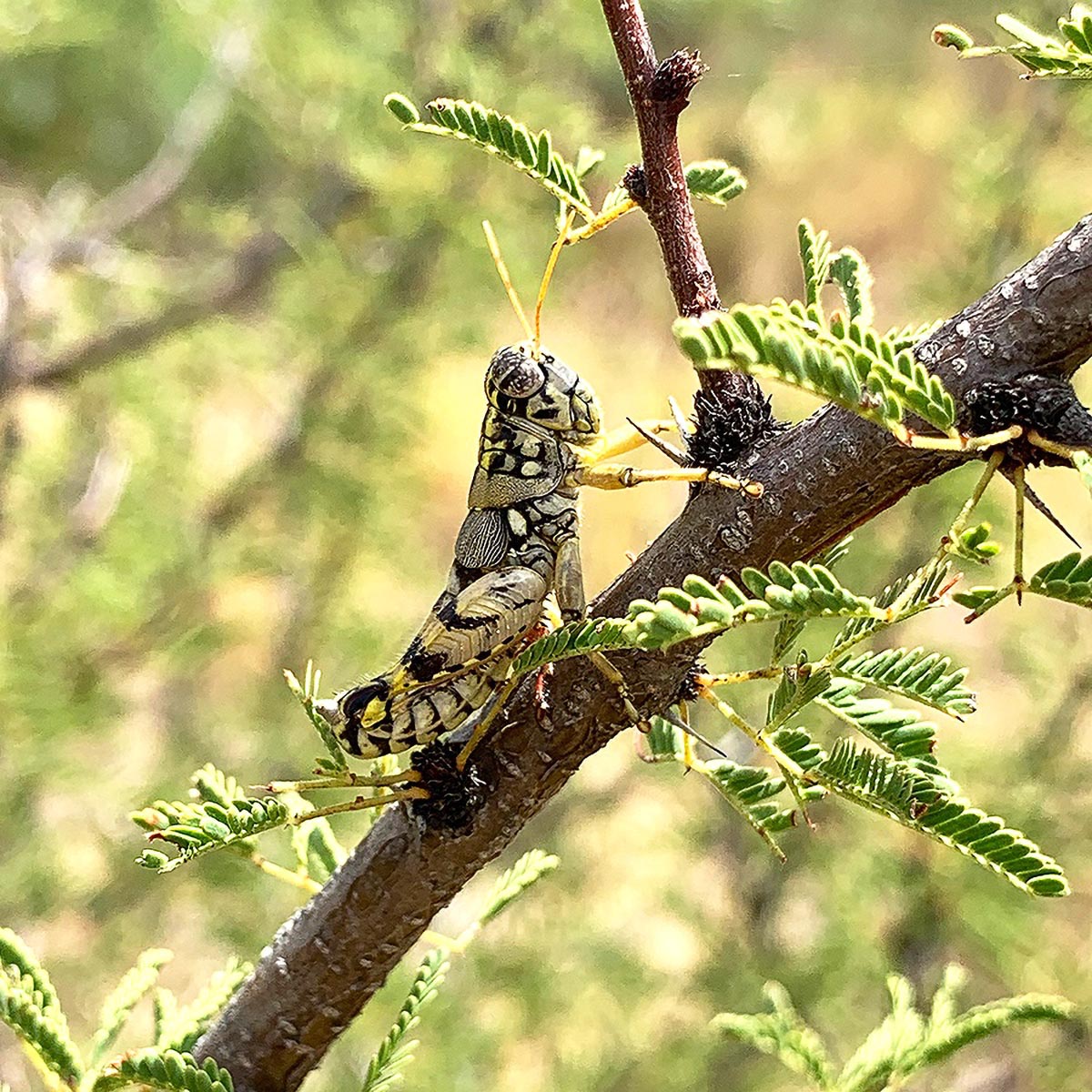
New research has discovered 16 new desert grasshopper species, revealing their Ice Age-driven isolation and diversification.
A Mississippi State University scientist has uncovered a hopping treasure trove—16 new species of grasshoppers thriving in the thorny scrublands of U.S. and Mexican deserts.
Before JoVonn Hill’s discovery, only three species of Agroecotettix were known. Hill, director of MSU’s Mississippi Entomological Museum, emphasized the importance of carefully examining our environment.
“It is important to keep exploring our biodiversity, especially from a conservation standpoint, before we lose it,” Hill said.
These newly uncovered species, native to the southern U.S. and Mexican deserts, showcase the thriving biodiversity in arid ecosystems. Published in the scientific journal ZooKeys, Hill’s article provides valuable insights into the region’s evolution and ecology.
Evolution and Isolation of the New Species
Hill, an assistant professor in MSU’s Mississippi Agricultural and Forestry Experiment Station, said this grasshopper genus likely diversified during the Pleistocene Epoch, also known as the Ice Age. He noted that in the Rocky Mountains, species of this subfamily in alpine grasslands likely became isolated as glaciers receded and their habitats shifted to higher elevations. Hill suspects the desert species his team discovered underwent a similar process of isolation and speciation.
“These grasshoppers we described live in a lowland thorny scrub habitat. Somewhere along the line, they, too, got isolated and speciated, because each one is still associated with a specific mountain range,” he said. “Their sexually selective nature and lack of premating rituals have kept populations stable and tied to specific mountain ranges.”

DNA from collected specimens will be sequenced by collaborators at the University of Michigan and will help confirm these observations. Using a molecular clock, Hill’s team will estimate when the species diverged, revealing how past climate change influenced distributions and how future shifts may affect them.
Understanding the past impacts of climate change can also help us prepare for what we may face in the future, Hill said. Plus, it’s a reminder that there’s still so much to discover, even in our own backyard.”
Collaborative Research and Future Studies
Funded by the National Science Foundation, this project complements two others. In one, Hill and mentor Daniel Otte, a senior curator at the Academy of Natural Sciences, are coauthoring “The North American Grasshoppers, Volume III.”
“These grasshoppers are a part of the Melanoplinae subfamily, which is the most diverse subfamily of North American grasshoppers, and most of our major grasshopper pest species occur in that genus. There are a lot of new species to be discovered, and we’re trying to get them all described before we produce the book,” he said.
The second project, in partnership with Lacey Knowles at the University of Michigan, examines the factors driving Melanoplinae diversity across North America and Mexico by sampling over 600 species.
“That study aims to determine what produced this diversity, when it occurred, and how individual populations may have become isolated over time,” Hill said.
“I loved catching grasshoppers as a kid, and I still get to do it now—discovering new things, uncovering their history and understanding how they’re related,” the MSU researcher said. “Sharing this fascinating piece of American natural heritage makes it all worthwhile.”
Reference: “Desert diversification: revision of Agroecotettix Bruner, 1908 (Orthoptera, Acrididae, Melanoplinae) with descriptions of sixteen new species from the United States and Mexico” by JoVonn G. Hill, 21 November 2024,
ZooKeys.
DOI: 10.3897/zookeys.1218.133703
Funding partners include the NSF, Texas Ecolab, the National Institute of Food and Agriculture and MAFES.
Never miss a breakthrough: Join the SciTechDaily newsletter.
Follow us on Google and Google News.