

Close Menu
    Facebook X (Twitter) Instagram
    SciTechDaily
    • Biology
    • Chemistry
    • Earth
    • Health
    • Physics
    • Science
    • Space
    • Technology
    Facebook X (Twitter) Pinterest YouTube RSS
    SciTechDaily
    Home»Technology»Diamond Devices Break Limits: Scientists Unveil New High-Performance Nuclear-Grade Transistor
    Technology

    Diamond Devices Break Limits: Scientists Unveil New High-Performance Nuclear-Grade Transistor

    By National Institute for Materials Science, JapanApril 8, 2025No Comments3 Mins Read
    Facebook Twitter Pinterest Telegram LinkedIn WhatsApp Email Reddit
    Share
    Facebook Twitter LinkedIn Pinterest Telegram Email Reddit
    Diamond CPU Chip Semiconductor
    A NIMS research team has successfully developed the world’s first n-channel diamond MOSFET, a breakthrough that enables the creation of diamond-based CMOS integrated circuits for high-performance use in extreme environments. This innovation leverages diamond’s exceptional properties, such as high thermal conductivity and radiation resistance, paving the way for energy-efficient electronics capable of operating under intense heat and radiation. (Artist’s concept.) Credit: SciTechDaily.com

    A step forward in the development of diamond CMOS integrated circuits.

    A research team at NIMS has developed the world’s first n-channel diamond MOSFET (metal-oxide-semiconductor field-effect transistor). This breakthrough marks a significant step toward realizing CMOS (complementary metal-oxide-semiconductor) integrated circuits based on diamond, enabling their use in extreme environments and advancing the development of diamond-based power electronics.

    Diamond as a semiconductor offers exceptional physical properties, including an ultra-wide bandgap of 5.5 eV, high carrier mobility, and excellent thermal conductivity. These characteristics make diamond a highly promising material for high-performance, high-reliability applications in extreme conditions, such as high temperatures and intense radiation—like those near nuclear reactor cores.

    Diamond electronics not only reduce the need for complex thermal management systems compared to conventional semiconductors, but they also offer greater energy efficiency, higher breakdown voltage tolerance, and enhanced durability in harsh environments.

    Demand for Diamond CMOS Integration

    On the other hand, with the development of diamond growth technologies, power electronics, spintronics, and microelectromechanical system (MEMS) sensors operatable under high-temperature and strong-radiation conditions, the demand for peripheral circuitry based on diamond CMOS devices has increased for monolithic integration. For the fabrication of CMOS integrated circuits, both p-type and n-type channel MOSFETs are needed, just as in conventional silicon electronics. However, n-channel diamond MOSFETs had not yet been developed.
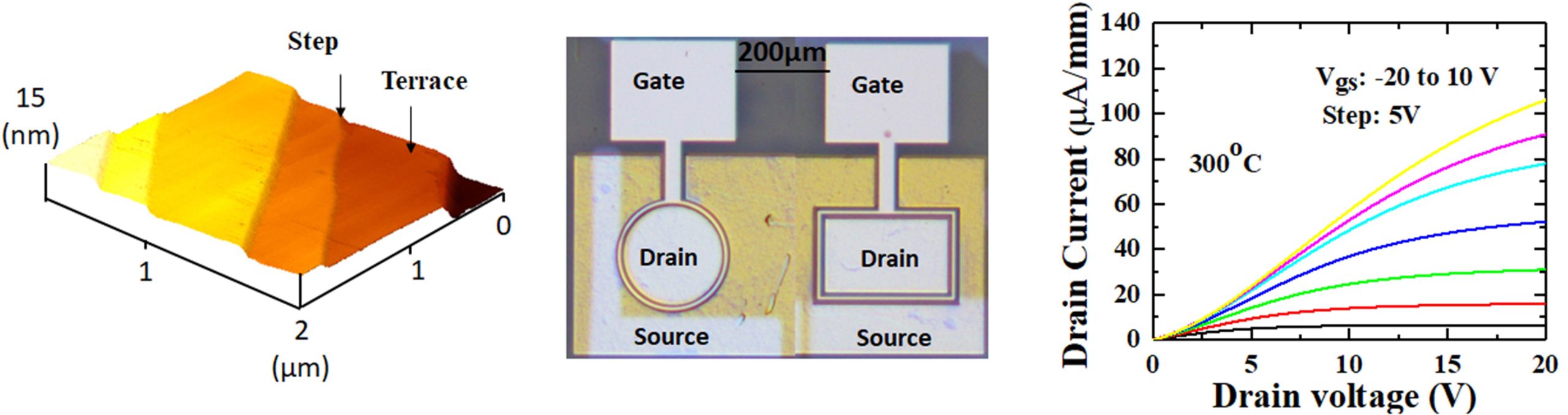
    World’s First N Channel Diamond Field Effect Transistor
    (Left) Atomic force microscope image of diamond epilayer surface morphology. (Middle) Optical microscope image of the diamond MOSFET. (Right) Performance of the MOSFET measured at 300°C. The drain current increased when the gate voltage (Vg) was increased from -20 V (indicated by a black line) to 10 V (indicated by a yellow line). Credit: Satoshi Koizumi, Meiyong Liao National Institute for Materials Science

    This NIMS research team developed a technique to grow high-quality monocrystalline n-type diamond semiconductors with smooth and flat terraces at the atomic level by doping diamond with a low concentration of phosphorus (diagram on the left in the figure). Using this technique, the team succeeded in fabricating an n-channel diamond MOSFET for the first time in the world.

    Design and Performance Validation

    This MOSFET is composed mainly of an n-channel diamond semiconductor layer atop another diamond layer doped with a high concentration of phosphorus (middle diagram in the figure). The use of the latter diamond layer significantly reduced source and drain contact resistance. The team confirmed that the fabricated diamond MOSFET actually functioned as an n-channel transistor.

    In addition, the team verified the excellent high-temperature performance of the MOSFET as indicated by its field-effect mobility—an important transistor performance indicator—of approximately 150 cm2/V・sec at 300°C (graph on the right in the figure).

    These achievements are expected to facilitate the development of CMOS integrated circuits for the manufacture of energy-efficient power electronics, spintronic devices, and (MEMS) sensors under harsh environments.

    Reference: “High-Temperature and High-Electron Mobility Metal-Oxide-Semiconductor Field-Effect Transistors Based on N-Type Diamond” by Meiyong Liao, Huanying Sun and Satoshi Koizumi, 19 January 2024, Advanced Science.
    DOI: 10.1002/advs.202306013

    Never miss a breakthrough: Join the SciTechDaily newsletter.
    Follow us on Google and Google News.

    Diamonds Electronics Semiconductors Spintronics
    Share. Facebook Twitter Pinterest LinkedIn Email Reddit

    Related Articles

    How Diamonds Are Shaping the Future of Electronics and Quantum Tech

    Quantum Computing Breakthrough: Entanglement of Three Spin Qubits Achieved in Silicon

    Technology Breakthrough Enables Practical Semiconductor Spintronics

    Artificial “Magnetic Texture” Induced in Graphene – May Lead to Powerful Quantum Computers

    Photoconductive Diamond Switches: Diamonds Are Not Just for Jewelry Anymore

    Scientists Make Electrifying Diamond Find

    Turning Diamond Into Metal – For Improved Solar Cells, LEDs, and Power Electronics

    Gallium Nitride Electronics Poised to Drastically Cut Energy Usage

    Brookhaven National Laboratory Scientists Explore Ways to Synchronize Magnetic Spins for Nanoscale Electronic Devices

    Leave A Reply Cancel Reply

    • Facebook
    • Twitter
    • Pinterest
    • YouTube

    Don't Miss a Discovery

    Subscribe for the Latest in Science & Tech!

    Trending News

    Your Blood Pressure Reading Could Be Wrong Because of One Simple Mistake

    Astronomers Stunned by Ancient Galaxy With No Spin

    Physicists May Be on the Verge of Discovering “New Physics” at CERN

    Scientists Solve 320-Million-Year Mystery of Reptile Skin Armor

    Scientists Say This Daily Walking Habit May Be the Secret to Keeping Weight Off After Dieting

    New Therapy Rewires the Brain To Restore Joy in Depression Patients

    Giant Squid Detected off Western Australia in Stunning Deep-Sea Discovery

    Popular Sugar-Free Sweetener Linked to Liver Disease, Study Warns

    Follow SciTechDaily
    • Facebook
    • Twitter
    • YouTube
    • Pinterest
    • Newsletter
    • RSS
    SciTech News
    • Biology News
    • Chemistry News
    • Earth News
    • Health News
    • Physics News
    • Science News
    • Space News
    • Technology News
    Recent Posts
    • Scientists Revive Ancient Chemistry Trick To Engineer Next-Generation Glass
    • Scientists Use AI To Supercharge Ultrafast Laser Simulations by More Than 250x
    • Scientists Just Found a Surprising Way To Destroy “Forever Chemicals”
    • Popular Supplement Ingredient Linked to Shorter Lifespan in Men
    • Scientists May Have Found a Way To Repair Nerve Damage in Multiple Sclerosis
    Copyright © 1998 - 2026 SciTechDaily. All Rights Reserved.
    • Science News
    • About
    • Contact
    • Editorial Board
    • Privacy Policy
    • Terms of Use

    Type above and press Enter to search. Press Esc to cancel.