

Forests store microplastics carried in from the air. These particles accumulate in soils through rain, leaf fall, and decomposition.
Microplastics and nanoplastics are not only contaminating oceans, rivers, and agricultural land but are also present in forests. This finding comes from geoscientists at TU Darmstadt, whose study has just been published in the journal Nature Communications Earth & Environment.
How plastic particles enter forests
According to a new study, harmful microplastics are not only stored in agricultural and urban soils, but also in forests. The majority of the tiny plastic particles enter the forests from the air and accumulate in the forest soil.
“The microplastics from the atmosphere initially settle on the leaves of the tree crowns, which scientists refer to as the ‘comb-out effect’,” explains lead author Dr Collin J. Weber from the Institute of Applied Geosciences at TU Darmstadt. “Then, in deciduous forests, the particles are transported to the forest soil by rain or the autumn leaf fall, for example.”
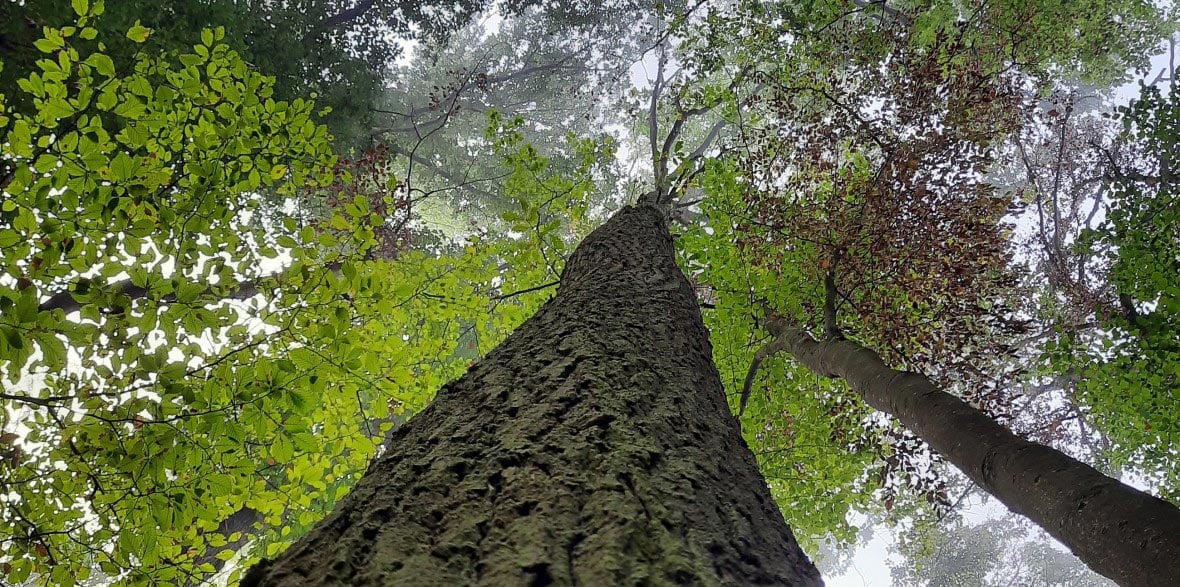
Once in the soil, leaf decomposition becomes a key factor in trapping these pollutants. The researchers found that the highest concentrations of microplastics occur in the upper layers of leaf litter that are only partially decomposed. However, large amounts are also found deeper in the soil, carried downward not only by decomposition itself but also through the activity of organisms that contribute to breaking down organic matter.
Sampling and new methods
To conduct their study, researchers from the Department of Soil Mineralogy and Soil Chemistry collected samples at four forest locations east of Darmstadt, Germany. They applied a newly refined analytical technique that allowed them to measure the concentration of microplastics in soil, fallen leaves, and atmospheric deposition (the movement of substances from the Earth’s atmosphere to its surface).
The team then used spectroscopic methods to chemically analyze the samples. In addition, they created a model estimating atmospheric microplastic inputs since the 1950s, helping them assess how much these inputs have contributed to overall storage in forest soils.
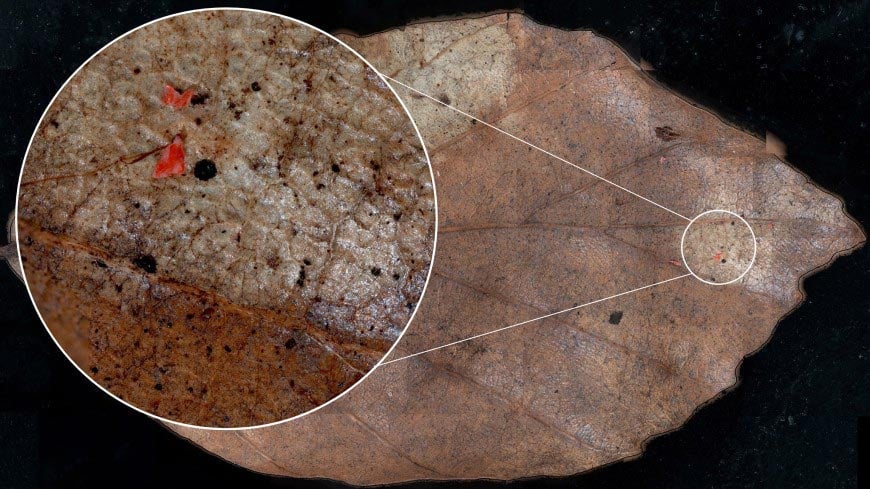
“Our results indicate that microplastics in forest soils originate primarily from atmospheric deposition and from leaves falling to the ground, known as litterfall. Other sources, on the other hand, have only a minor influence,” explains Weber. “We conclude that forests are good indicators of atmospheric microplastic pollution and that a high concentration of microplastics in forest soils indicates a high diffuse input – as opposed to direct input such as from fertilizers in agriculture – of particles from the air into these ecosystems.”
The study is the first to demonstrate the pollution of forests with microplastics and the direct link between atmospheric inputs and the storage of microplastics in forest soil, as these issues had not previously been scientifically investigated. The results provide an important basis for assessing the environmental risks posed by microplastics in the air and soil.
“Forests are already threatened by climate change, and our findings suggest that microplastics could now pose an additional threat to forest ecosystems,” says Weber. The findings may also be relevant for assessing health risks, as they highlight the global transport of microplastics in the air and thus also in the air we breathe.
Reference: “Forest soils accumulate microplastics through atmospheric deposition” by Collin J. Weber and Moritz Bigalke, 26 August 2025, Communications Earth & Environment.
DOI: 10.1038/s43247-025-02712-4
Never miss a breakthrough: Join the SciTechDaily newsletter.
Follow us on Google and Google News.
5 Comments
Get a metal water bottle, fill it at home, and carry it with you.
Take a metal water bottle for pets too. Rig up counterbalancing for ease on bikes and scooters, onewheels etc. Have a hell of a time convincing people you just lift water instead of Ghost and catering metalware.
Micro-plastic and nano-plastic contamination is so widespread as to have become unavoidable, and soils and water are all infused with it, to the point that every Earth-dweller is now part of a non-scientific experiment in how our animal biology is going to be effected long-term. Interrogation of the effects should begin to be done as this condition continues. no one is exempt, alas.
I mean, there’s no IG panel for finding nuclear proteins and stuff misfolded by phase agglomeration of inert-ish microjunk Maybe you could make one for ROS and antioxidants or metabolic matter if you ran a treatment that gets the microplastics eaten somehow to point up any differences?
Unfortunately, the article does not provide us with the consequences of microplastic contamination to the health and wellness of humans other living creatures. It would be beneficial Il to see the dire consequences if not no one will care!!