
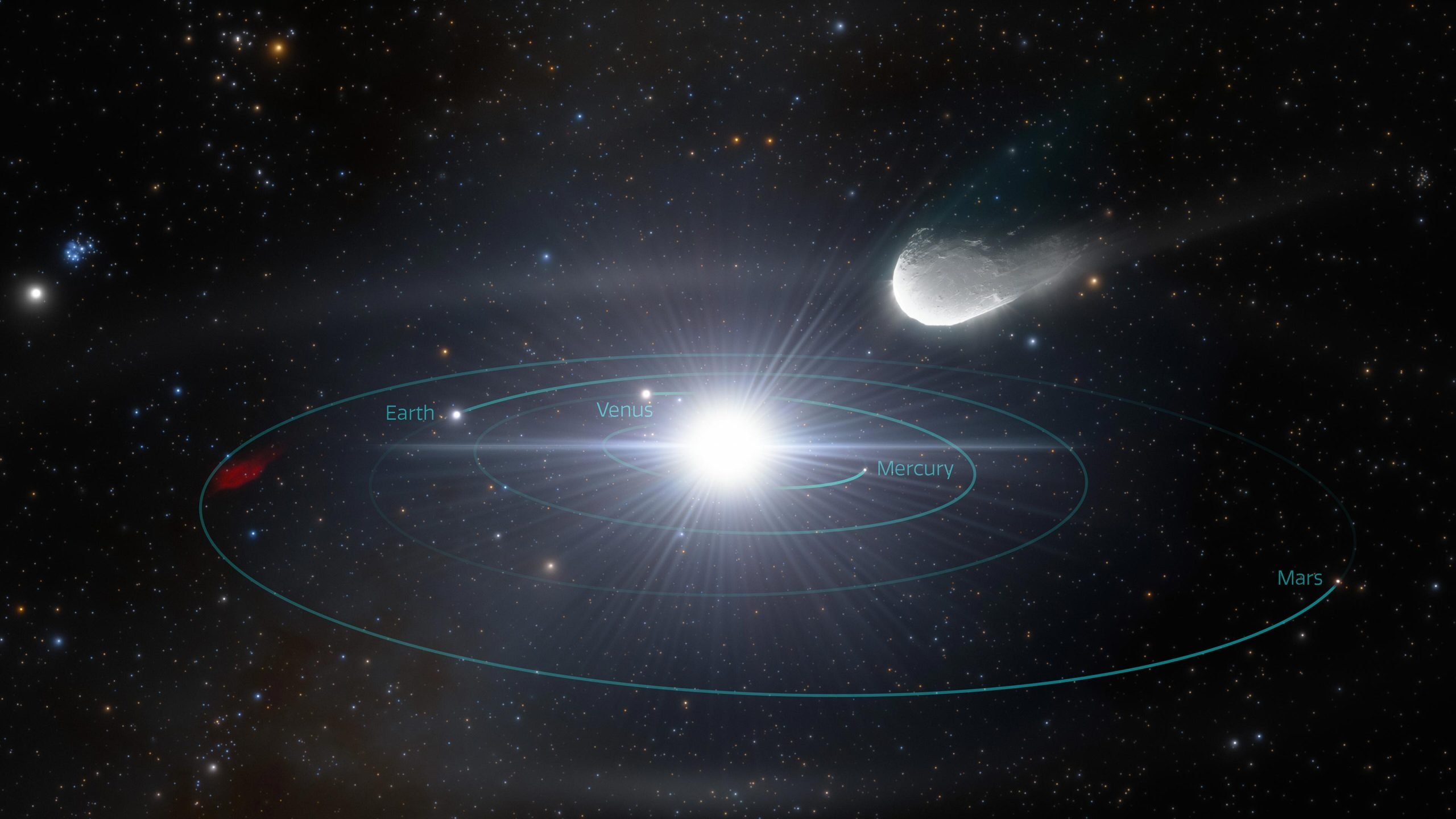
Rubin Observatory/NOIRLab/NSF/AURA/J. daSilva/ M. Zamani
Vera C. Rubin Observatory’s Legacy Survey of Space and Time will revolutionize Solar System science by revealing a population of previously undiscovered interstellar comets and asteroids passing through our cosmic neighborhood
Many as-yet-undiscovered interstellar objects exist throughout our Milky Way Galaxy: comets and asteroids that have been ejected from their home star systems. Some of these objects pass through our Solar System, bringing valuable information about how planetary systems form and evolve. Currently, only two such interstellar visitors have been discovered: 1I/ʻOumuamua and comet 2I/Borisov. Rubin’s upcoming Legacy Survey of Space and Time will show us many more.
Advancing Astronomical Techniques With Rubin Observatory
We’ve learned a lot about the biggest, brightest objects in our Solar System using existing instruments and telescopes. However, astronomers like Michele Bannister, Rutherford Discovery Fellow at the University of Canterbury in Aotearoa New Zealand and member of the Rubin Observatory/LSST Solar System Science Collaboration, want to search deeper, for small, faint bodies that originated in planetary systems far beyond our own. These interstellar objects — which were flung from their home systems into the space between stars — are so faint that they have been virtually undetectable. But with the upcoming Legacy Survey of Space and Time (LSST), conducted with Vera C. Rubin Observatory in Chile, scientists are expecting an explosive period of discovery as these faint objects come into view for the first time.
Rubin Observatory is jointly funded by the National Science Foundation (NSF) and the US Department of Energy (DOE). Rubin is a Program of NSF’s NOIRLab, which, along with SLAC National Accelerator Laboratory, will operate Rubin.
This video shows the paths through our Solar System of the two confirmed interstellar objects, ‘Oumuamua (formally known as 1I/2017 U1), discovered in 2017, and the comet 2I/Borisov, discovered in 2019. The paths of these objects are markedly different than the orbits of objects in our Solar System, making them easy to differentiate as interstellar objects. Rubin Observatory and the Legacy Survey of Space and Time will provide data that enables scientists to identify many interstellar objects early in the survey. Credit: Rubin Observatory/NSF/AURA/J. Pinto
Understanding Our Cosmic Origins
The origins of our Solar System lay in a massive swirling cloud of gas and dust that collapsed to form new stars, one of which was our Sun. The stars gobbled up most of the cosmic ingredients, but around each star the remainder formed the small building blocks of planets — called planetesimals — ranging from tens of meters to a few kilometers in size. Some of these coalesced into planets and their moons and rings, but trillions of leftover planetesimals continued to orbit their host stars.
With the aid of observations of our Solar System and computer simulations, scientists speculate that the gravity of larger planets and passing nearby stars often launches most of these remnant planetesimals away from their home systems and out into their galaxies. Traveling through space and not bound to any star, they’re now known as interstellar objects.
The Messenger Role of Interstellar Objects
“Planetary systems are a place of change and growth, of sculpting and reshaping,” said Bannister. “And planets are like active correspondents in that they can move trillions of little tiny planetesimals out into galactic space.”
If planets are the correspondents, interstellar objects are the telegrams containing valuable information about distant planetary systems and how they formed. And for a short time, some of these messages from afar are right in our cosmic backyard. “A rock from another solar system is a direct probe of how planetesimal formation took place at another star,” said Bannister, “so to actually have them come to us is pretty neat.”
Though astronomers think many interstellar objects exist, and likely pass through our Solar System on a regular basis, only two have been confirmed: ʻOumuamua in 2017 (also known as 1I/2017 U1), and the comet 2I/Borisov in 2019. These were discovered thanks to great timing, a lot of effort, and a little luck — these small, faint interstellar travelers are only visible when they’re close enough to see, and when our telescopes are pointing in the right place at the right time.
Enhancing Detection With Rubin Observatory
“We calculate that there are a whole lot of these little worlds in our Solar System right now,” said Bannister. “We just can’t find them yet because we aren’t seeing faint enough.”
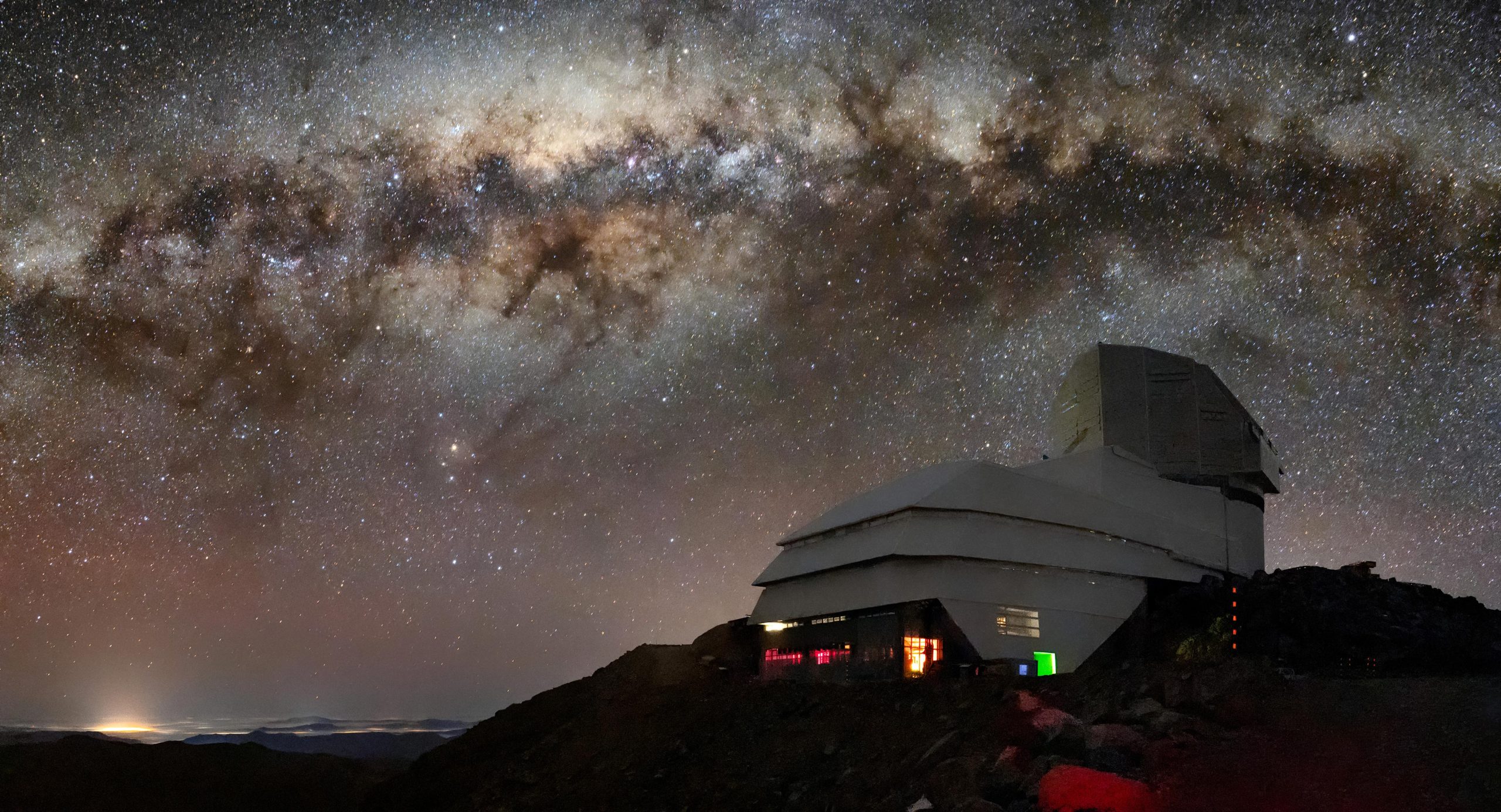
Rubin Observatory will change that. Using an 8.4-meter telescope equipped with the highest-resolution digital camera in the world, Rubin will detect fainter interstellar objects than we’ve ever seen before. “It’s as though you suddenly go from being on a little boat bobbing around in the beautiful shallows just off the shore, to now you’re out over the big deep ocean and you can see into all that expanse for the first time,” said Bannister.
Additionally, Rubin’s fast-moving telescope can scan the entire visible sky every few nights, capturing a timelapse view of interstellar objects on their fast journeys through our Solar System.
Predicting Future Discoveries
While we call both ‘Omuamua and 2I/Borisov interstellar objects, they differ in just about every way we can measure. What will the third, or the twentieth, interstellar object look like? Within the first year of Rubin Observatory’s 10-year LSST, scheduled to begin in 2025, scientists expect to get a good idea. “We’re going to go from a study of two individual objects to a population study of at least dozens,” Bannister said. As interstellar objects could come from stars all across the Milky Way, this increase will allow scientists to directly study how planetary systems form at distant stars throughout our galaxy’s history — including at ancient stars that no longer exist.
For now, scientists can only make loose predictions of how many interstellar objects Rubin will reveal. Bannister playfully places her bet on 21, but says we really have no idea yet. Whatever the outcome, Rubin is poised to revolutionize Solar System studies — along with many other areas of astronomy and astrophysics. “It’s going to be one of the gifts that Rubin provides,” she said, “a new history of the Solar System and a greater understanding of where we come from.”
Never miss a breakthrough: Join the SciTechDaily newsletter.
Follow us on Google and Google News.