
Close Menu
    Facebook X (Twitter) Instagram
    SciTechDaily
    • Biology
    • Chemistry
    • Earth
    • Health
    • Physics
    • Science
    • Space
    • Technology
    Facebook X (Twitter) Pinterest YouTube RSS
    SciTechDaily
    Home»Science»How Homo Erectus Mastered Desert Survival Over a Million Years Ago
    Science

    How Homo Erectus Mastered Desert Survival Over a Million Years Ago

    By SpringerJanuary 16, 20251 Comment3 Mins Read
    Facebook Twitter Pinterest Telegram LinkedIn WhatsApp Email Reddit
    Share
    Facebook Twitter LinkedIn Pinterest Telegram Email Reddit
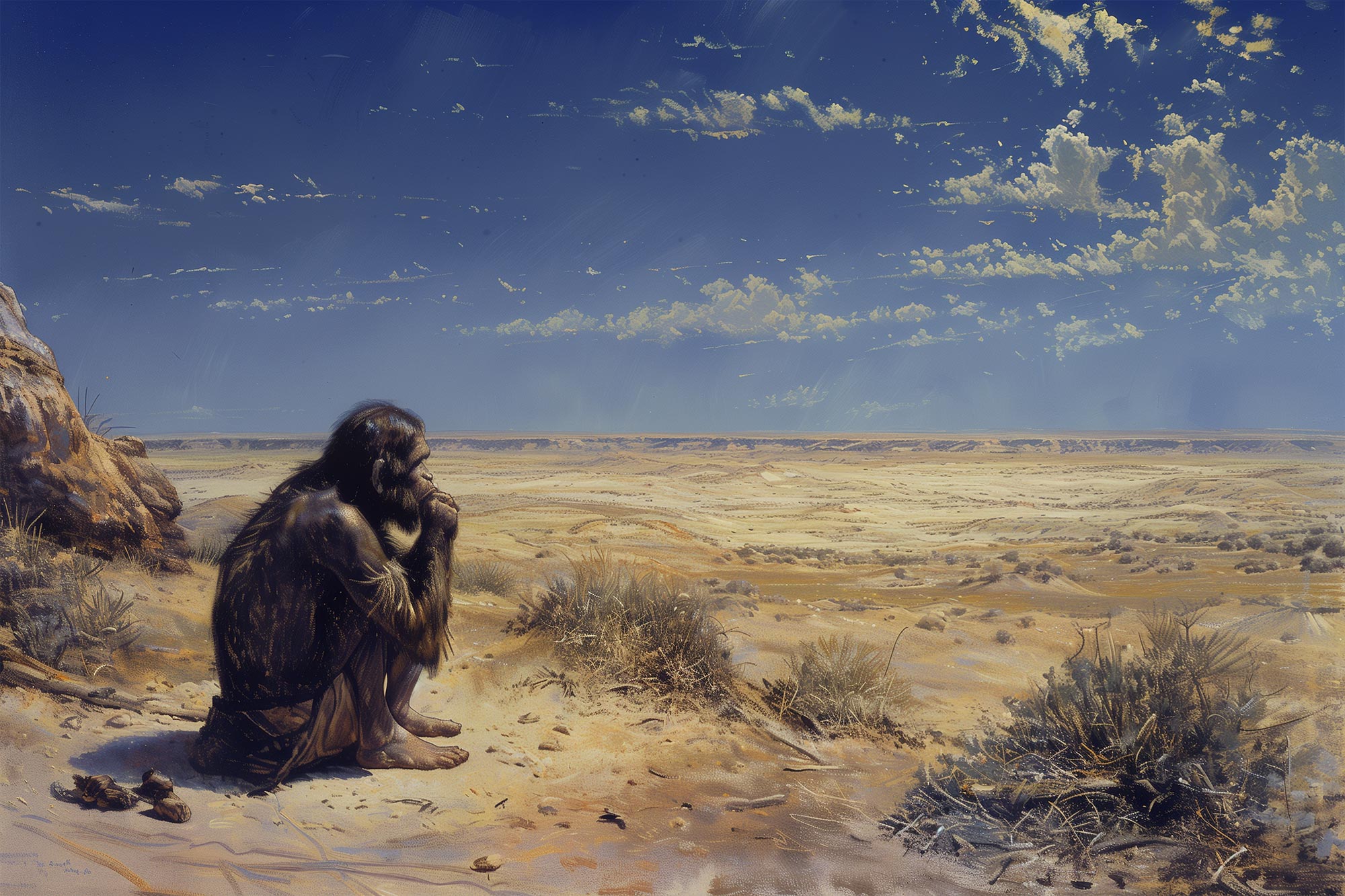
    Early Humans Desert Art
    New evidence reveals that Homo erectus could survive in extreme environments like deserts over 1.2 million years ago, challenging the notion that only Homo sapiens were so adaptable. Credit: SciTechDaily.com

    Over a million years ago, Homo erectus demonstrated remarkable adaptability by thriving in harsh desert environments, contradicting previous beliefs that only Homo sapiens could manage such feats.

    Researchers at Oldupai Gorge, Tanzania, uncovered evidence of this early human’s ability to repeatedly utilize specific freshwater sources and develop specialized tools for survival.

    Early Adaptability of Homo Erectus

    Homo erectus demonstrated the ability to survive in desert-like environments as far back as 1.2 million years ago, according to a study published today (January 16) in Communications Earth & Environment. Researchers found evidence that these early humans repeatedly returned to specific rivers and ponds for freshwater over thousands of years and developed specialized tools to support their survival. This adaptability may have played a crucial role in the species’ geographic expansion.

    The question of when early humans first adapted to extreme environments, such as deserts or rainforests, has long been debated. Previous studies often concluded that only Homo sapiens possessed the capability to thrive in such challenging conditions.

    Stone Tools From Engaji Nanyori.
    Selected stone tools from Engaji Nanyori. Credit: Julio Mercader

    Archaeological Findings at Oldupai Gorge

    Julio Mercader, Paul Durkin, and colleagues collected archaeological, geological, and palaeoclimatic data at Engaji Nanyori in Oldupai Gorge, Tanzania — a key early hominin archaeological site. The authors report that between approximately 1.2 million and 1 million years ago, semi-desert conditions persisted in the area with characteristic plant life evident. The archaeological data suggests that groups of H. erectus in the area adapted to the conditions over the period by repeatedly returning to live in locations with freshwater availability such as ponds, and developing specialized stone tools such as scrapers and notched tools (known as denticulates), which the authors suggest were probably used to increase the efficiency of butchery.

    The authors suggest that, together, these findings demonstrate that H. erectus had a much greater adaptability to survive in extreme environments than was previously thought. The authors conclude that their results contradict previous hypotheses that only H. sapiens could adapt to extreme ecosystems, and that H. erectus may have been a generalist species able to survive in a variety of landscapes in Africa and Eurasia.

    Reference: “Homo erectus adapted to steppe-desert climate extremes one million years ago” by Julio Mercader, Pamela Akuku, Nicole Boivin, Alfredo Camacho, Tristan Carter, Siobhán Clarke, Arturo Cueva Temprana, Julien Favreau, Jennifer Galloway, Raquel Hernando, Haiping Huang, Stephen Hubbard, Jed O. Kaplan, Steve Larter, Stephen Magohe, Abdallah Mohamed, Aloyce Mwambwiga, Ayoola Oladele, Michael Petraglia, Patrick Roberts, Palmira Saladié, Abel Shikoni, Renzo Silva, María Soto, Dominica Stricklin, Degsew Z. Mekonnen, Wenran Zhao and Paul Durkin, 16 January 2025, Communications Earth & Environment.
    DOI: 10.1038/s43247-024-01919-1

    Never miss a breakthrough: Join the SciTechDaily newsletter.
    Follow us on Google and Google News.

    Anthropology Archaeology Ecology Evolution Hominin Homo Erectus Popular Springer
    Share. Facebook Twitter Pinterest LinkedIn Email Reddit

    Related Articles

    Desert Pioneers: How Homo Erectus Mastered Arid Africa Millions of Years Ago

    “Meat Made Us Human” Evolutionary Narrative Starts To Unravel

    Defining Moment in Human Evolution: Turbulent Era Sparked Leap in Human Behavior, Technology 320,000 Years Ago

    Neandertals Dove Underwater to Collect Clam Shells to Use as Tools

    Earliest Interbreeding Between Ancient Human Populations Discovered – Evolutionary Puzzle Solved

    What Caused Neanderthal Extinction and Were Our Human Ancestors to Blame?

    New Evidence Shows Humans Mastered Fire Earlier Than Thought

    400,000 Year Old Fossil Helps Shed New Light on Human Evolution

    Million-Year-Old Ash in South African Cave Yields Evidence of Cooking

    1 Comment

    1. Rob on January 17, 2025 11:21 pm

      H erectus was, to date, the most successful hominim on Earth. It was in Indonesia 100 000 years ago, so one may assume that it could stay afloat, however it did that; and thus one might wonder if it had got to Australia at some time in the past.

      Reply
    Leave A Reply Cancel Reply

    • Facebook
    • Twitter
    • Pinterest
    • YouTube

    Don't Miss a Discovery

    Subscribe for the Latest in Science & Tech!

    Trending News

    AI Could Detect Early Signs of Alzheimer’s in Under a Minute – Far Before Traditional Tests

    What if Dark Matter Has Two Forms? Bold New Hypothesis Could Explain a Cosmic Mystery

    This Metal Melts in Your Hand – and Scientists Just Discovered Something Strange

    Beef vs. Chicken: Surprising Results From New Prediabetes Study

    Alzheimer’s Breakthrough: Scientists Discover Key Protein May Prevent Toxic Protein Clumps in the Brain

    Quantum Reality Gets Stranger: Physicists Put a Lump of Metal in Two Places at Once

    Scientists May Have Found the Key to Jupiter and Saturn’s Moon Mystery

    Scientists Uncover Brain Changes That Link Pain to Depression

    Follow SciTechDaily
    • Facebook
    • Twitter
    • YouTube
    • Pinterest
    • Newsletter
    • RSS
    SciTech News
    • Biology News
    • Chemistry News
    • Earth News
    • Health News
    • Physics News
    • Science News
    • Space News
    • Technology News
    Recent Posts
    • What if Your Memories Never Happened? Physicists Take a New Look at the Boltzmann Brain Paradox
    • Students Found an Ancient Star That Shouldn’t Be in the Milky Way
    • Astronomers Solve 50-Year Mystery and Reveal Hidden Culprit Behind Strange X-Ray Emissions
    • One of the Universe’s Largest Stars May Be Getting Ready To Explode
    • Scientists Discover Enzyme That Could Supercharge Ozempic-Like Weight Loss Drugs
    Copyright © 1998 - 2026 SciTechDaily. All Rights Reserved.
    • Science News
    • About
    • Contact
    • Editorial Board
    • Privacy Policy
    • Terms of Use

    Type above and press Enter to search. Press Esc to cancel.