
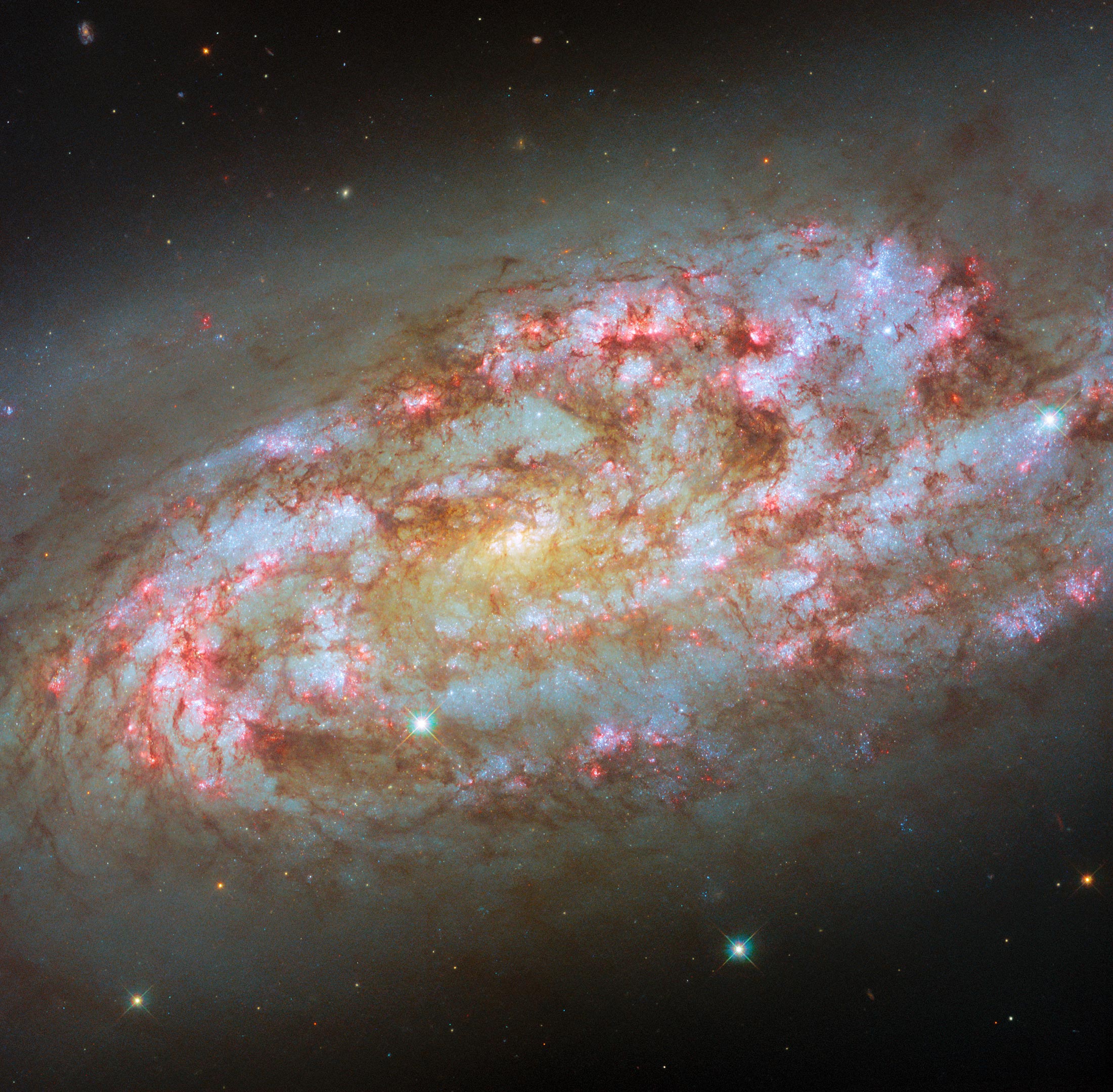
Hubble reveals a chaotic spiral galaxy whose close encounter with a neighbor has ignited a spectacular burst of star birth.
This Hubble Picture of the Week spotlights a restless and energetic spiral galaxy known as NGC 1792. This galaxy lies more than 50 million light-years away from Earth in the constellation Columba (the Dove), a small grouping of stars in the southern sky. At first glance, NGC 1792 looks unbalanced. Its bright central region does not sit neatly in the middle, and instead appears offset from its loosely wound spiral arms. These arms have a flocculent appearance, meaning they look patchy and clumpy rather than forming a clean, symmetrical spiral. This uneven structure gives the galaxy a sparkling, almost chaotic look.
Spiral galaxies like NGC 1792 are common in the universe and include our own Milky Way. They are defined by rotating disks of stars, gas, and dust that form sweeping arms around a central core. In this case, the unusual structure hints that powerful forces are shaping the galaxy from within and beyond.
A Starburst Galaxy Fueled by Gravity
NGC 1792 draws special attention from astronomers because it is classified as a starburst galaxy. This term refers to a galaxy that is forming new stars at an exceptionally high rate compared to its size. In NGC 1792, the spiral arms are packed with regions where dense clouds of gas are collapsing to form new stars. Despite having a relatively modest mass, the galaxy shines brightly, a sign that intense star formation is underway.
One reason for this stellar boom is its close relationship with a neighboring galaxy called NGC 1808, which is larger and more massive. The strong gravitational pull between the two galaxies disturbs NGC 1792, stirring up its reservoirs of gas. When gas is compressed by gravity, it becomes more likely to collapse and form stars. Much of this activity is concentrated on the side of the galaxy closest to its neighbor, where gravitational forces are strongest. Because of this, NGC 1792 offers astronomers a valuable opportunity to study how gas, star clusters, and exploding stars called supernovae interact inside galaxies.
A Deeper Look With New Hubble Data
Hubble previously captured images of NGC 1792 in 2020, but the latest view goes further. The new image combines earlier observations with additional data collected throughout 2025, allowing scientists to see deeper into the galaxy and better understand the violent processes shaping it.
One of the most striking features in the image is the presence of glowing red regions scattered along the spiral arms. These bright patches come from what astronomers call H-alpha emission. This light is produced when energetic young stars emit strong ultraviolet radiation that strips electrons from surrounding hydrogen gas. As the electrons recombine with the hydrogen atoms, the gas emits a specific red wavelength of light — a tell-tale sign of new stars. These glowing regions act like cosmic signposts, revealing where stars are being born and highlighting the intense activity that makes NGC 1792 such a fascinating target for study.
Never miss a breakthrough: Join the SciTechDaily newsletter.
Follow us on Google and Google News.
1 Comment
What a universe we live in. I’m glad I lived long enough to see these long-distance beauties.