

NGC 1559, a distant barred spiral galaxy, is beautifully captured in a composite image by the Hubble Space Telescope.
This image, derived from ten separate photos, reveals areas of active star formation through the glow of H-alpha light, vividly showing where new stars are being born within its spiral arms.
The magnificent galaxy featured in this stunning Hubble Picture of the Week is NGC 1559. It is a barred spiral galaxy located in the constellation Reticulum near the Large Magellanic Cloud, but much more distant at approximately 35 million light-years from Earth. Hubble last visited this object in 2018. The brilliant light captured in this image offers a wealth of information, which thanks to Hubble can be put to use by both scientists and the public.
Capturing NGC 1559 Through Hubble’s Lens
This picture is composed of a whopping ten different images taken by the Hubble Space Telescope, each filtered to collect light from a specific wavelength or range of wavelengths. It spans Hubble’s sensitivity to light, from ultraviolet at around 275 nanometers through blue, green, and red to near-infrared at 1600 nanometres.
This allows information about many different astrophysical processes in the galaxy to be recorded: a notable example is the red 656-nanometre filter used here. Hydrogen atoms that get ionized can emit light at this particular wavelength, called H-alpha emission.
New stars forming in a molecular cloud, made mostly of hydrogen gas, emit copious amounts of ultraviolet light which is absorbed by the cloud, but which ionizes it and causes it to glow with this H-alpha light. Therefore, filtering to detect only this light provides a reliable means to detect areas of star formation (called H II regions), shown in this image by the bright red and pink colors of the blossoming patches filling NGC 1559’s spiral arms.
Collaborative Astronomical Efforts
These ten images come from six different observing programs with Hubble, running from 2009 all the way up to the present year. These programs were led by teams of astronomers from around the world with a variety of scientific goals, ranging from studying ionized gas and star formation, to following up on a supernova, to tracking variable stars as a contribution to calculating the Hubble constant.
The data from all of these observations live on in the Hubble archive, available for anyone to use — not only for new science, but also to create spectacular images like this one! This image of NGC 1559, then, is a reminder of the incredible opportunities that the Hubble Space Telescope has provided and continues to provide.
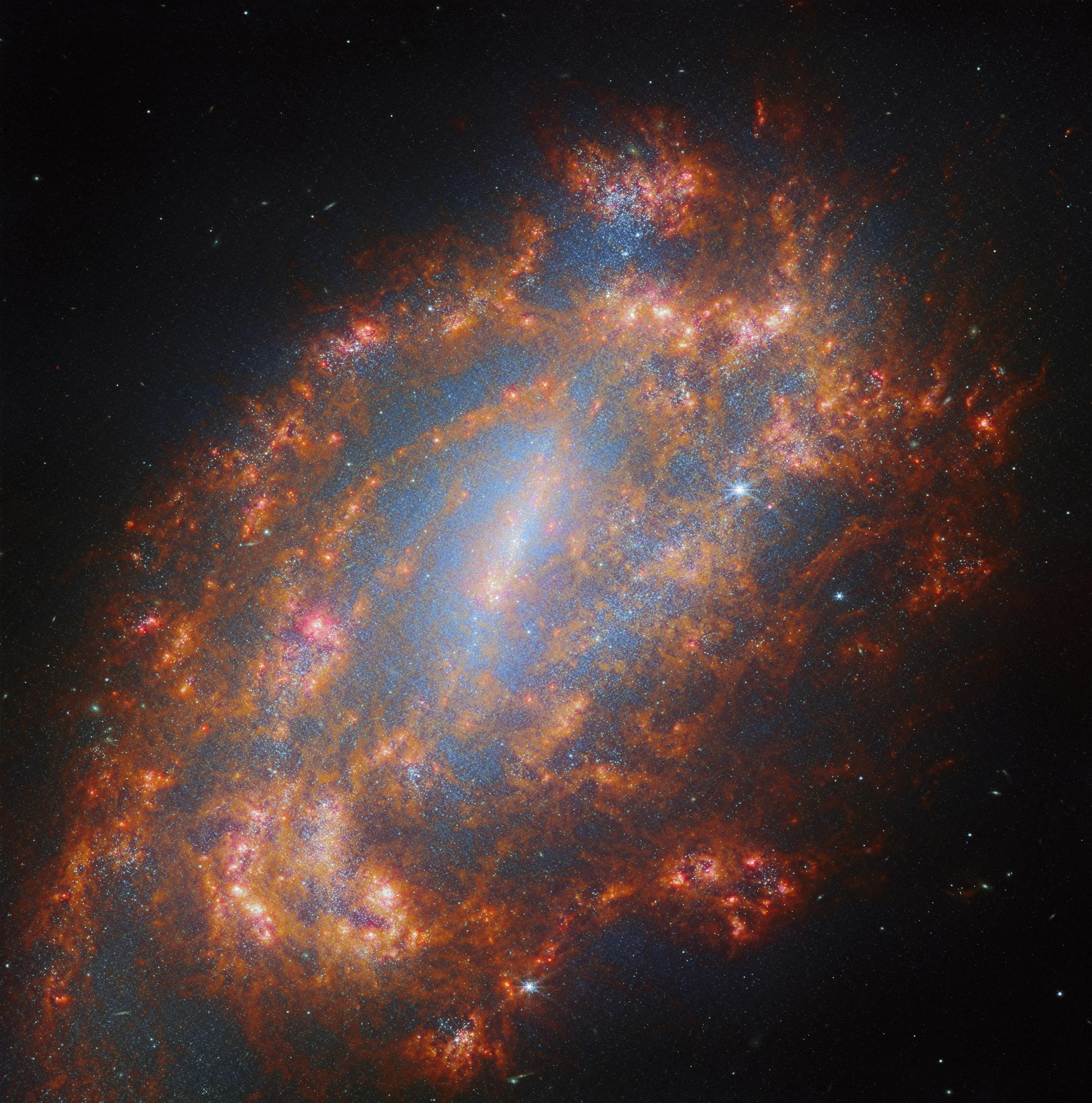
Advancements With James Webb Space Telescope
Besides Hubble’s observations, astronomers are using the NASA/ESA/CSA James Webb Space Telescope to research this galaxy in even greater depth. This Webb image (above) showcases the galaxy in near- and mid-infrared light.
Never miss a breakthrough: Join the SciTechDaily newsletter.
Follow us on Google and Google News.
3 Comments
Simply AMAZING !!
THANK YOU !
How many years have the galaxies been formed in the galaxy? It has been trillions of years since the galaxies were formed. I calculated that the age of the largest star in the Milky Way is at least ten trillion years. Calculate, if a star has a diameter of 3 billion kilometers, how many more years will the largest star live? The diameter of the star is 3 billion kilometers, almost two billion miles
Ahem, the universe is only 14.5 billion years old. Not trillions.