
Close Menu
    Facebook X (Twitter) Instagram
    SciTechDaily
    • Biology
    • Chemistry
    • Earth
    • Health
    • Physics
    • Science
    • Space
    • Technology
    Facebook X (Twitter) Pinterest YouTube RSS
    SciTechDaily
    Home»Space»Hubble Image of NGC 5806 with a Supernova Explosion
    Space

    Hubble Image of NGC 5806 with a Supernova Explosion

    By NASASeptember 3, 2012No Comments3 Mins Read
    Facebook Twitter Pinterest Telegram LinkedIn WhatsApp Email Reddit
    Share
    Facebook Twitter LinkedIn Pinterest Telegram Email Reddit
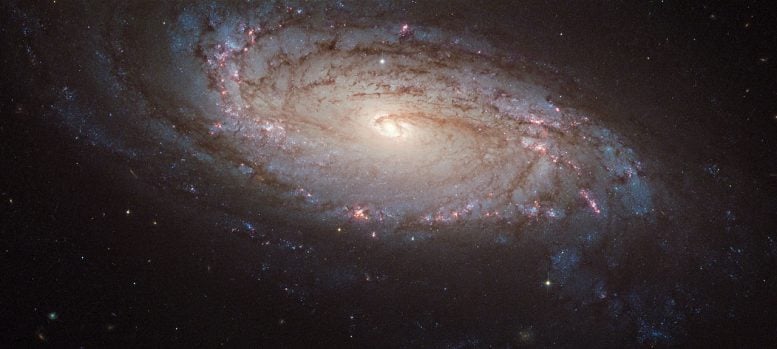
    spiral galaxy NGC 5806
    NGC 5806 is a spiral galaxy located in the constellation Virgo (the Virgin), approximately 80 million light-years away from Earth. Credit: ESA/NASA, Acknowledgment: Andre van der Hoeven

    This Hubble image shows spiral galaxy NGC 5806, which is located in the constellation Virgo roughly 80 million light years from Earth, and a supernova explosion called SN 2004dg.

    A new image from the NASA/ESA Hubble Space Telescope shows NGC 5806, a spiral galaxy in the constellation Virgo (the Virgin). It lies around 80 million light-years from Earth. Also visible in this image is a supernova explosion called SN 2004dg.

    The exposures that are combined into this image were carried out in early 2005 in order to help pinpoint the location of the supernova, which exploded in 2004. The afterglow from this outburst of light, caused by a giant star exploding at the end of its life, can be seen as a faint yellowish dot near the bottom of the galaxy.

    NGC 5806 was chosen to be one of a number of galaxies in a study into supernovae because Hubble’s archive already contained high-resolution imagery of the galaxy, collected before the star had exploded. Since supernovae are both relatively rare, and impossible to predict with any accuracy, the existence of such before-and-after images is precious for astronomers who study these violent events.

    Aside from the supernova, NGC 5806 is a relatively unremarkable galaxy: it is neither particularly large or small, nor especially close or distant.

    The galaxy’s bulge (the densest part in the center of the spiral arms) is a so-called disk-type bulge, in which the spiral structure extends right to the center of the galaxy, instead of there being a large elliptical bulge of stars present. It is also home to an active galaxy nucleus, a supermassive black hole that is pulling in large amounts of matter from its immediate surroundings. As the matter spirals around the black hole, it heats up and emits powerful radiation.

    This image is produced from three exposures in visible and infrared light, observed by Hubble’s Advanced Camera for Surveys. The field of view is approximately 3.3 by 1.7 arcminutes.

    A version of this image was entered into the Hubble’s Hidden Treasures Image Processing Competition by contestant Andre van der Hoeven (who won second prize in the competition for his image of Messier 77). Hidden Treasures is an initiative to invite astronomy enthusiasts to search the Hubble archive for stunning images that have never been seen by the general public. The competition has now closed.

    Never miss a breakthrough: Join the SciTechDaily newsletter.
    Follow us on Google and Google News.

    Astronomy Hubble Space Telescope NASA Popular
    Share. Facebook Twitter Pinterest LinkedIn Email Reddit

    Related Articles

    The Great Escape: NASA’s Hubble and MAVEN Help Solve Mystery of Mars’ Vanishing Water

    Webb and Hubble Unite: A Breathtaking 3D Journey Through the Pillars of Creation

    Stellar Sleuths: Citizen Scientists and AI Uncover Hidden Asteroids With Hubble

    Stellar Fireworks: Hubble Revisits a Strange Star’s 40-Year Nova Mystery

    Cosmic Geode: Hubble Captures the Birth of a Sun-like Star

    Hubble Celebrates 34th Anniversary With a Spectacular View of the Little Dumbbell Nebula

    Jupiter Unveiled: Hubble Captures the Giant’s Roaring Storms and Volcanic Moon Io

    Galaxies Collide, Stars Awaken: Hubble’s Stunning Revelation

    Hubble Spots Water Vapor in Small Exoplanet’s Atmosphere

    Leave A Reply Cancel Reply

    • Facebook
    • Twitter
    • Pinterest
    • YouTube

    Don't Miss a Discovery

    Subscribe for the Latest in Science & Tech!

    Trending News

    Scientists May Have Found the Key to Jupiter and Saturn’s Moon Mystery

    Scientists Uncover Brain Changes That Link Pain to Depression

    Saunas May Do More Than Raise Body Temperature – They Activate Your Immune System

    Exercise in a Pill? Metformin Shows Surprising Effects in Cancer Patients

    Hidden Oceans of Magma Could Be Protecting Alien Life

    New Study Challenges Alzheimer’s Theories: It’s Not Just About Plaques

    Artificial Sweeteners May Harm Future Generations, Study Suggests

    Splashdown! NASA Artemis II Returns From Record-Breaking Moon Mission

    Follow SciTechDaily
    • Facebook
    • Twitter
    • YouTube
    • Pinterest
    • Newsletter
    • RSS
    SciTech News
    • Biology News
    • Chemistry News
    • Earth News
    • Health News
    • Physics News
    • Science News
    • Space News
    • Technology News
    Recent Posts
    • Ancient “Rock” Microbes May Reveal How Complex Life Began
    • Hidden “Trade Winds” Inside Cells Could Explain Cancer Spread
    • Humans Owe Their Eyes to a Tiny One-Eyed “Cyclops”
    • Researchers Capture Quantum Interference in One of Nature’s Rarest Atoms
    • Ancient DNA Reveals Irish Goats Have a 3,000-Year-Old Lineage Still Alive Today
    Copyright © 1998 - 2026 SciTechDaily. All Rights Reserved.
    • Science News
    • About
    • Contact
    • Editorial Board
    • Privacy Policy
    • Terms of Use

    Type above and press Enter to search. Press Esc to cancel.