
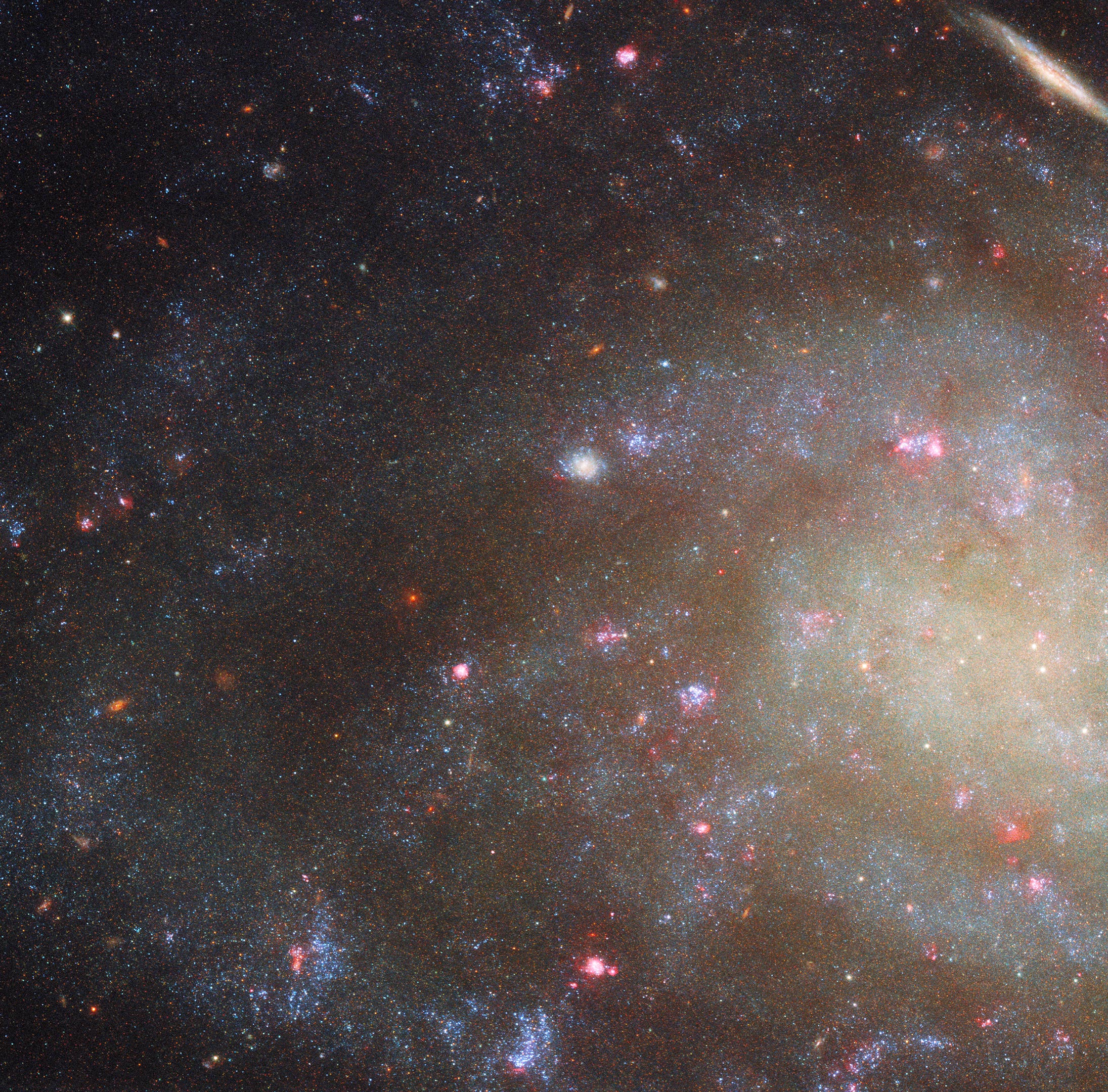
Hubble’s sharp gaze reveals NGC 45’s feathery arms and glowing star-forming regions. Far from an ordinary spiral, it’s a rare low surface brightness galaxy—massive in gas and dark matter but dim in starlight.
Stunning View of NGC 45’s Spiral Arms
The latest Hubble Space Telescope Picture of the Week offers a detailed look at the delicate, feather-like spiral arms of NGC 45, a galaxy located about 22 million light-years from Earth in the constellation Cetus (The Whale).
To create this striking image, astronomers combined observations from two related research programs. The first surveyed 50 nearby galaxies, using Hubble’s ability to capture light from the ultraviolet through the near-infrared spectrum to investigate how stars are born in these systems. The second focused on many of the same galaxies, but zeroed in on a specific red wavelength known as H-alpha. This type of light is strongly emitted by star-forming nebulae, and in NGC 45 several of these regions can be spotted by their vivid pinkish-red glow.
Probing Galaxies of All Shapes and Sizes
These observing programs aimed to study star formation in galaxies of different sizes, structures, and degrees of isolation, and NGC 45 makes for a particularly interesting target. Though it may appear to be a regular spiral galaxy, NGC 45 is actually a remarkable type called a low surface brightness galaxy.
Low surface brightness galaxies are fainter than the night sky itself, making them incredibly difficult to detect. They appear unexpectedly faint because they have relatively few stars for the amount of gas and dark matter they carry. In the decades since the first low surface brightness galaxy was serendipitously discovered in 1986, researchers have learned that 30–60% of all galaxies may fall into this category. Studying these hard-to-detect galaxies is key to understanding how galaxies form and evolve, and Hubble’s sensitive instruments are equal to the task.
Never miss a breakthrough: Join the SciTechDaily newsletter.
Follow us on Google and Google News.
1 Comment
Note 2508120228_Source1.Reinterpreting [】
Source 1.
https://scitechdaily.com/hubble-just-found-a-galaxy-fainter-than-the-night-sky/
1.
Hubble, I found a galaxy fainter than the night sky.
ESA/Hubble Presented August 11, 2025
The latest images from Hubble captured the delicate spiral arm of the galaxy NGC 45, 22 million light-years away from Cetacea.
1-1.
Hubble’s keen observations reveal the feathery arms and glowing star-forming regions of NGC 45. Far from a normal spiral galaxy, it is a rare galaxy with low surface brightness. The gas and dark matter are enormous, but the starlight is faint.
>>>>>><<<>>>>><<<<^!^
^Lightness is the intensity of light emitted in a given area and direction. Typically, brightness is described as the intensity of light emitted from a light source.
^ This is as if the low-surface high-brightness galaxy msbase is becoming qpeoms…(*new).
^So a low-surface, high-brightness galaxy that becomes a unit? That's possible! Where there are few people, just like naturalization goes on…
^The life of apartments in modern cities, which left modern civilizations homeless, was eventually like a commodity product in artificial structures that lived in unnatural high-surface low-brightness,
^The future lives are becoming lonely individualized and high-brightness particles trapped in wide and deeply dispersed unitized and unnatural structures. Uh-huh.
^Philosophically, the future people are living in an unnaturalized civilized world, msoss, with broad sides
^It eventually returns to the process of natural unitization qpeoms. Huh.
-^Studying such hard-to-observe galaxies is essential for understanding human civilization or the formation and evolution of galaxies, and Hubble's high-sensitivity observational instrument is fully capable of this task.