
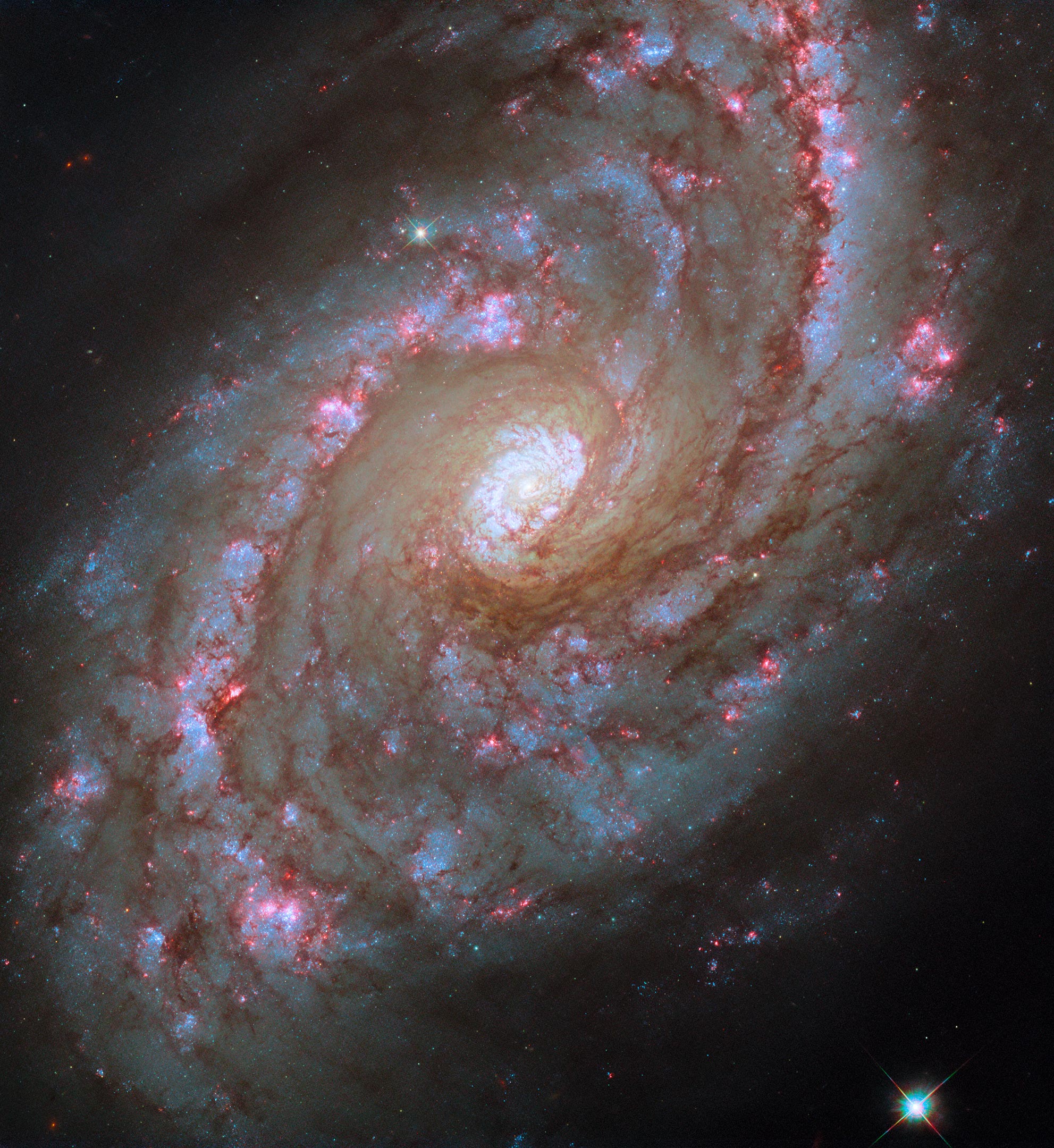
NGC 5248, a spiral galaxy located 42 million light-years away in the constellation Boötes and known as Caldwell 45, showcases a stunning structure with grand design spiral arms and a central bar.
Its intricate gas flows fuel star formation across the galaxy, especially in its dual nuclear rings, making it a fascinating subject for astronomers.
This breathtaking image captured by the Hubble Space Telescope showcases the spiral galaxy NGC 5248, situated 42 million light-years away in the constellation Boötes. Also known as Caldwell 45, this galaxy is listed in a catalog of visually striking celestial objects that, although recognized, are less frequently observed by amateur astronomers compared to the more renowned Messier objects.
NGC 5248 is one of the so-called ‘grand design’ spirals, with prominent spiral arms that reach from near the core out through the disc. It also has a faint bar structure in the center, between the inner ends of the spiral arms, which is not quite so obvious in this visible-light portrait from Hubble. Features like these which break the rotational symmetry of a galaxy have a huge influence on how matter moves through it, and eventually its evolution through time. They feed gas from a galaxy’s outer reaches to inner star-forming regions, and even to a galaxy’s central black hole where it can kick-start an active galactic nucleus.
These flows of gas have shaped NGC 5248 in a big way; it has many bright ‘starburst regions’ of intense star formation spread across its disc, and it is dominated by a population of young stars. The galaxy even has two very active, ring-shaped starburst regions around its nucleus, filled with young clusters of stars. These ‘nuclear rings’ are remarkable enough, but normally a nuclear ring tends to block gas from getting further into the core of a galaxy. NGC 5248 having a second ring inside the first is a marker of just how forceful its flows of matter and energy are! Its relatively nearby, highly visible starburst regions make the galaxy a target for professional and amateur astronomers alike.
Never miss a breakthrough: Join the SciTechDaily newsletter.
Follow us on Google and Google News.
1 Comment
Topological vortices and their fractal structures are the foundation of the motion and evolution of cosmic matter.
When physics uses imagined things as the Formal Base and Evidential Base for research. What is the difference between physics and religion?
Please ask researchers to think deeply:
1. What is the difference between imagined particles and imagined God?
2. What are you exploring and searching for?
3. What does the physical phenomenon you observed explain?
4. What is the dirtiness and ugliness in academic activities?
and so on.
Scientific research guided by correct theories can help people avoid detours, failures, and exaggeration. The physical phenomena observed by researchers in experiments are always appearances, never the natural essence of things. The natural essence of things needs to be extracted and sublimated based on mathematical theories via appearances , rather than being imagined arbitrarily.
Everytime scientific revolution, the scientific research space brought by the new paradigm expands exponentially. Physics should not ignore the analyzable physical properties of topological vortices.
(1) Traditional physics: based on mathematical formalism, experimental verification and arbitrary imagination.
(2) Topological Vortex Theory: Although also based on mathematics (such as topology), it focuses more on non intuitive geometry and topological structures, challenging traditional physical intuition.
Extension of the Standard Model: Topological Vortex Theory points out the limitations of the Standard Model in describing the large-scale structure of the universe, proposes the need to consider non-standard model components such as dark matter and dark energy, and suggests that topological vortex fields may be key to understanding these phenomena.
Topological vortex theory heralds innovative technologies such as topological electronics, topological smart batteries, topological quantum computing, etc., which may bring low-energy electronic components, almost inexhaustible currents, and revolutionary computing platforms, etc.
Topology tells us that topological vortices and antivortices can form new spacetime structures via the synchronous effect of superposition, deflection, or twisting of them. In fact, mathematics does not tell us that there must be God particles, ghost particles, fermions, or bosons present. When physics and mathematics diverge, arbitrary imagination will make physics no different from theology. Topological vortex research reflections on the philosophy and methodology of science help us understand the nature essence of science and the limitations of scientific methods. This not only has guiding significance for scientific research itself, but also has important implications for science education and popularization.
Today, so-called official (such as PRL, Nature, Science, PNAS, etc.) in physics stubbornly believes that two sets of cobalt-60 rotating in opposite directions can become two sets of objects that mirror each other, is a typical case that pseudoscience is rampant and domineering. Please witness the exemplary collaboration between theoretical physicists and experimentalists (https://scitechdaily.com/microscope-spacecrafts-most-precise-test-of-key-component-of-the-theory-of-general-relativity/#comment-854286). Let us continue to witness together the dirtiest and ugliest era in the scientific and humanistic history of human society. The laws of nature will not change due to misleading of so-called academic publications.