
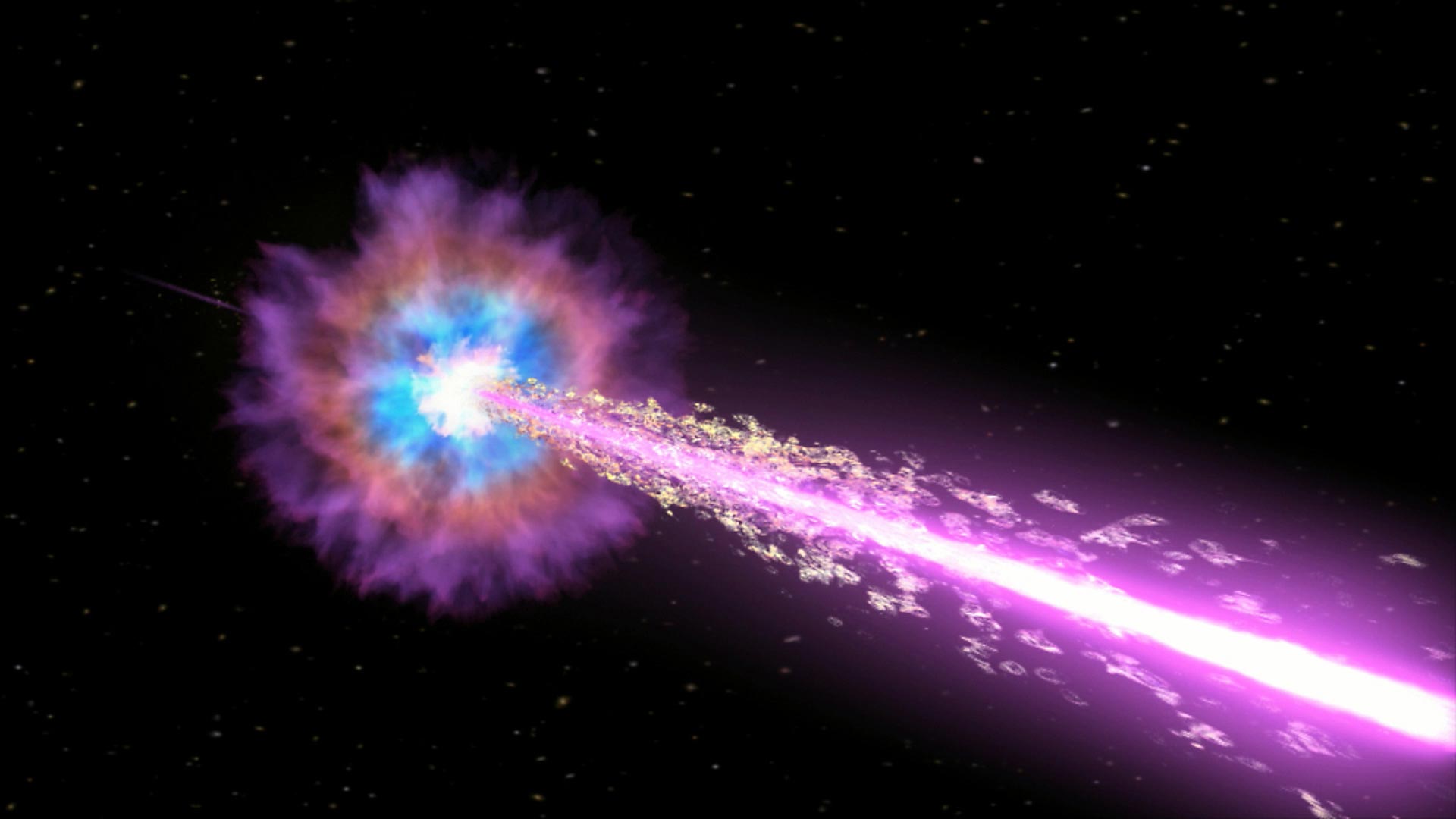
An international team has cataloged over 500 gamma-ray bursts (GRBs), rivaling the historical deep-sky catalog by Charles Messier.
GRBs, the universe’s most potent explosions, could potentially disrupt Earth’s atmosphere if they occurred nearby. This cataloging effort, led by Professor Maria Giovanna Dainotti, helps decipher the universe’s history and enhances our understanding of cosmic phenomena. The research reveals some GRBs remain unchanged over time, challenging current cosmic evolution theories.
Gamma-Ray Bursts (GRBs)
Hundreds of gamma-ray bursts (GRBs) have been recorded as part of an enormous global effort so extensive it “rivals the catalog of deep-sky objects created by Messier 250 years ago,” astronomers say.
GRBs are the most violent explosions in the Universe, releasing more energy than the Sun would in 10 billion years. They occur when either a massive star dies or two neutron stars merge.
The explosions are so formidable that if one were to erupt within a distance of 1,000 light-years from Earth – which is predicted to happen every 500 million years – the blast of radiation could damage our ozone layer and have devastating consequences for life. However, the chances of such an event occurring any time soon are extremely low.
Historical Insights From GRBs
First observed almost six decades ago, GRBs also have the potential to help us better understand the history of our Universe, from its earliest stars to how it looks today.
The latest research recorded 535 GRBs – the nearest of which was 77 million light-years from Earth – from 455 telescopes and instruments across the world.
It was led by Professor Maria Giovanna Dainotti, of the National Astronomical Observatory of Japan, and has been published recently in the Monthly Notices of the Royal Astronomical Society.
The researchers likened their collection to the 110 deep-sky objects cataloged by the French astronomer Charles Messier in the 18th century. To this day the catalog continues to provide astronomers – both professional and amateur – with a range of easy-to-find objects in the night sky.
This animation models a gamma-ray burst called GRB 080319B, detected by NASA’s Swift satellite in 2008. It shows jets of particles and gamma radiation being emitted in opposite directions as a massive star collapses, first a narrow beam (white) and then a wider one (purple). Credit: NASA/Swift/Cruz deWilde
“Our research enhances our understanding of these enigmatic cosmic explosions and showcases the collaborative effort across nations,” said Professor Dainotti.
“The result is a catalog akin to the one created by Messier 250 years ago, which classified deep-sky objects observable at that time.”
It has been hailed by co-author Professor Alan Watson, of the National Autonomous University of Mexico, as a “great resource” that could help “push the frontiers of our knowledge forward”.
Professors Watson and Dainotti were part of a team of more than 50 scientists who meticulously studied how GRB light reaches Earth over several weeks and, in some cases, even months after the explosion. The result, they say, is the largest catalog ever assembled of GRBs observed in optical wavelengths with measured distances.
It includes 64,813 photometric observations collected over 26 years, with notable contributions from the Swift satellites, the RATIR camera, and the Subaru Telescope.
Stability and Change in GRBs
What the team found particularly interesting about their findings was that nearly a third of the GRBs recorded (28 percent) did not change or evolve as the light from the explosions traveled across the cosmos.
Co-author Dr. Rosa Becerra, of the University of Tor Vergata in Rome, said this suggests that some of the most recent GRBs behave in exactly the same way as those which occurred billions of years ago.
Such a finding is at odds with the big picture commonly seen in the Universe, where objects have continuously evolved from the Big Bang.
Professor Dainotti added: “This phenomenon could indicate a very peculiar mechanism for how these explosions occur, suggesting that the stars linked to GRBs are more primitive than those born more recently.
“However, this hypothesis still needs more investigation.”
On the other hand, for the few GRBs where this optical evolution matches the X-ray evolution, a more straightforward explanation is possible.
“Specifically, we are observing an expanding plasma composed of electrons and positrons that cools over time, and like a hot iron rod radiating redder and redder light as it cools, we do see a transition of the emission mechanism,” said fellow researcher Professor Bruce Gendre, of the University of the Virgin Islands.
“In this case, this mechanism may be linked to the magnetic energy that powers these phenomena.”
A Call for Collaboration
The researchers now want the astronomical community to help expand their GRB compilation further. They have made the data accessible through a user-friendly web app and have called on their peers to add to it, ideally by sharing findings in the same format.
“Adopting a standardized format and units, potentially linked to the International Virtual Observatory Alliance protocols, will enhance the consistency and accessibility of the data in this field,” Professor Gendre said.
“Once the data are secured, additional population studies will be conducted, triggering new discoveries based on the statistical analysis of the current work.”
Reference: “An optical gamma-ray burst catalogue with measured redshift – I. Data release of 535 gamma-ray bursts and colour evolution” by M G Dainotti, B De Simone, R F Mohideen Malik, V Pasumarti, D Levine, N Saha, B Gendre, D Kido, A M Watson, R L Becerra, S Belkin, S Desai, A C C do E. S. Pedreira, U Das, L Li, S R Oates, S B Cenko, A Pozanenko, A Volnova, Y -D Hu, A J Castro-Tirado, N B Orange, T J Moriya, N Fraija, Y Niino, E Rinaldi, N R Butler, J d J G González, A S Kutyrev, W H Lee, X Prochaska, E Ramirez-Ruiz, M Richer, M H Siegel, K Misra, A Rossi, C Lopresti, U Quadri, L Strabla, N Ruocco, S Leonini, M Conti, P Rosi, L M T Ramirez, S Zola, I Jindal, R Kumar, L Chan, M Fuentes, G Lambiase, K K Kalinowski and W Jamal, 21 June 2024, Monthly Notices of the Royal Astronomical Society.
DOI: 10.1093/mnras/stae1484
Never miss a breakthrough: Join the SciTechDaily newsletter.
Follow us on Google and Google News.