
A team led by an astronomer from the University of Maryland has, for the first time, detected large complex organic molecules frozen in ice beyond the Milky Way, providing new insight into the chemistry of the early universe.
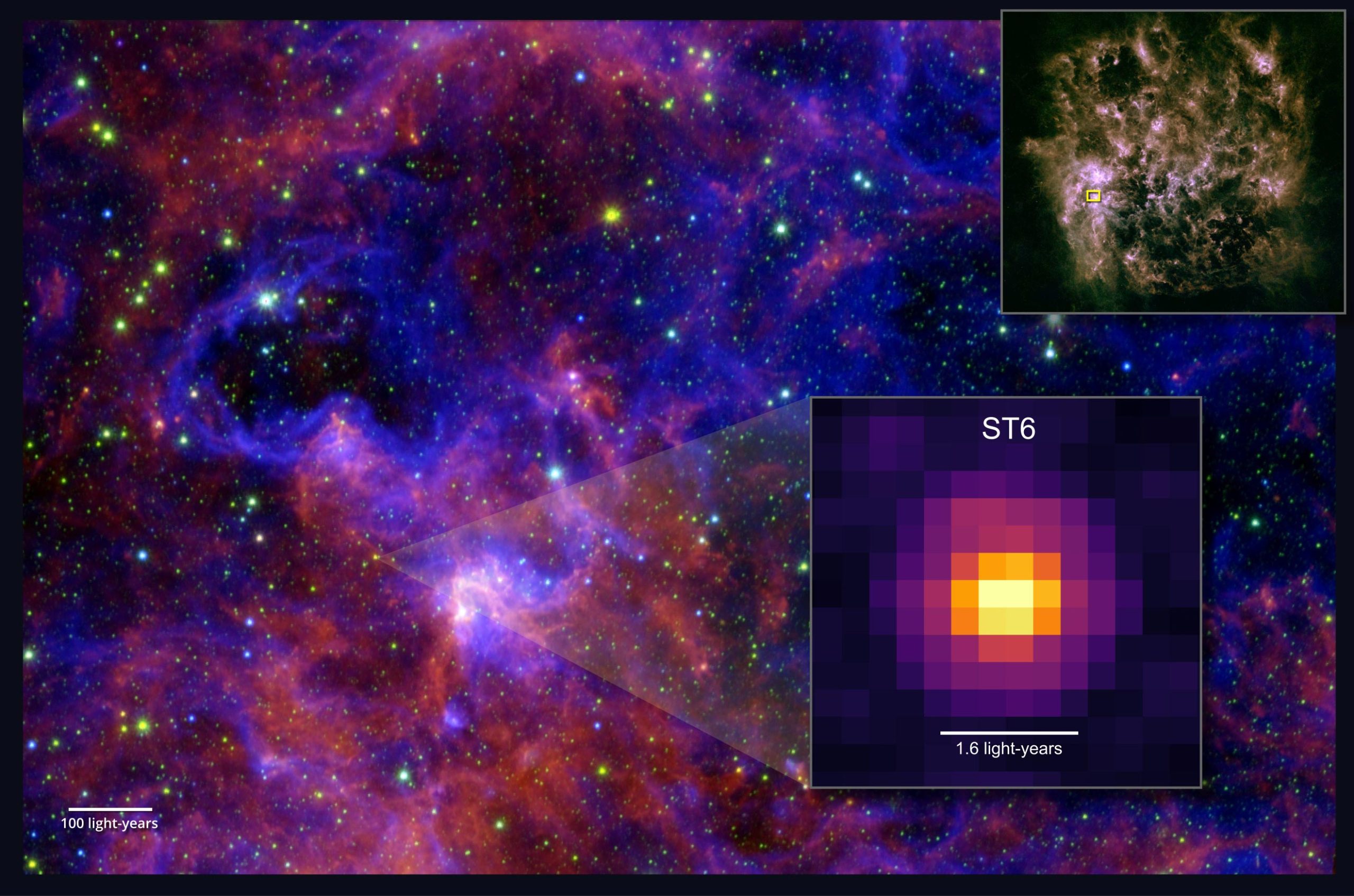
In a finding that may transform our understanding of how life’s chemical precursors are distributed across the universe, astronomers have detected organic molecules containing more than six atoms frozen in ice around a young star named ST6, located in a galaxy beyond the Milky Way.
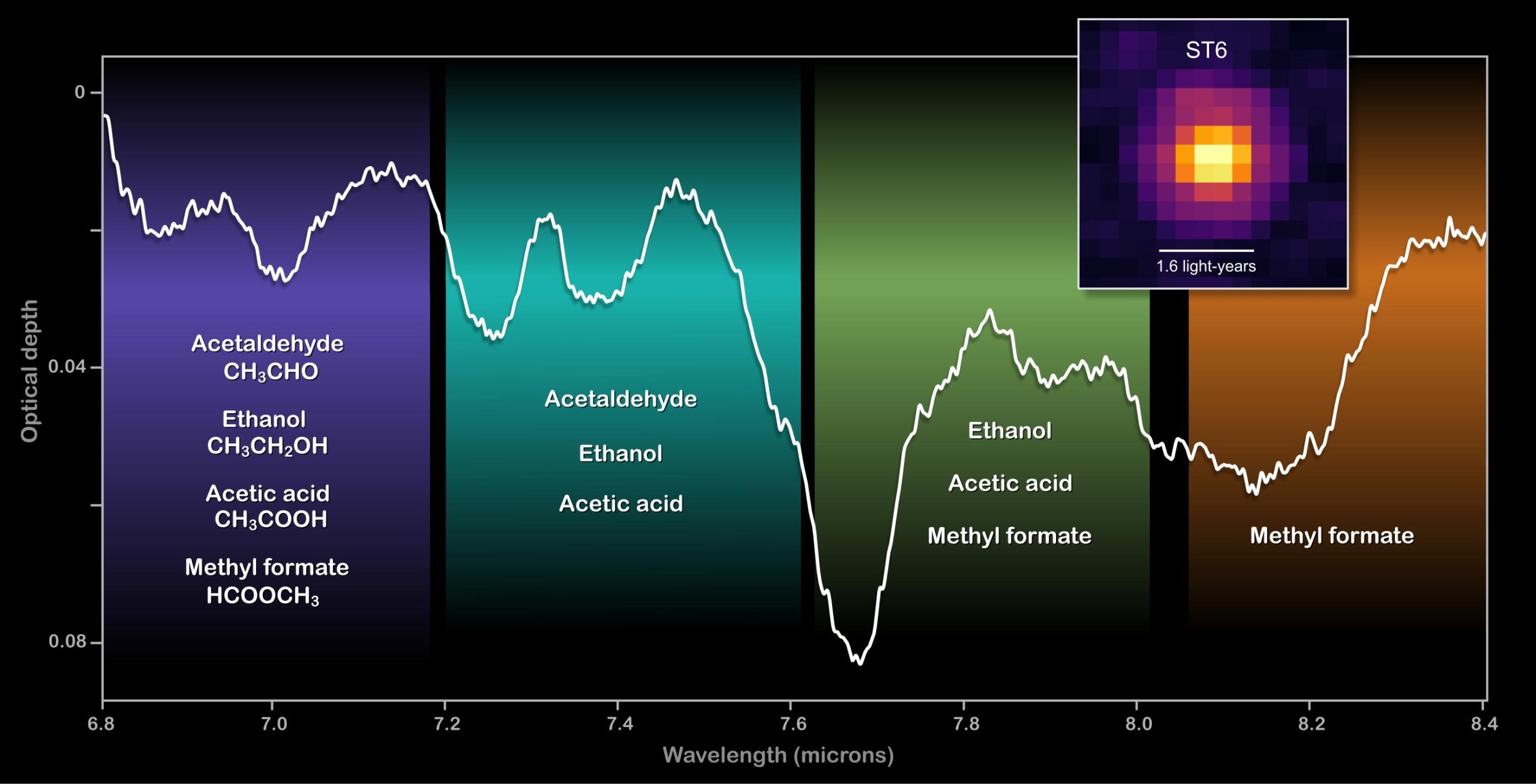
Using the James Webb Space Telescope’s (JWST) Mid-Infrared Instrument (MIRI), the team identified five distinct carbon-based compounds in the Large Magellanic Cloud, our nearest neighboring galaxy. The research, led by University of Maryland and NASA scientist Marta Sewilo, was published in the Astrophysical Journal Letters on October 20, 2025.
Discovery of five organic molecules in interstellar ice
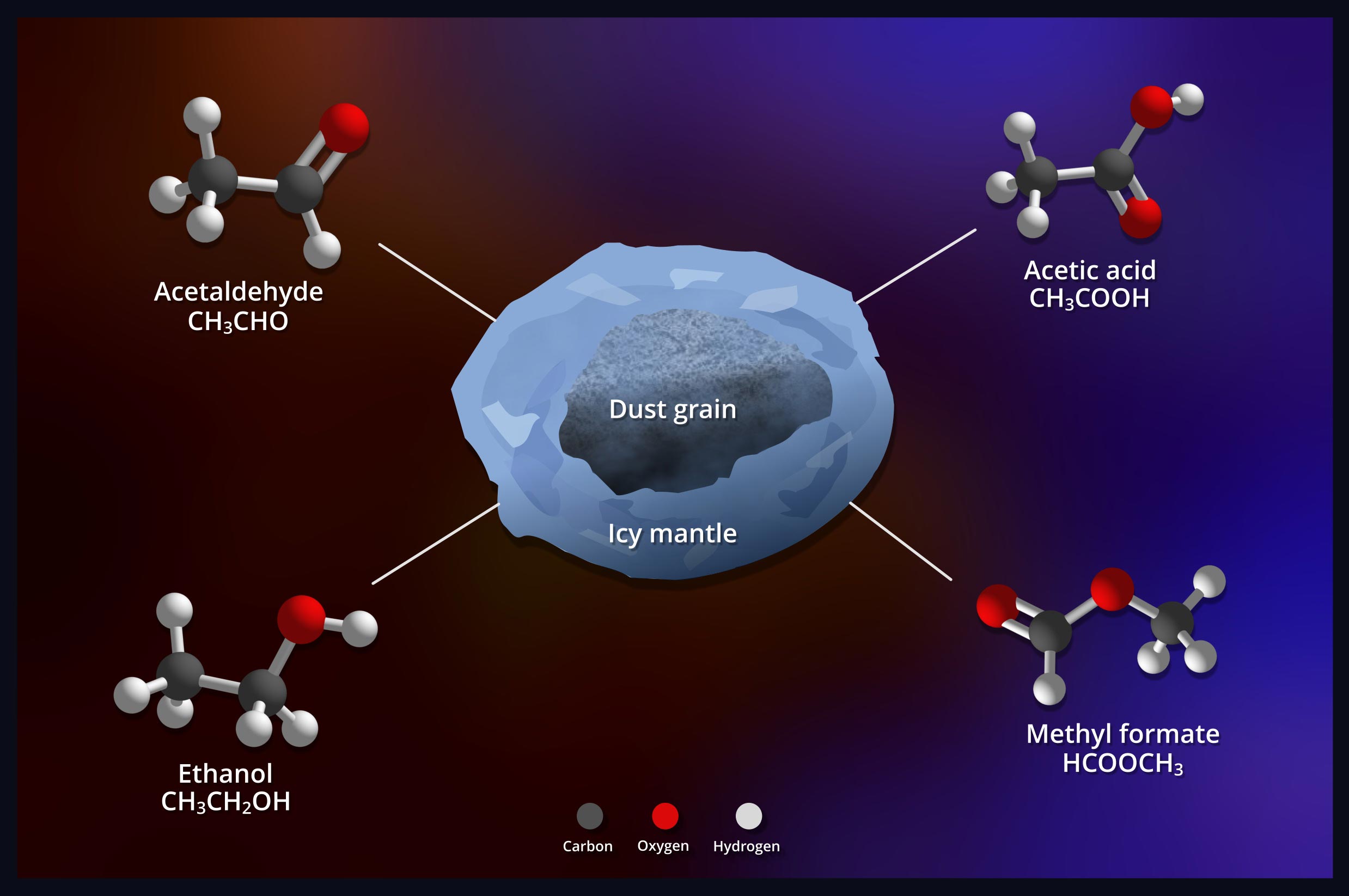
Sewilo and her colleagues discovered five complex organic molecules (COMs) embedded in the ice surrounding the young protostar—several of which are familiar from everyday life on Earth. These include methanol and ethanol (types of alcohol), methyl formate and acetaldehyde (industrial chemicals), and acetic acid (the main ingredient in vinegar).
Among these, acetic acid had never before been definitively identified in space ice, while ethanol, methyl formate, and acetaldehyde represent the first confirmed detections of these molecules in interstellar ice beyond the Milky Way.
The team also found spectral signatures resembling glycolaldehyde—a sugar-related compound and a building block for larger biomolecules such as RNA components—though further analysis is needed to verify its presence.
“It’s all thanks to JWST’s exceptional sensitivity combined with high angular resolution that we’re able to detect these faint spectral features associated with ices around such a distant protostar. The spectral resolution of JWST is sufficiently high to allow for reliable identifications,” Sewilo noted. “Before Webb, methanol had been the only complex organic molecule conclusively detected in ice around protostars, even in our own galaxy. The exceptional quality of our new observations helped us gather an immense amount of information from a single spectrum, more than we’ve ever had before.”
Harsh galactic environment offers clues to early-universe chemistry
What makes this discovery especially notable is the extreme setting in which these molecules were found. The Large Magellanic Cloud, about 160,000 light-years from Earth, provides a natural testing ground for understanding star formation under conditions that resemble those of the early universe.
The galaxy contains only about one-third to one-half the concentration of heavy elements (those heavier than helium) found in our solar system and is exposed to much stronger ultraviolet radiation.
“The low metallicity environment, meaning the reduced abundance of elements heavier than hydrogen and helium, is interesting because it’s similar to galaxies at earlier cosmological epochs,” Sewilo explained. “What we learn in the Large Magellanic Cloud, we can apply to understanding these more distant galaxies from when the universe was much younger. The harsh conditions tell us more about how complex organic chemistry can occur in these primitive environments where much fewer heavy elements like carbon, nitrogen and oxygen are available for chemical reactions.”
Evidence for chemical reactions on interstellar dust
Study co-author Will Rocha, a researcher from Leiden University in the Netherlands, noted that COMs can form in both the gas and ices on interstellar dust grains. After their formation, ice COMs can be released to the gases; previously, methanol and methyl formate were detected in the gas-phase in the Large Magellanic Cloud. While the formation process of COMs is still not fully understood, chemical models and lab experiments show that chemical reactions on the surfaces of interstellar dust grains are the main contributors to COM production.
“Our detection of COMs in ices supports these results,” Rocha explained. “The detection of icy COMs in the Large Magellanic Cloud provides evidence that these reactions can produce them effectively in a much harsher environment than in the solar neighborhood.”
Implications for life’s chemical origins and future research
Finding icy COMs in similar conditions to those in the early universe suggests that the building blocks for larger biomolecules, important for the emergence of life, were formed much earlier and under a greater variety of cosmic conditions than previously thought.
While the team’s findings do not prove the existence of life beyond Earth, the research suggests that these species could survive the evolution of planetary systems and later be assimilated to early planets once they are formed, where life could flourish. Sewilo plans to expand this work to include more protostars in both the Large Magellanic Cloud and potentially the Small Magellanic Cloud, the next closest galaxy to Earth, and continue to explore questions about the complex chemistry of the universe.
“We currently only have one source in the Large Magellanic Cloud and only four sources with detection of these complex organic molecules in ices in the Milky Way. We need larger samples from both to confirm our initial results that indicate differences in COM abundances between these two galaxies,” Sewilo said. “But with this discovery, we’ve made significant advancements in understanding how complex chemistry emerges in the universe and opening new possibilities for research into how life came to be.”
Reference: “Protostars at Subsolar Metallicity: First Detection of Large Solid-state Complex Organic Molecules in the Large Magellanic Cloud” by Marta Sewiło, Will R. M. Rocha, Martijn van Gelder, Maria Gabriela Navarro, Steven B. Charnley, Miwha Jin, Joana M. Oliveira, Jacco Th. van Loon, Logan Francis, Jennifer Wiseman, Remy Indebetouw, C.-H. Rosie Chen, Roya Hamedani Golshan and Danna Qasim, 20 October 2025, The Astrophysical Journal Letters.
DOI: 10.3847/2041-8213/ae0ccd
This research was supported by NASA.
Never miss a breakthrough: Join the SciTechDaily newsletter.
Follow us on Google and Google News.