

Astronomers may have uncovered a hidden population of galaxies that could rewrite what we know about the universe’s evolution.
These faint, dusty galaxies were discovered using the deepest far-infrared image ever created, thanks to data from the Herschel Space Observatory. Their collective light might explain a long-standing mystery about the universe’s energy output in the infrared spectrum. If confirmed, these galaxies would challenge current galaxy evolution models and reveal a previously unseen side of the cosmos—one shrouded in dust and only visible in longer wavelengths of light.
Unveiling Hidden Galaxies in the Early Universe
Astronomers have discovered what appears to be a previously unseen population of “hidden” galaxies. These faint, dust-shrouded objects could reveal important clues about the structure and evolution of the universe.
If their existence is confirmed it would “effectively break current models of galaxy numbers and evolution.”
They could also help solve a long-standing mystery about the universe’s energy output. Their combined infrared light may account for the missing portion of the cosmic energy budget, filling a gap in what we observe at long wavelengths.
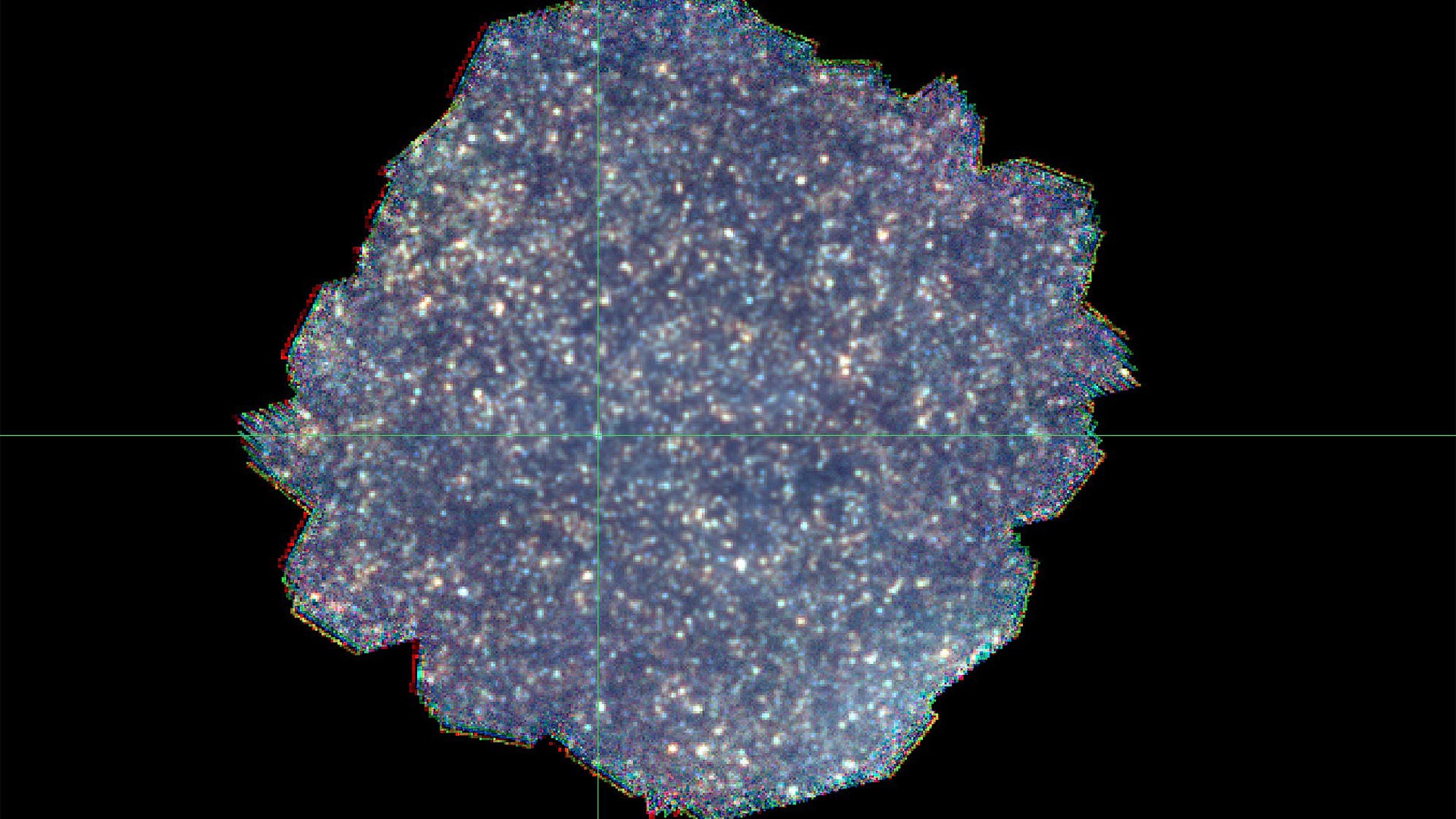
Deepest Far-Infrared Image Ever Captured
Evidence for these galaxies comes from the deepest-ever image of the universe taken in far-infrared light. The image, which includes nearly 2,000 distant galaxies, was created by a team led by STFC RAL Space and Imperial College London.
Dr. Chris Pearson, from STFC RAL Space, is the lead author on one of two papers published on April 10 in Monthly Notices of the Royal Astronomical Society.
He said: “This work has pushed the science with Herschel to its absolute limit, probing far below what we can normally discernibly see and potentially revealing a completely new population of galaxies that are contributing to the very faintest light we can observe in the universe.”
Stacking Images to See the Unseen
The team behind the research created their deep view of the universe by stacking 141 images on top of each other using data from the SPIRE instrument on the Herschel Space Observatory, a European Space Agency mission that ran from 2009 to 2013.
The resulting Herschel-SPIRE Dark Field is the deepest ever image of the far-infrared sky – five times deeper than the previous single deepest Herschel observation and at least twice as deep as any other area on the sky observed by the telescope.
Placing the images on top of each other allowed astronomers to see the dustiest galaxies, where most new stars are formed in the cosmos.
The SPIRE Dark Field observed at different wavelengths (colors) moving from the shortest to the longest infrared wavelengths. The shorter wavelength images are from the Spitzer space telescope using the IRAC camera at 3.5 and 8 micrometers and the MIPS camera at 24 micrometers. These wavelengths are between 10-100 times short than the SPIRE observations and therefore appear sharper (higher resolution). The SPIRE images at 250, 250, 500 micrometers (and the final 250 + 350 + 500 combined RGB image) appear blurrier due to the lower resolution at the wavelengths, highlighting the challenges in identifying individual galaxies in the SPIRE maps. The green cross hair marks the same galaxy for reference in each of the images emphasising how different the sky looks at different wavelengths. Credit: Chris Pearson et al. (Herschel), Krick et al. 2009 (Spitzer)
Tracking Cosmic Dust and Energy Emissions
It also enabled them to track how the number of galaxies changes with brightness and to measure the contribution each one makes to the total energy budget of the universe.
However, the image was so deep and detected so many galaxies that the individual objects began to merge and become indistinguishable from each other.
This made extracting information challenging, according to Thomas Varnish, a PhD student at the Massachusetts Institute of Technology (MIT) and lead author on the second paper.
“We employed statistical techniques to get around this overcrowding, analyzing the blurriest parts of the image to probe and model the underlying distribution of galaxies not individually discernible in the original image,” said Mr. Varnish, who carried out most of his research as a summer intern at Imperial College London and RAL Space.
A New Population That Could Rewrite Cosmic History
“What we found was possible evidence of a completely new, undiscovered population of faint galaxies hidden in the blur of the image, too faint to be detected by conventional methods in the original analysis.
“If confirmed, this new population would effectively break all of our current models of galaxy numbers and evolution.”
The researchers are now hoping to confirm the existence of the potential new group of galaxies using telescopes at other wavelengths.
Their aim is to decipher the nature of these faint, dusty objects and their importance in the grand scheme of the evolution of our universe.
The Hidden Half of the Universe’s Light
Dr. Pearson said: “When we look at starlight through normal telescopes, we are only able to read half of the story of our universe, the other half is hidden, obscured by the intervening dust.
“In fact, roughly half of the energy output of the universe is from starlight that has been absorbed by dust and re-emitted as cooler infrared radiation. To fully understand the evolution of our universe we need to observe the sky in both optical and longer wavelength infrared light.”
The Herschel Space Observatory was tasked with observing the universe in the infrared, with its SPIRE instrument covering the very longest wavelengths.
Like any scientific instrument in space, the SPIRE instrument also required regular observations for calibration and routinely stared at a single patch of ‘dark sky’ every month or so, over the duration of its four-year mission.
Herschel held the record for the largest-ever infrared space telescope, until it was eclipsed by the James Webb Space Telescope in 2021.
The Future: A New Generation Telescope on the Horizon
Imperial College London astrophysicist Dr. David Clements, who was also involved in the research, added: “These results show just how valuable the Herschel archive is.
“We’re still getting great new results more than 10 years after the satellite stopped operating.
“What we can’t get, though, is more data at these wavelengths to follow up these fascinating new results. For that we need the next generation far-IR mission, PRIMA, currently being proposed to NASA.”
The Probe far-Infrared Mission for Astrophysics (PRIMA) is being supported by a UK consortium including RAL Space, the University of Sussex, Imperial College London, and Cardiff University.
It would involve the use of a 1.8-meter telescope optimized for far-infrared imaging and spectroscopy, bridging the gap between existing observatories such as the James Webb Space Telescope and radio telescopes.
PRIMA is one of two proposals shortlisted for NASA’s next $1 billion (£772 million) probe mission. The US space agency will confirm its final mission selection in 2026.
References:
“The Herschel-SPIRE Dark Field I: the deepest Herschel image of the submillimetre Universe” by Chris Pearson, Thomas W O Varnish, Xinni Wu, David L Clements, Ayushi Parmar, Helen Davidge and Matthew Pearson, 10 April 2025, Monthly Notices of the Royal Astronomical Society.
DOI: 10.1093/mnras/staf335
“The Herschel-SPIRE Dark Field – II. A P(D) fluctuation analysis of the deepest Herschel image of the submillimetre universe” by Thomas W O Varnish, Xinni Wu, Chris Pearson, David L Clements and Ayushi Parmar, 10 April 2025, Monthly Notices of the Royal Astronomical Society.
DOI: 10.1093/mnras/staf318
Never miss a breakthrough: Join the SciTechDaily newsletter.
Follow us on Google and Google News.