
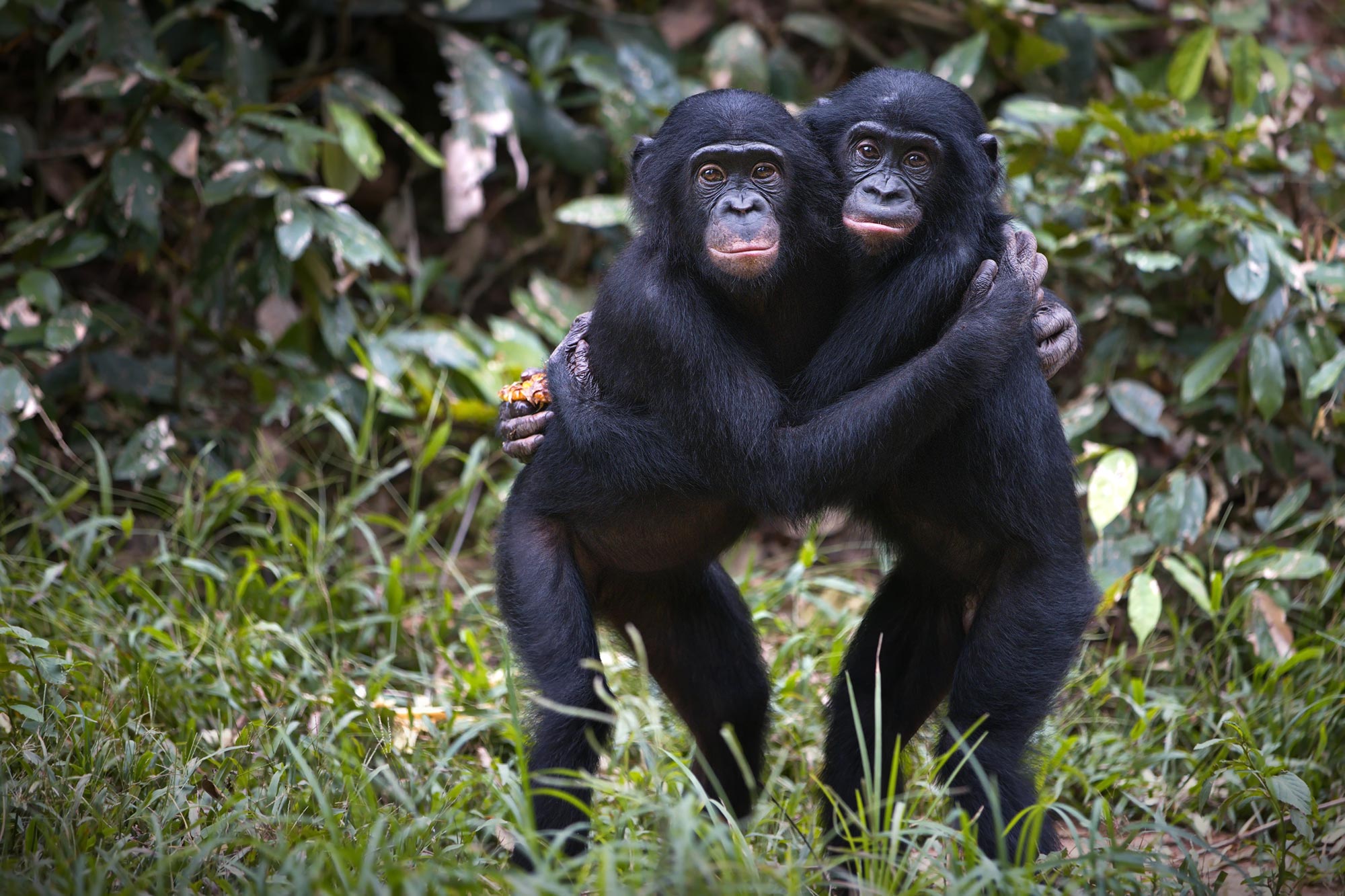
Male bonobos have developed a surprisingly savvy strategy for navigating the confusing fertility cues of females, whose conspicuous swelling doesn’t reliably indicate ovulation.
By tracking both how long it’s been since a female reached peak swelling and the age of her youngest infant, males zero in on the moments when conception is most likely.
Male Bonobos Read Fertility Clues Hidden in Unreliable Signals
Male bonobos are able to interpret female fertility cues even when those signals do not reliably indicate ovulation. This ability helps them direct their mating efforts toward times when conception is most likely, according to a study led by Heungjin Ryu at Kyoto University, Japan, published today (December 9) in the open-access journal PLOS Biology.
In many mammals, females are receptive only during ovulation, which allows males to synchronize mating with the period of highest fertility. Bonobos (Pan paniscus), however, differ from this pattern. Females are sexually receptive for extended periods and develop a noticeable pink swelling around the genital area that can remain visible far beyond the actual fertile window.
Field Research Reveals How Bonobos Interpret Confusing Signals
To understand how males respond to this unreliable indicator, researchers observed a wild bonobo community at Wamba in the Luo Scientific Reserve in the Democratic Republic of the Congo. The team monitored sexual interactions and assessed the size and appearance of female genital swellings during daily observations. They also collected urine samples on filter paper to measure levels of estrogen and progesterone, which helped estimate when ovulation occurred.
Their analysis showed that ovulation was most likely to occur between 8 and 27 days after a female reached maximum swelling. This wide range made prediction difficult. Even so, male mating behavior closely matched the true timing of ovulation. Males showed more interest in females who had reached maximum swelling earlier and in those with older infants, two cues linked with higher chances of ovulation.
In this clip, the beta male Nobita carefully looks at the sexual swelling of the female Sala while they forage for fungi on the forest floor. Male bonobos take this task seriously—watching and checking swelling changes so they do not miss potential ovulatory periods. Credit: Heungjin Ryu (CC-BY 4.0)
Flexible Strategies Help Bonobos Maintain an Imperfect Signaling System
The findings indicate that males combine swelling timing with information from a female’s reproductive history to identify the most fertile periods. Because they are able to judge fertility relatively well despite imprecise cues, there may have been little evolutionary pressure for these signals to become more accurate. According to the authors, this may help explain why such a system has persisted over long evolutionary timescales.
The authors add, “In this study, we found that bonobo males, instead of trying to predict precise ovulation timing, use a flexible strategy—paying attention to the end-signal cue of the sexual swelling along with infant age—to fine-tune their mating efforts. This finding reveals that even imprecise signals can remain evolutionarily functional when animals use them flexibly rather than expecting perfect accuracy. Our results help explain how conspicuous but noisy ovulatory signals, like those of bonobos, can persist and shape mating strategies in complex social environments.”
Researchers Describe the Challenges of Daily Tracking in the Rainforest
“The male bonobos weren’t the only ones paying close attention to sexual swelling—we spent countless days in the rainforest at Wamba, DRC doing exactly the same thing! All that watching, sweating, and scribbling in our notebooks eventually paid off. By tracking these daily changes, we uncovered just how impressively bonobos can read meaning in a signal that seems noisy and confusing to us.”
Reference: “Male bonobo mating strategies target female fertile windows despite noisy ovulatory signals during sexual swelling” by Heungjin Ryu, Chie Hashimoto, David A. Hill, Keiko Mouri, Keiko Shimizu and Takeshi Furuichi, 9 December 2025, PLOS Biology.
DOI: 10.1371/journal.pbio.3003503
This study was supported by the Global Environment Research Fund (D-1007 to TF) of the Japanese Ministry of the Environment, the Japan Society for the Promotion of Science (JSPS) Grants-in-Aid for Scientific Research (22255007 to TF, and 25304019 to CH), and the JSPS Asia-Africa Science Platform Program (2012–2014 to TF). The funders had no role in study design, data collection and analysis, decision to publish, or preparation of the manuscript.
Never miss a breakthrough: Join the SciTechDaily newsletter.
Follow us on Google and Google News.