
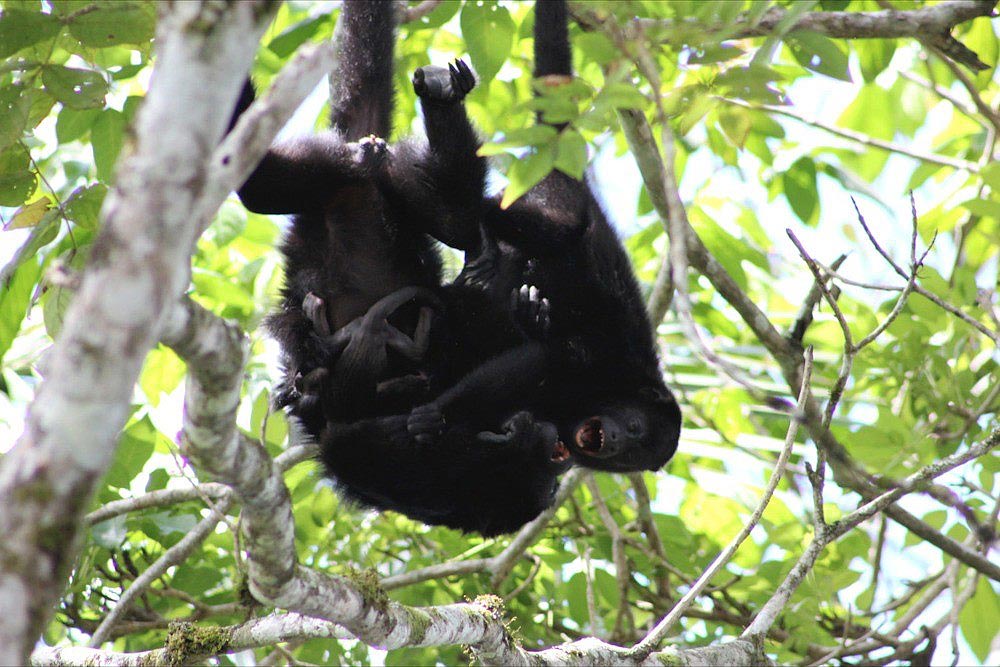
Play amongst adult howler monkeys increases during competitive foraging.
New research has discovered that adult howler monkeys use play to avoid conflict and reduce group tension, with levels of play increasing when they are faced with scarce resources.
The study, carried out by a team of researchers from Spain, Brazil, and the UK, and published in the journal Animal Behaviour, focuses on the activity of two subspecies of howler monkey: the Mexican howler (Alouatta palliata mexicana) and the golden-mantled howler (Alouatta palliata palliata).
The researchers examined how play varies with age, and they measured the amount of time adults play with other adults and with juvenile monkeys within their groups.
The Energy Costs and Benefits of Play
Howler monkey play involves individuals hanging from their tails and making facial expressions and signals, such as shaking their heads. However, play is an energy-costly activity for howler monkeys, who generally have an inactive lifestyle due to their mainly leaf-based diet.
By studying seven different groups of howler monkeys in the rainforests of Mexico and Costa Rica, the researchers found that the amount of adult play is linked to the number of potential playmates, increasing in line with the size of the group. Adults spend more time playing with other adults, rather than juveniles, and adult females spend more time engaged in play than adult males.
The Role of Play in Reducing Conflict
Crucially, the researchers found that play amongst adults increases in line with time spent foraging on fruit. Howler monkeys typically eat leaves, and fruit is a highly prized resource that generates competition amongst the monkeys.
Howler monkeys do not have a fixed social hierarchy within their groups to navigate competition and conflict, and they do not engage in collective grooming, which is used by some primates for group cohesiveness and tension reduction. Instead, the study authors believe play has a key role in helping howler monkeys regulate relationships within their social group and avoid conflict.
Co-author Dr. Jacob Dunn, Associate Professor in Evolutionary Biology at Anglia Ruskin University (ARU), said: “Despite its appearance and our own perception of what play means, play is not always associated with frivolity or education. Instead, we think it fulfills an important function in howler monkey society by reducing tension when there is competition over scarce resources.
“We found that levels of play are at their highest when howler monkeys are feeding on fruit – which is a valuable and defendable resource – and female adults play more than males. This is striking, as females would be more vulnerable to food competition than males. Howler monkeys are a particularly energy-conservative species, and we would have assumed females would have played less, as they are also constrained by the energy requirements of reproduction.”
Lead author Dr. Norberto Asensio, of University of the Basque Country, said: “One theory for the positive effect of fruit consumption on play is that a fruit-based diet simply provides the howler monkeys with more energy compared to their typical diet of leaves.”
“However, if this was the case, we should have observed adults engaging in more play with all members of the group during fruit foraging, rather than just with other adults. Because juveniles do not pose a threat or provide competition at fruit trees, we believe that play amongst adults is a mechanism for solving conflicts within the group, in a similar way that grooming is used by some other primate species.”
Reference: “Socioecological correlates of social play in adult mantled howler monkeys” by Norberto Asensio, Eugenia Zandonà, Jacob C. Dunn and Jurgi Cristóbal-Azkarate, 16 March 2022, Animal Behaviour.
DOI: 10.1016/j.anbehav.2022.01.017
Never miss a breakthrough: Join the SciTechDaily newsletter.
Follow us on Google and Google News.