
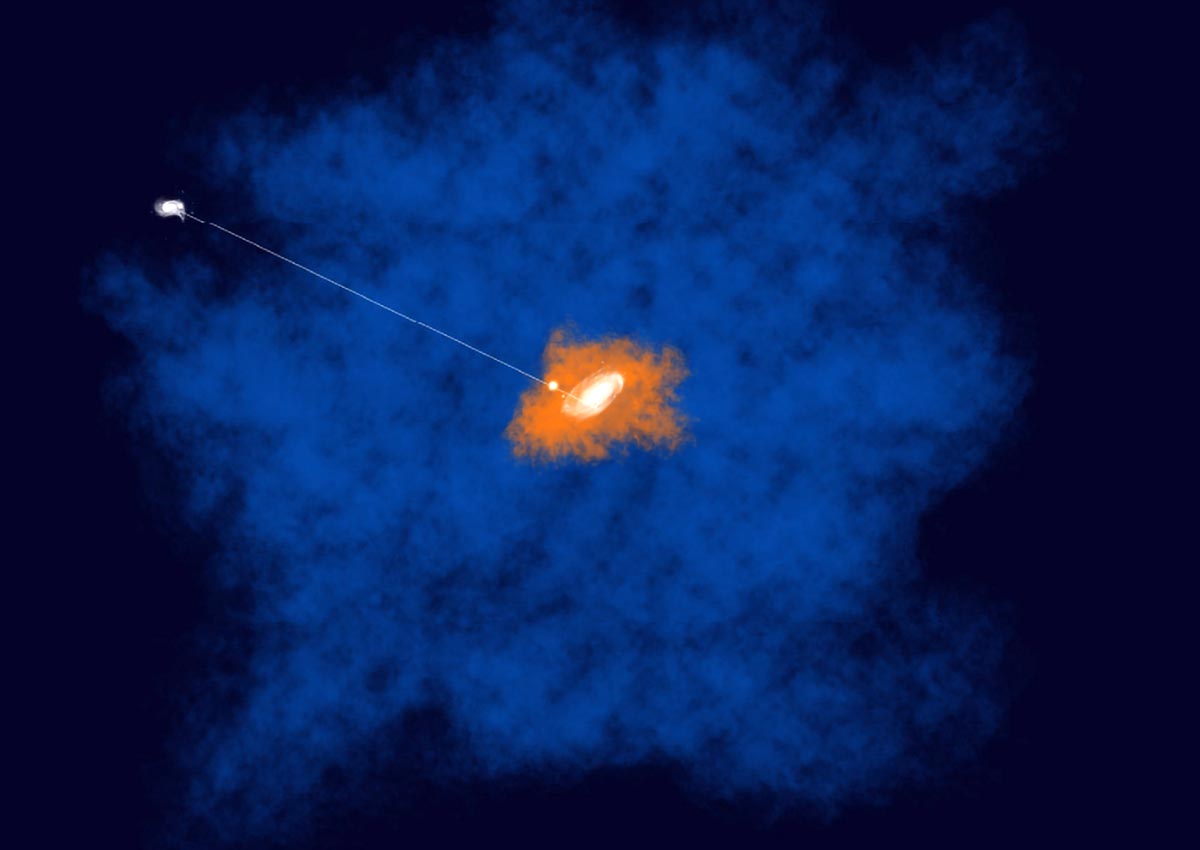
Scientists have linked supernovae to the heating of the Milky Way’s outer gas layer, revealing a cosmic dance of creation and destruction that shapes our galactic environment.
Scientists may have uncovered the mysterious sources responsible for heating and sustaining the super-hot gas recently detected around the Milky Way — a phenomenon that has puzzled astronomers until now.
Our galaxy contains more gas than stars. This vast reserve of gas serves as the primary fuel for star formation, enabling this process to continue over billions of years. However, the gas is so diffuse that it has been incredibly challenging for astronomers to observe directly or measure accurately.
Hot Gas Around the Milky Way
A few decades ago, researchers confirmed the presence of a massive sphere of gas enveloping the Milky Way. This gas, heated to millions of degrees Kelvin, extends an astonishing 700,000 light-years from the galactic center. Scientists linked these extreme temperatures to the Milky Way’s gravitational pull, which forces gas atoms into constant motion to avoid being drawn into the galaxy’s core.
But what further intrigued the scientific community, in the more recent years, was the discovery of gaseous matter which was even hotter than what was known previously. This latest discovered gaseous matter was pitched to be around ten million degrees Kelvin. Faint X-ray emissions were found in all directions of the Milky Way that bore a strong signature of a super-hot gas. At the same time, this gas also showed up in the spectra of at least three distant quasars, as an absorbing medium.
Insights from Raman Research Institute
A keenly studied research area emerged, and, since then, astronomers have been trying to find clues and links to the sources that was pumping heat and keeping alive the fiery hot gas.
Scientists at the Raman Research Institute (RRI), an autonomous institute funded by the Department of Science and Technology (DST), Government of India, along with their collaborators at IIT-Palakkad and Ohio State University, have detailed the mysterious source through their proposed model in two related studies.
The Role of Supernovae in Galactic Dynamics
They have confirmed that the gas responsible for emitting and absorbing the signals detected by astronomers were not the same. Instead, the X-ray emitting hot gas was caused by a puffed-up region around the stellar disc of the Milky Way. Since there is a continuous ongoing star formation at various regions across the disk of the Milky Way, the massive stars in these regions explode as supernovae, and heat the gas around the disk to high temperatures.
“As such, explosions keep heating up the gas floating around the disc of the Milky Way and they enrich the gaseous matter with elements synthesized within massive stars,” said Mukesh Singh Bisht, PhD student at RRI.
As this turbulent gas is swept up from the disc and swirls around violently, it either escapes into the surrounding medium or cools and falls back onto the disc.
Elemental Composition of Galactic Gas
In the case of absorption studies, along with the superhot temperatures that the vast gaseous matter possessed, its elemental composition, too, surprised the astronomers. This absorbing hot gas was found to be enriched with α-elements.
“This fiery gas, at least in a few directions, seems to be enriched with large quantities of α-elements, such as sulfur, magnesium, neon, etc., whose nuclei are nothing but multiples of Helium nuclei. This is a vital clue of nuclear reactions occurring within the stellar core. These elements are thrown out of massive stars during supernovae explosions,” explained Biman Nath, faculty, RRI, and one of the contributory authors in both papers.
Even though there are thousands of run-away stars that get constantly ejected out of the Milky Way disc, when some of them which may hover above the stellar disc explode as supernovae, they potentially create a puff of α-enriched and fiery gas around them.
“If they fall in line with the direction of distant sources of light quasars, the atoms in this hot gas would absorb and produce shadow signals, thus explaining the absorbing hot gas. At the same time, a veil of fiery hot gas keeps engulfing the Milky Way disc, as a result of the star-forming activities in the stellar disc of the Milky Way which explains the hot gas seen in X-ray emission,” said Bisht. The study was published in the Astrophysical Journal.
The faint X-ray signals thus produced could be further studied to obtain more clues. The group plans to test the models in other frequencies.
Reference: “On the Origin of the 107 K Hot Emitting Gas in the Circumgalactic Medium of the Milky Way” by Mukesh Singh Bisht, Biman B. Nath and Smita Mathur, 24 October 2024, The Astrophysical Journal.
DOI: 10.3847/1538-4357/ad77c0
Never miss a breakthrough: Join the SciTechDaily newsletter.
Follow us on Google and Google News.
1 Comment
Imagine all the life that was perished just so that we could have a faint fireworks in the night sky.