
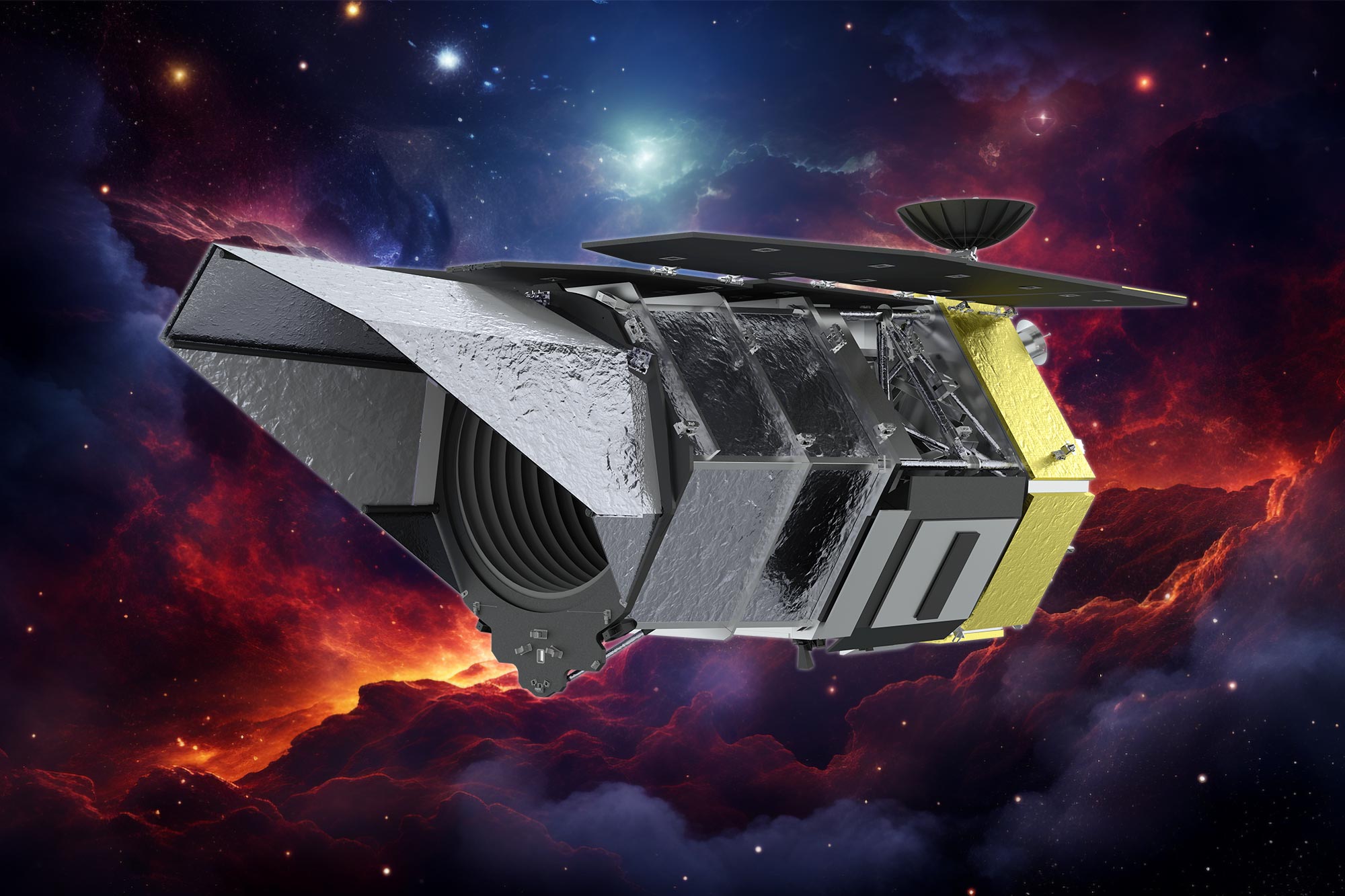
The Nancy Grace Roman Space Telescope team at NASA has completed the integration of the telescope and its instruments onto the carrier, a significant milestone in the assembly process.
With the Coronagraph Instrument and the Optical Telescope Assembly in place, the Roman telescope is equipped to explore a vast array of astronomical phenomena, including exoplanets and cosmic mysteries like dark energy and dark matter. The Wide Field Instrument, a powerful 300-megapixel infrared camera, will enhance the telescope’s capability to survey the universe extensively. The project is on schedule for a 2026 completion and a 2027 launch.
Integration of Roman Space Telescope Components
NASA’s Nancy Grace Roman Space Telescope team has successfully integrated the telescope and its two key instruments onto the instrument carrier, completing the assembly of the Roman payload. The team at NASA’s Goddard Space Flight Center in Greenbelt, Maryland, will now begin attaching the payload to the spacecraft.
“We’re in the middle of an exciting stage of mission preparation,” said Jody Dawson, a Roman systems engineer at NASA Goddard. “All the components are now here at Goddard, and they’re coming together in quick succession. We expect to integrate the telescope and instruments with the spacecraft before the year is up.”
Advanced Instrumentation and Capabilities
The first instrument integrated was the Coronagraph Instrument, a technology demonstration designed to capture images of exoplanets — worlds beyond our solar system. It uses a sophisticated system of masks and active mirrors to block the intense light from host stars, allowing the dimmer planets to be seen.
Then the team integrated the Optical Telescope Assembly, which includes a 7.9-foot (2.4-meter) primary mirror, nine additional mirrors, and their supporting structures and electronics. The telescope will focus cosmic light and send it to Roman’s instruments, revealing billions of objects strewn throughout space and time. Roman will be the most stable large telescope ever built, at least 10 times more so than NASA’s James Webb Space Telescope and 100 times more than the agency’s Hubble Space Telescope. This will allow scientists to make measurements at levels of precision that can answer important questions about dark energy, dark matter, and worlds beyond our solar system.
With those components in place, the team then added Roman’s primary instrument. Called the Wide Field Instrument, this 300-megapixel infrared camera will give Roman a deep, panoramic view of the universe. Through the Wide Field Instrument’s surveys, scientists will be able to explore distant exoplanets, stars, galaxies, black holes, dark energy, dark matter, and more. Thanks to this instrument and the observatory’s efficiency, Roman will be able to image large areas of the sky 1,000 times faster than Hubble with the same sharp, sensitive image quality.
“It would be quicker to list the astronomy topics Roman won’t be able to address than those it will,” said Julie McEnery, the Roman senior project scientist at NASA Goddard. “We’ve never had a tool like this before. Roman will revolutionize the way we do astronomy.”
Final Assembly and Launch Timeline
The telescope and instruments were mounted to Roman’s instrument carrier and precisely aligned in the largest clean room at Goddard, where the observatory is being assembled. Now, the whole assembly is being attached to the Roman spacecraft, which will deliver the observatory to its orbit and enable it to function once there.
At the same time, the mission’s deployable aperture cover — a visor that will shield the telescope from unwanted light — is being joined to the outer barrel assembly, which serves as the telescope’s exoskeleton.
“We’ve had an incredible year, and we’re looking forward to another one!” said Bear Witherspoon, a Roman systems engineer at NASA Goddard. “While the payload and spacecraft undergo a smattering of testing together, the team will work toward integrating the solar panels onto the outer barrel assembly.”
That keeps the observatory on track for completion by fall 2026 and launch no later than May 2027.
The Nancy Grace Roman Space Telescope is NASA’s next-generation observatory designed to explore cosmic mysteries such as dark energy, dark matter, exoplanets, and galaxy formation. Managed by NASA’s Goddard Space Flight Center with support from NASA’s Jet Propulsion Laboratory, Caltech/IPAC, and the Space Telescope Science Institute, the mission brings together scientists from leading research institutions worldwide. Its key instruments include the Wide Field Instrument, a 300-megapixel infrared camera for panoramic cosmic surveys, and the Coronagraph Instrument, which can directly image exoplanets by blocking their stars’ glare. Major industrial partners such as BAE Systems Inc., L3Harris Technologies, and Teledyne Scientific & Imaging play critical roles in the project. Scheduled for launch by 2027, the Roman Space Telescope builds on the legacy of missions like Hubble and James Webb, promising transformative discoveries about the universe.
Never miss a breakthrough: Join the SciTechDaily newsletter.
Follow us on Google and Google News.
10 Comments
10 times more stable than the James Webb very exciting to say the least , waiting anxiously to see the data images that will be a result .
Me too. Can’t wait…
For who? Nasa the funding tax payers pay doesn’t even let us see iss live anymore
Just the pictures they want us to see. I am done funding things we have no part of
So you are against a launch of a telscope that is only beneficial, but you are ignoring the billions if dollars we send to foreign countries every year? We have sent 21 billion dollars to Isreal from 2023 to 2025
Just what is more stable. That’s a little confusing.
I’m 68 years old but I’ve had a love for astronomy since I was a child. It’s exciting to see planets in other star systems. I am watching for the supernova of Betelguise.
68 years old? I wouldn’t hold my breath.
Me too!..also planets that can support life as we know it
I’m 52, so a decade+ sooner. I was in college when the mission to repair Hubble’s flawed mirror and upgrade it’s processor the first time was underway. I’ll get to see the results, but at some point it’ll be into my next life. That said my parents both lived into their 80s so I should still have a fair few years to see what comes next
Were the operations for this telescope competitively sourced?