
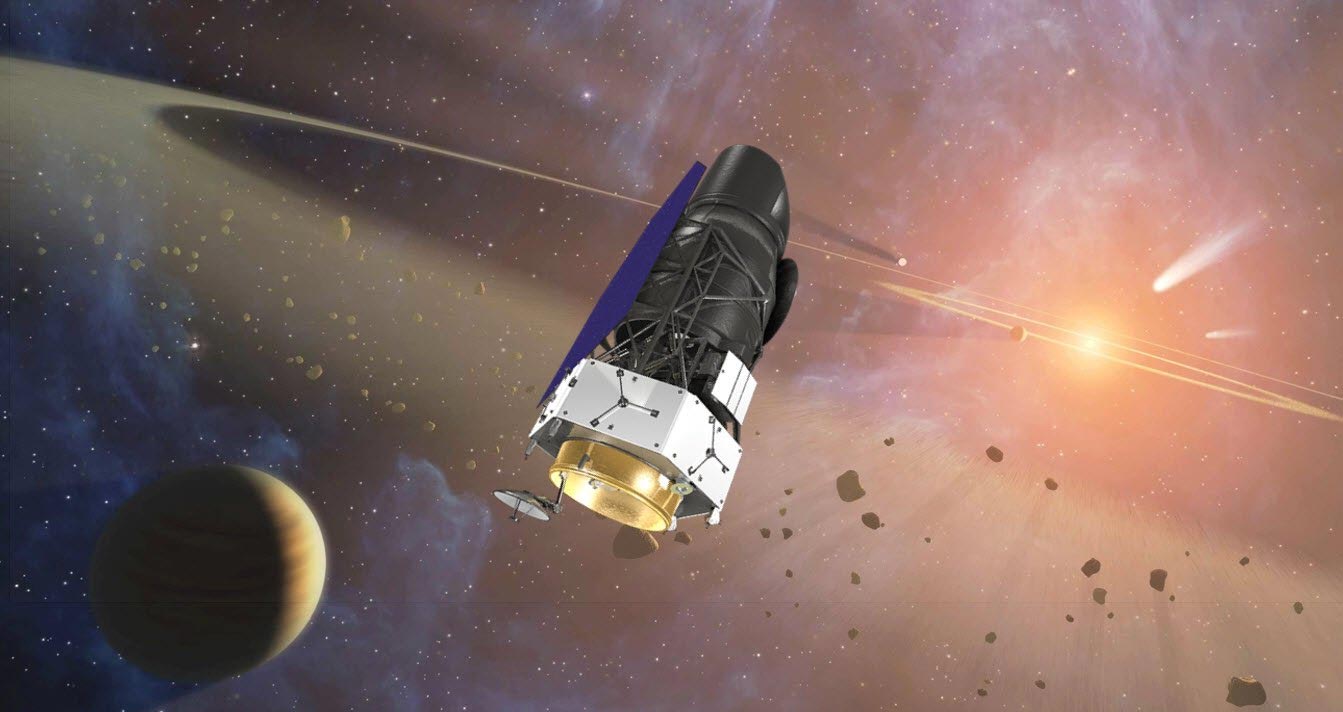
NASA’s Nancy Grace Roman Space Telescope, featuring a state-of-the-art camera, will significantly enhance our cosmic exploration, providing insights into dark energy, dark matter, and distant exoplanets through detailed, expansive surveys.
The primary instrument for NASA’s Nancy Grace Roman Space Telescope is a sophisticated camera that will survey the cosmos from the outskirts of our solar system all the way out to the edge of the observable universe. Called the Wide Field Instrument, it was recently delivered to the agency’s Goddard Space Flight Center in Greenbelt, Maryland.
Expanding Cosmic Understanding
The camera’s large field of view, sharp resolution, and sensitivity from visible to near-infrared wavelengths will give Roman a deep, panoramic view of the universe. Scanning much larger portions of the sky than astronomers can with NASA’s Hubble or James Webb space telescopes will open new avenues of cosmic exploration. Roman is designed to study dark energy (a mysterious cosmic pressure thought to accelerate the universe’s expansion), dark matter (invisible matter seen only via its gravitational influence), and exoplanets (worlds beyond our solar system).
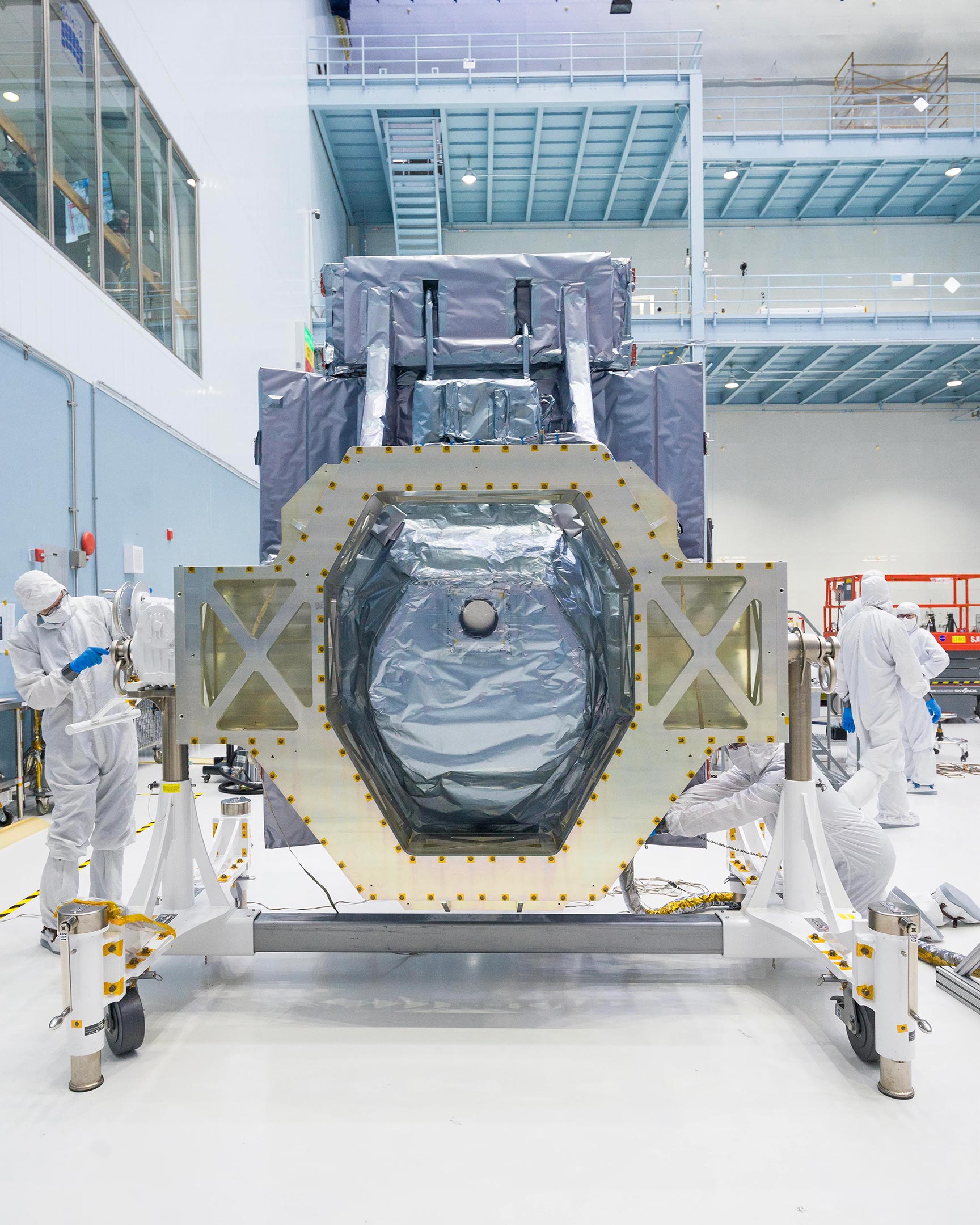
This photo shows the Wide Field Instrument for NASA’s Nancy Grace Roman Space Telescope arriving at the big clean room at NASA’s Goddard Space Flight Center. About the size of a commercial refrigerator, this instrument will help astronomers explore the universe’s evolution and the characteristics of worlds outside our solar system. Unlocking these cosmic mysteries and more will offer a better understanding of the nature of the universe and our place within it. Credit: NASA/Chris Gunn
“This instrument will turn signals from space into a new understanding of how our universe works,” said Julie McEnery, the Roman senior project scientist at Goddard. “To achieve its main goals, the mission will precisely measure hundreds of millions of galaxies. That’s quite a dataset for all kinds of researchers to pull from, so there will be a flood of results on a vast array of science.”
Collaborative Engineering Triumph
About 1,000 people contributed to the Wide Field Instrument’s development, from the initial design phase to assembling it from around a million individual components. The WFI’s design was a collaborative effort between Goddard and BAE Systems in Boulder, Colorado. Teledyne Imaging Sensors, Hawaii Aerospace Corporation, Applied Aerospace Structures Corporation, Northrop Grumman, Honeybee Robotics, CDA Intercorp, Alluxa, and JenOptik provided critical components. Those parts and many more, made by other vendors, were delivered to Goddard and BAE Systems, where they were assembled and tested prior to the instrument’s delivery to Goddard this month.
“I am so happy to be delivering this amazing instrument,” said Mary Walker, Roman’s Wide Field Instrument manager at Goddard. “All the years of hard work and the team’s dedication have brought us to this exciting moment.”
NASA’s Nancy Grace Roman Space Telescope is a next-generation observatory that will survey the infrared universe from beyond the orbit of the Moon. The spacecraft’s giant camera, the Wide Field Instrument, will be fundamental to this exploration. Data it gathers will enable scientists to discover new and uniquely detailed information about planetary systems around other stars. The instrument will also map how matter is structured and distributed throughout the cosmos, which could ultimately allow scientists to discover the fate of the universe. Watch this video to see a simplified version of how the Wide Field Instrument works. NASA’s Goddard Space Flight Center
Unprecedented Observational Capability
After Roman launches by May 2027, each of the Wide Field Instrument’s 300-million-pixel images will capture a patch of the sky bigger than the apparent size of a full moon. The instrument’s large field of view will enable sweeping celestial surveys, revealing billions of cosmic objects across vast stretches of time and space. Astronomers will conduct research that could take hundreds of years using other telescopes.
And by observing from space, Roman’s camera will be very sensitive to infrared light – light with longer wavelengths than our eyes can see – from far across the cosmos. This ancient cosmic light will help scientists address some of the biggest cosmic mysteries, one of which is how the universe evolved to its present state.
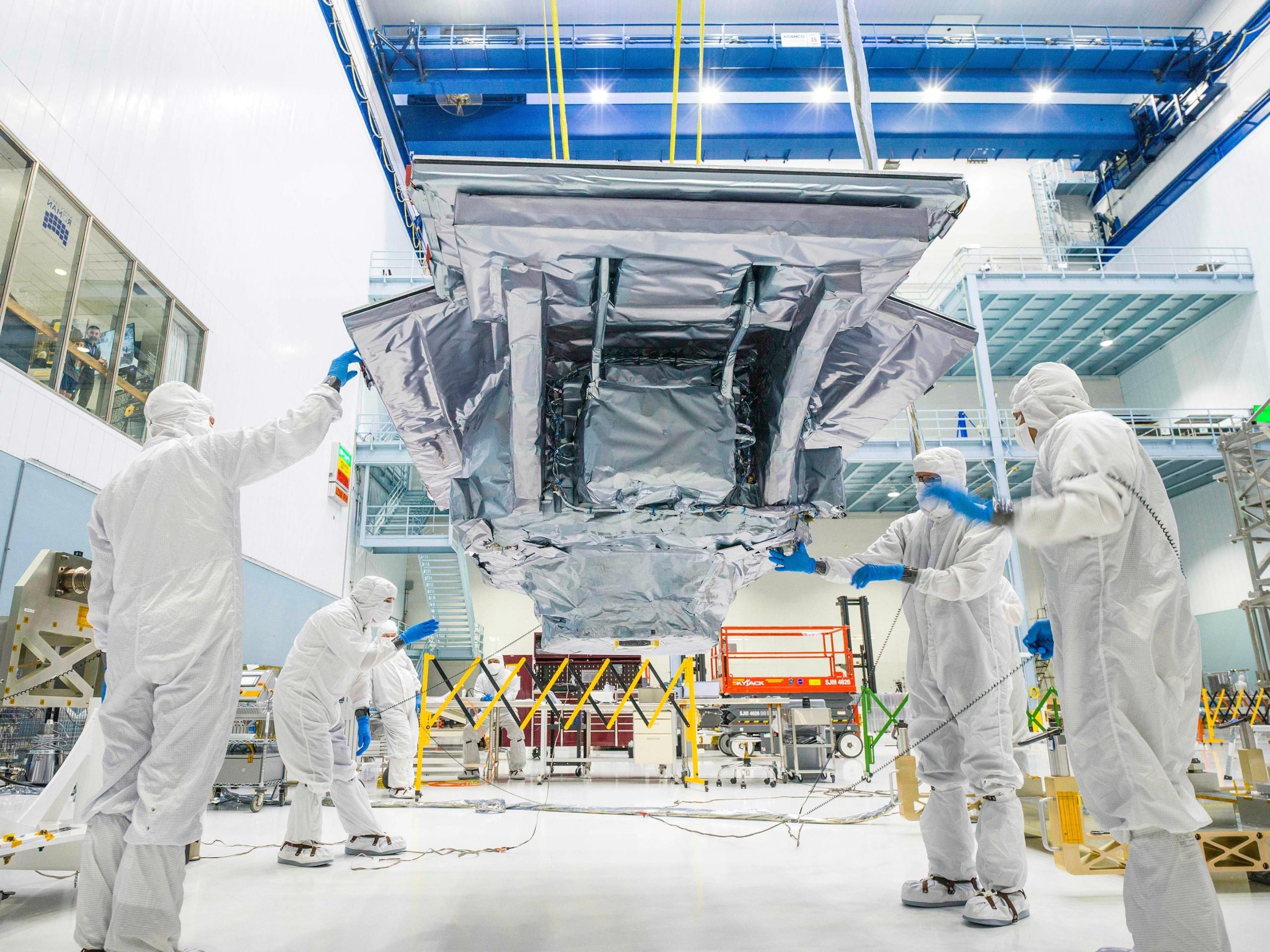
Technicians inspect NASA’s Nancy Grace Roman Space Telescope’s Wide Field Instrument upon delivery to the big clean room at NASA’s Goddard Space Flight Center. Credit: NASA/Chris Gunn
Journey Through the Cosmos
From the telescope, light’s path through the instrument begins by passing through one of several optical elements in a large wheel. These elements include filters, which allow specific wavelengths of light to pass through, and a grism and prism, which split light into all of its individual colors. These detailed patterns, called spectra, reveal information about the object that emitted the light.
Then, the light travels on toward the camera’s set of 18 detectors, which each contain 16 million pixels. The large number of detectors and pixels gives Roman its large field of view. The instrument is designed for accurate, stable images and exquisite precision in measuring the exact amount of light in every pixel of every image, giving Roman unprecedented power to study dark energy. The detectors will be held at about minus 300 degrees Fahrenheit (minus 184 degrees Celsius) to increase sensitivity to the infrared universe.
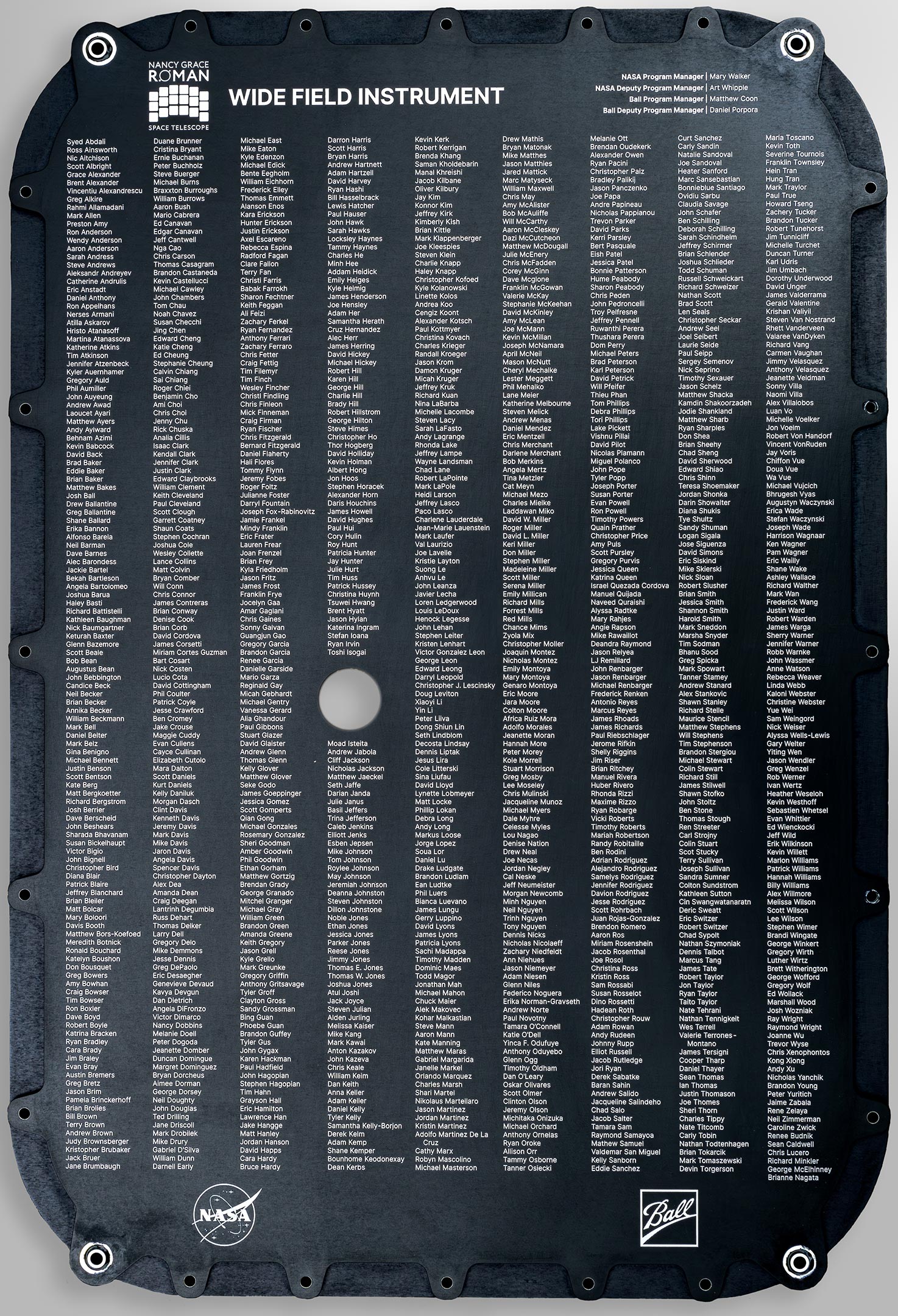
One panel on the Wide Field Instrument for NASA’s Nancy Grace Roman Space Telescope contains hundreds of names of team members who helped design and build the instrument. Credit: BAE Systems
“When the light reaches the detectors, that marks the end of what may have been a 10-billion-year journey through space,” said Art Whipple, an aerospace engineer at Goddard who has contributed to the Wide Field Instrument’s design and construction for more than a decade.
Preparing for a Data Deluge
Once Roman begins observing, its rapid data delivery will require new analysis techniques.
“If we had every astronomer on Earth working on Roman data, there still wouldn’t be nearly enough people to go through it all,” McEnery said. “We’re looking at modern techniques like machine learning and artificial intelligence to help sift through Roman’s observations and find where the most exciting things are.”
Now that the Wide Field Instrument is at Goddard, it will be tested to ensure everything is operating as expected. It will be integrated onto the instrument carrier and mated to the telescope this fall, bringing scientists one step closer to making groundbreaking discoveries for decades to come.
Interactive Exploration Available
To virtually tour an interactive version of the telescope, visit:
https://roman.gsfc.nasa.gov/interactive
The Nancy Grace Roman Space Telescope
The Nancy Grace Roman Space Telescope, named after NASA’s first chief astronomer, is an ambitious space observatory designed to delve into the mysteries of the universe with unprecedented depth and clarity. Slated for launch in the mid-2020s, this telescope will extend the legacy of telescopes like Hubble and James Webb by employing a wide field of view to capture panoramic views of the cosmos in high-resolution. Its primary mission objectives include unraveling the secrets of dark energy and dark matter, exploring the structures and distributions of galaxies, and searching for exoplanets using its sophisticated suite of instruments including the groundbreaking Wide Field Instrument.
Roman’s capabilities are expected to revolutionize our understanding of the universe. The telescope will conduct a variety of observational programs, such as the Cosmic Microwave Background, the spectroscopic survey of galaxies, and direct imaging of nearby exoplanets. Through its advanced technology, the Roman Space Telescope will not only provide insights into the evolution of the cosmos but also offer a detailed survey of the infrared universe, opening new avenues for astronomical discoveries and enhancing our knowledge of fundamental physics.
Never miss a breakthrough: Join the SciTechDaily newsletter.
Follow us on Google and Google News.