
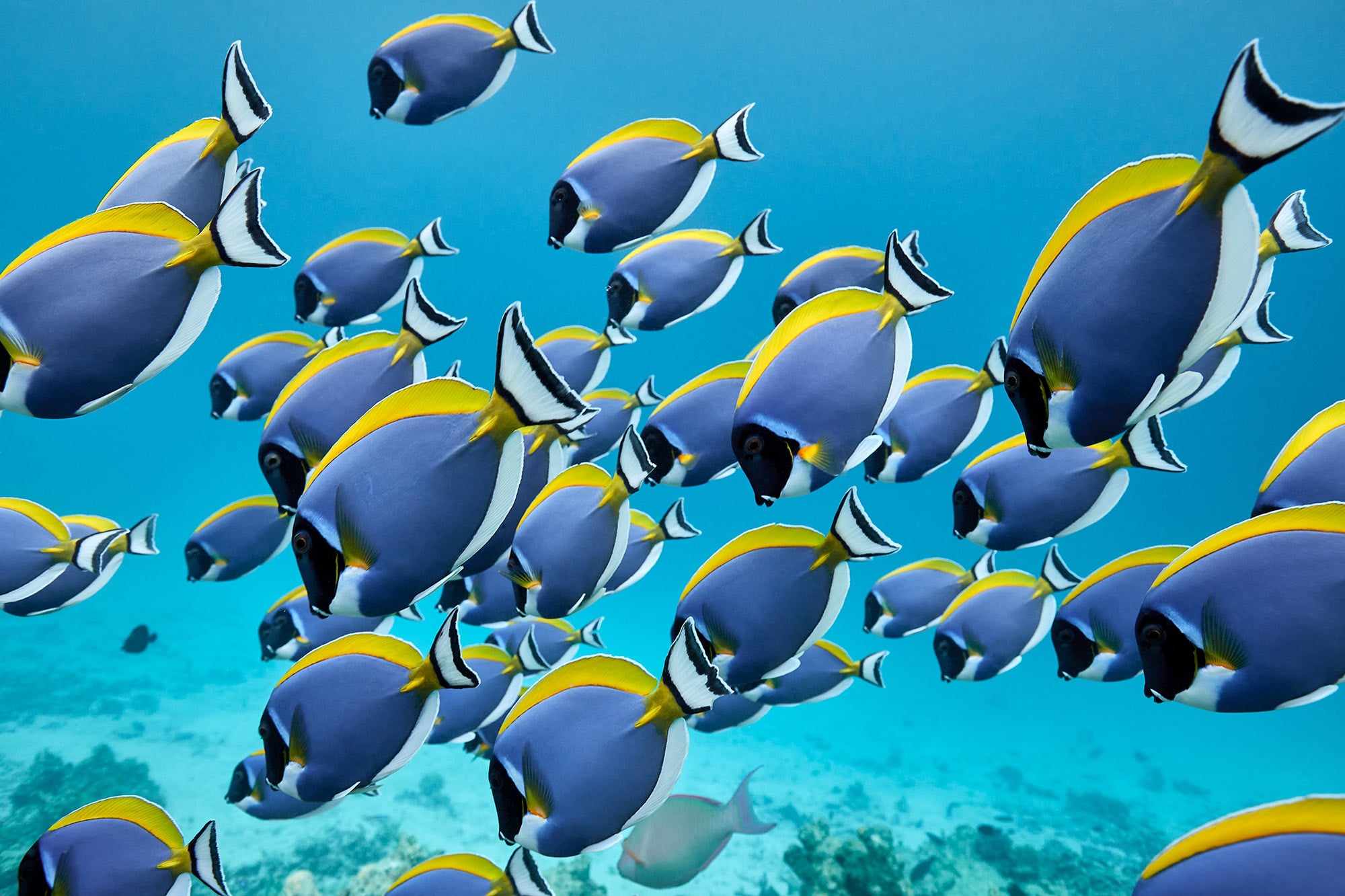
Scientists have long assumed that fish save energy by swimming in neat diamond formations, but a new study using advanced 3D tracking tells a different story.
For 50 years, scientists believed that fish swimming in tightly organized diamond shapes could conserve the most energy. But a new experiment from researchers at Princeton and Harvard set out to test whether this long-standing theory holds up under real-world conditions.
Surprisingly, the findings show that fish rarely swim in diamond shapes. Instead, they move in a more flexible and constantly shifting pattern the researchers describe as a “ladder.” In this formation, the fish are positioned in staggered layers across three dimensions, similar to how fighter jets arrange themselves in flight.
To make this discovery, the research team—led by Radhika Nagpal, a professor of robotics at Princeton—modified advanced computer vision software. Originally designed to track the movement of individual animals, the tool was adapted to capture the first three-dimensional data of how fish actually position themselves while swimming in schools.
Studying Giant Danios in 3D
Working with Harvard University biologist George Lauder, the researchers analyzed a group of six giant danios swimming for 10 hours in a tank with recirculating flow. They found that the fish almost never formed a diamond, instead swimming in a ladder shape 79 percent of the time.
“When swimming, fish on average generate a jet going backward, like the jet engine of a plane,” said Hungtang Ko, postdoctoral researcher at Princeton and lead author on the study. Because of this, it’s beneficial to avoid being directly behind one another. Ko said the ladder formation provides similar hydrodynamic benefits as in the diamond shape, but the fish don’t have to work as hard to synchronize because they can stagger in multiple planes instead of just one.
Example video of fish school tracked for 2 minutes. Credit: Ko et al.
The diamond formation was first proposed as the most hydrodynamically efficient in the 1970s, and has since been reinforced by models and experiments that were limited to a 2D view. Models of fish schools have generally been limited to flat planes because it’s difficult to capture accurate 3D movement from multiple camera angles. The new software adaptation solved that problem, laying a foundation for future studies to examine fish schools in 3D.
Implications for Robotics and Bio-Inspired Design
The researchers said this work has interesting applications in robotics. The Nagpal lab is working on fish-inspired underwater robot swarms that in the future, could move in similar dynamic ladder formations and gain energetic benefits. Understanding fish schools will help engineers design more efficient underwater robots for tasks like monitoring reefs and kelp forests.
“The collaboration is a two-way street,” said Ko. “We can use computer vision to discover how and why animal groups do things together. And then we can ask, what kind of real-world robotic system could this biological insight be applied to?”
Reference: “Beyond planar: fish schools adopt ladder formations in 3D” by Hungtang Ko, Abigail Girma, Yangfan Zhang, Yu Pan, George Lauder and Radhika Nagpal, 27 June 2025, Scientific Reports.
DOI: 10.1038/s41598-025-06150-2
The research was supported by ONR MURI grant N00014-22-1-2616. Ko is supported by the James S. McDonnell Foundation’s Postdoctoral Fellowship for Understanding Dynamic & Multi-scale Systems and the Company of Biologists Travelling Fellowship. Zhang is supported by a Postdoctoral Fellowship of the Natural Sciences and Engineering Research Council of Canada and a Banting Postdoctoral Fellowship of NSERC & Canadian Institutes of Health Research
Never miss a breakthrough: Join the SciTechDaily newsletter.
Follow us on Google and Google News.