
Close Menu
    Facebook X (Twitter) Instagram
    SciTechDaily
    • Biology
    • Chemistry
    • Earth
    • Health
    • Physics
    • Science
    • Space
    • Technology
    Facebook X (Twitter) Pinterest YouTube RSS
    SciTechDaily
    Home»Physics»Physicists Challenge the Accepted Wisdom on How Liquids Behave With Other Materials
    Physics

    Physicists Challenge the Accepted Wisdom on How Liquids Behave With Other Materials

    By University of BristolOctober 16, 2019No Comments3 Mins Read
    Facebook Twitter Pinterest Telegram LinkedIn WhatsApp Email Reddit
    Share
    Facebook Twitter LinkedIn Pinterest Telegram Email Reddit

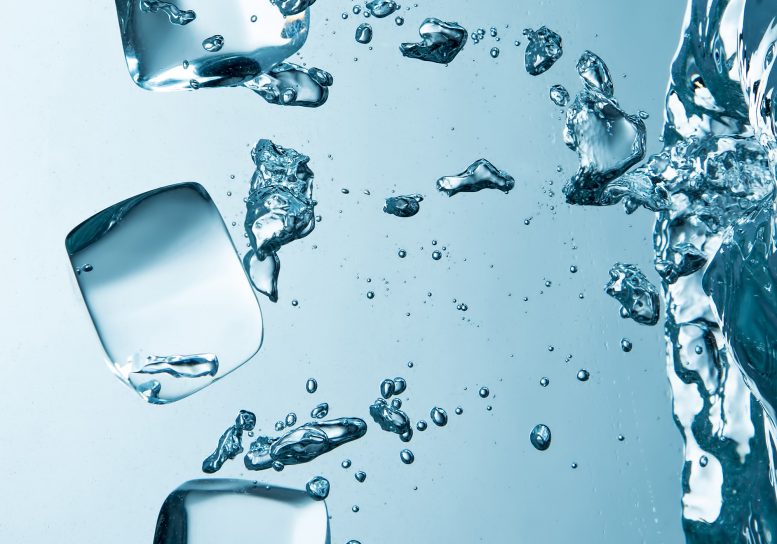
    Liquid Behavior Illustration

    Their findings, published in the Proceedings of the National Academy of Sciences (PNAS), challenge the accepted wisdom on wetting and drying phase behavior.

    The authors provide a firm conceptual framework for tailoring the properties of new materials, including finding super-repellant substrates, such as expelling water from windscreens, as well as understanding hydrophobic interactions at the length scale of biomolecules.

    When a liquid such as water is repelled from a solid substrate, the drop created exhibits a large contact angle. This is known as a hydrophobic state, or superhydrophobic if the contact angle is very large, so that the drop forms a near-spherical shape.

    By contrast, if the substrate attracts the liquid sufficiently strongly – in other words, a hydrophilic substrate – this creates a small contact angle and the drop spreads over the surface.

    Whether a surface is hydrophobic or hydrophilic is determined by the degree of molecular attraction between the substrate and the liquid.

    Controlling the attraction is key to the wettability of substrates, which determines how many physical and biological systems function. For instance, plant leaves are often hydrophobic, allowing them to remain dry during rain so that gas exchange can occur through their pores. However, liquids such as paints, inks, and lubricants are required to spread out to coat or ‘wet’ surfaces.

    Building on early insights gained by former Bristol Ph.D. student Dr. Maria Stewart, Professor Bob Evans, and Professor Nigel Wilding from the School of Physics applied a number of theoretical and simulation techniques to realistic fluid models in order to study the properties of hydrophobic and hydrophilic substrates.

    They discovered rich and unexpected behavior such as divergent density fluctuations associated with the phenomenon of ‘critical drying’ at a superhydrophobic substrate.

    Professor Evans said: “Clarifying the factors that control the contact angle of a liquid on a solid substrate is a long-standing scientific problem pertinent across physics, chemistry, and materials science. Progress has been hampered by the lack of a comprehensive and unified understanding of the physics of wetting and drying phase transitions. Our results show the character of these transitions depends sensitively on both the range of fluid-fluid and substrate-fluid interactions and the temperature.

    Professor Wilding added: “Our work has uncovered previously unrecognized classes of surface phase diagrams to which most experimental and simulation studies of liquids in contact with a substrate belong. A particularly interesting feature relates to the water near superhydrophobic substrates where one observes the phenomenon of  ‘critical drying’ as θ →180°. This is signaled by divergent density fluctuations which lead to rich structural properties including fractal arrangements of vapor bubbles near the substrate.”

    Reference: “A unified description of hydrophilic and superhydrophobic surfaces in terms of the wetting and drying transitions of liquids” by Robert Evans, Maria C. Stewart and Nigel B. Wilding, 14 October 2019, Proceedings of the National Academy of Sciences (PNAS).
    DOI: 10.1073/pnas.1913587116

    Never miss a breakthrough: Join the SciTechDaily newsletter.
    Follow us on Google and Google News.

    University of Bristol Water
    Share. Facebook Twitter Pinterest LinkedIn Email Reddit

    Related Articles

    Ingenious New Method Measures the 3D Position of Individual Atoms

    MIT’s Surprising Discovery: Light Can Evaporate Water Without Heat

    The Science Behind Skipping Stones: Gateway to Marine Engineering Advances

    Scientists Reveal That Water Can “Talk” to Electrons in Graphene

    “Counterportation” – Landmark Quantum Breakthrough Paves Way for World-First Experimental Wormhole

    Unsolved for 500 Years: Researchers Crack Leonardo da Vinci’s Paradox

    Mesmerizing: Watch Water Droplets Merge on the International Space Station

    “Quantum Friction” Explains Fluid Dynamics Mystery That Has Baffled Scientists for 15 Years

    Using Ice To Boil Water: Heat Transfer Discovery Expands on 18th Century Physics Principle

    Leave A Reply Cancel Reply

    • Facebook
    • Twitter
    • Pinterest
    • YouTube

    Don't Miss a Discovery

    Subscribe for the Latest in Science & Tech!

    Trending News

    Popular Sugar-Free Sweetener Linked to Liver Disease, Study Warns

    What Is Hantavirus? The Deadly Disease Raising Alarm Worldwide

    Scientists Just Discovered How the Universe Builds Monster Black Holes

    Scientists Unveil New Treatment Strategy That Could Outsmart Cancer

    A Simple Vitamin May Hold the Key to Treating Rare Genetic Diseases

    Scientists Think the Real Fountain of Youth May Be Hiding in Your Gut

    Ravens Don’t Follow Wolves, They Predict Them

    This Common Knee Surgery May Be Doing More Harm Than Good

    Follow SciTechDaily
    • Facebook
    • Twitter
    • YouTube
    • Pinterest
    • Newsletter
    • RSS
    SciTech News
    • Biology News
    • Chemistry News
    • Earth News
    • Health News
    • Physics News
    • Science News
    • Space News
    • Technology News
    Recent Posts
    • Scientists Uncover the Surprising Source of Strange Clouds Near the Milky Way’s Supermassive Black Hole
    • This Dazzling Green Snake Was Hiding in Plain Sight for Decades
    • Scientists Discover That a Single Dose of Psilocybin Changes the Human Brain
    • “Totally Unexpected” – Scientists Discover Pancreatic Cancer’s Fatal Addiction
    • A Strange Quantum Effect May Explain One of Biology’s Greatest Mysteries
    Copyright © 1998 - 2026 SciTechDaily. All Rights Reserved.
    • Science News
    • About
    • Contact
    • Editorial Board
    • Privacy Policy
    • Terms of Use

    Type above and press Enter to search. Press Esc to cancel.