

A research team at the Institute of Astronomy, Academia Sinica (ASIAA) has achieved groundbreaking insights into the physics of supernova shockwaves.
Using the powerful Kawas computing cluster at ASIAA, the team conducted over two years of intensive calculations to develop the world’s first two-dimensional multi-wavelength radiation-hydrodynamics simulations. These advanced simulations have provided a detailed understanding of shock breakout flashes by accurately modeling how photons of different energies interact with the shockwave dynamics.
This breakthrough allows scientists to compare the simulated shockwave flash signals directly with real observational data, improving our ability to study and predict supernovae. The team’s findings have been published in the latest issue of the Astrophysical Journal.
Supernova Formation
Massive stars, with masses between 10 and 30 times that of the Sun, undergo dramatic changes in their final stages of life. As they near the end, they develop an iron core that eventually collapses under its own gravity, forming a neutron star. This collapse releases an immense amount of gravitational energy, primarily through neutrinos, which trigger a powerful shockwave that tears the star apart.
The shockwave travels through the star at supersonic speeds and plays a key role in the supernova explosion. When it reaches the star’s surface, energy from the shockwave begins to diffuse outward, creating an incredibly bright flash known as the “supernova shock breakout.” The duration of this flash depends on the star’s size and mass, typically lasting only a few hours. Most of the radiation from this event is emitted in X-rays and ultraviolet light, appearing long before the explosion becomes visible to the naked eye.
Because the shock breakout occurs early in the supernova process, it serves as a valuable early-warning signal, helping astronomers predict when a star is about to explode.

Simulation Insights on Supernova 1987A
The team’s simulations focused on the well-known supernova 1987A, which provides a unique opportunity to study the evolution from core-collapse supernovae to supernova remnants. The research revealed that the environment of the progenitor star significantly impacts the breakout flash, indicating that the flash can be used to investigate the conditions surrounding supernova explosions and infer the relationship between the circumstellar medium and mass loss of the star.
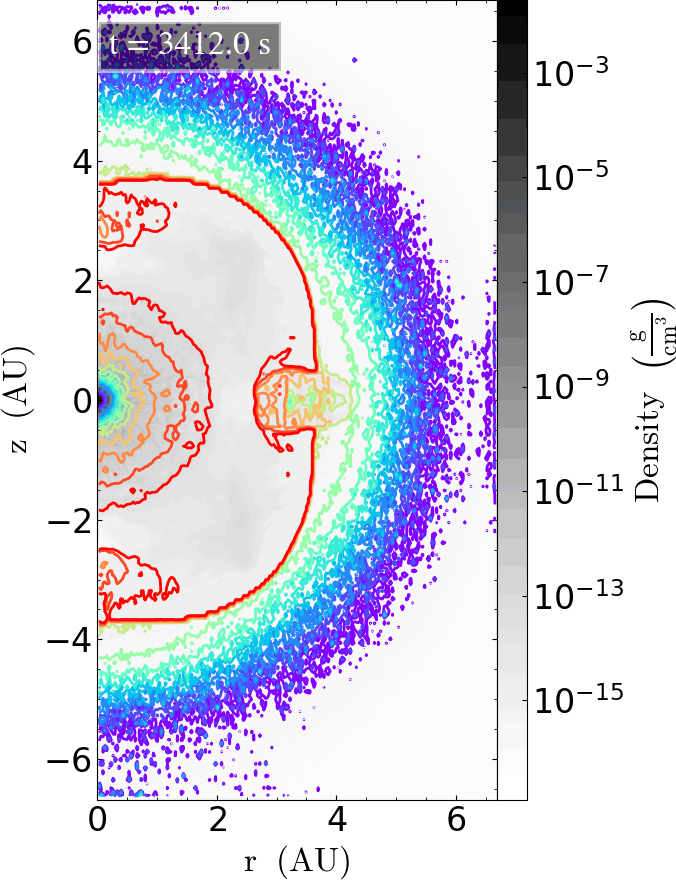
The multi-dimensional simulations showed that fluid instabilities during the shock breakout enhance the brightness of the flash and prolong its duration, differing significantly from previous one-dimensional simulations and fundamentally reshaping our understanding of breakout flashes for supernovae.
Advanced Modelling Techniques for Supernova Studies
“The interaction between radiation precursors and the surrounding medium is crucial for forming the shock breakout signal. Our new multi-dimensional, multi-band simulations can more accurately describe the complex radiative fluid dynamics during shock breakout,” noted Wun-Yi Chen, who is the first author of the paper.
Dr. Masaomi Ono, a co-author of the study at ASIAA, adds: “This research clearly demonstrates that even for spherical explosions, the shock breakout signals derived from two-dimensional radiative fluid dynamics may differ from those predicted by one-dimensional models. Multi-dimensional radiative fluid dynamics is vital for assessing the shock breakout signals of core-collapse supernovae, especially in the non-uniform circumstellar medium.”
Implications for Future Supernova Observations
“These simulations provide essential reference data for future observations and predictions of supernovae. Next-generation X-ray and ultraviolet space telescopes will capture more supernova shock breakout flashes, furthering our understanding of the early evolution of supernovae and the final evolution of massive stars,” emphasized Dr. Ke-Jung Chen, leader of the research team.
Reference: “Multidimensional Radiation Hydrodynamics Simulations of SN 1987A Shock Breakout” by Wun-Yi Chen, Ke-Jung Chen and Masaomi Ono, 19 November 2024, The Astrophysical Journal.
DOI: 10.3847/1538-4357/ad7de3
Never miss a breakthrough: Join the SciTechDaily newsletter.
Follow us on Google and Google News.