
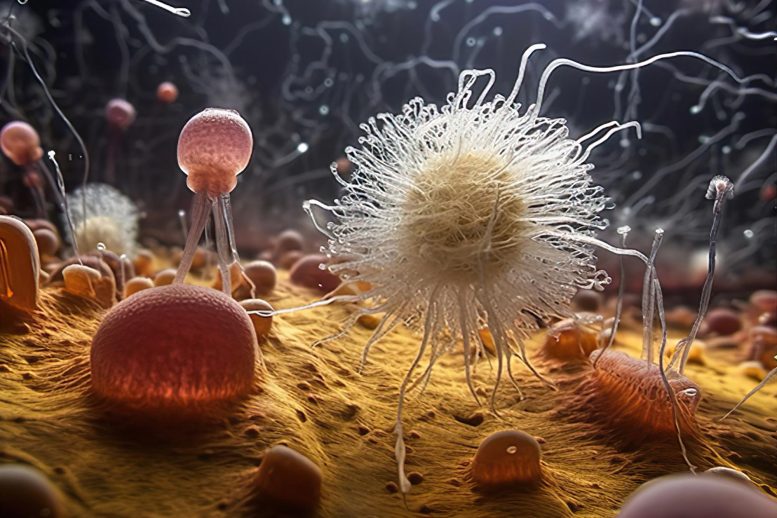
A multinational research team has found ancient protosteroids in rocks, indicating that complex life existed up to 1.6 billion years ago. These molecules offer a novel insight into the evolution of complex life and reconcile the discrepancies between traditional and lipid fossil records.
The newly discovered record of so-called protosteroids was shown to be surprisingly abundant throughout Earth´s Middle Ages. The primordial molecules were produced at an earlier stage of eukaryotic complexity – extending the current record of fossil steroids beyond 800 and up to 1600 million years ago. Eukaryotes is the term for a kingdom of life including all animals, plants and algae and set apart from bacteria by having a complex cell structure that includes a nucleus, as well as a more complex molecular machinery.
“The highlight of this finding is not just the extension of the current molecular record of eukaryotes,” says Christian Hallmann one of the participating scientists from the German Research Center for Geosciences (GFZ) in Potsdam. “Given that the last common ancestor of all modern eukaryotes, including us humans, was likely capable of producing ‘regular’ modern sterols, chances are high that the eukaryotes responsible for these rare signatures belonged to the stem of the phylogenetic tree.”
This “stem” represents the common ancestral lineage that was a precursor to all still-living branches of eukaryotes. Its representatives are long extinct, yet details of their nature may shed more light on the conditions surrounding the evolution of complex life. Although more research is needed to evaluate what percentage of protosteroids may have had a rare bacterial source, the discovery of these new molecules not only reconciles the geological record of traditional fossils with that of fossil lipid molecules, but yields a rare and unprecedented glimpse of a lost world of ancient life. The competitive demise of stem group eukaryotes, marked by the first appearance of modern fossil steroids some 800 million years ago, may reflect one of the most incisive events in the evolution of increasingly complex life.
The Transition From Ancient to Modern Eukaryotic Steroids
“Almost all eukaryotes biosynthesize steroids, such as cholesterol that is produced by humans and most other animals” adds Benjamin Nettersheim from MARUM, University of Bremen, who shares first authorship of the study with Jochen Brocks from the Australian National University (ANU) – “due to potentially adverse health effects of elevated cholesterol levels in humans, cholesterol doesn’t have the best reputation from a medical perspective. However, these lipid molecules are integral parts of eukaryotic cell membranes where they aid in a variety of physiological functions. By searching for fossilized steroids in ancient rocks, we can trace the evolution of increasingly complex life.”
Nobel laureate Konrad Bloch had already speculated about such a biomarker in an essay almost 30 years ago. Bloch suggested that short-lived intermediates in the modern biosynthesis of steroids may not always have been intermediates. He believed that lipid biosynthesis evolved in parallel with changing environmental conditions throughout Earth history. In contrast to Bloch, who did not believe that these ancient intermediates could ever be found, Nettersheim started searching for protosteroids in ancient rocks that were deposited at a time when those intermediates could actually have been the final product.
But how to find such molecules in ancient rocks? “We employed a combination of techniques to first convert various modern steroids to their fossilized equivalent; otherwise, we wouldn’t have even known what to look for,” says Jochen Brocks. Scientists had overlooked these molecules for decades because they do not conform to typical molecular search images. “Once we knew our target, we discovered that dozens of other rocks, taken from billion-year-old waterways across the world, were oozing with similar fossil molecules.”
The Tonian Transformation: A Turning Point in Evolution
The oldest samples with the biomarker are from the Barney Creek Formation in Australia and are 1.64 billion years old. The rock record of the next 800 million years only yields fossil molecules of primordial eukaryotes before molecular signatures of modern eukaryotes first appear in the Tonian period. According to Nettersheim “the Tonian Transformation emerges as one of the most profound ecological turning points in our planet´s history“. Hallmann adds that “both primordial stem groups and modern eukaryotic representatives such as red algae may have lived side by side for many hundreds of millions of years”. During this time, however, the Earth’s atmosphere became increasingly enriched with oxygen – a metabolic product of cyanobacteria and of the first eukaryotic algae – that would have been toxic to many other organisms. Later, global “Snowball Earth” glaciations occurred and the protosterol communities largely died out. The last common ancestor of all living eukaryotes may have lived 1.2 to 1.8 billion years ago. Its descendants were likely better able to survive heat and cold as well as UV radiation and displaced their primordial relatives.
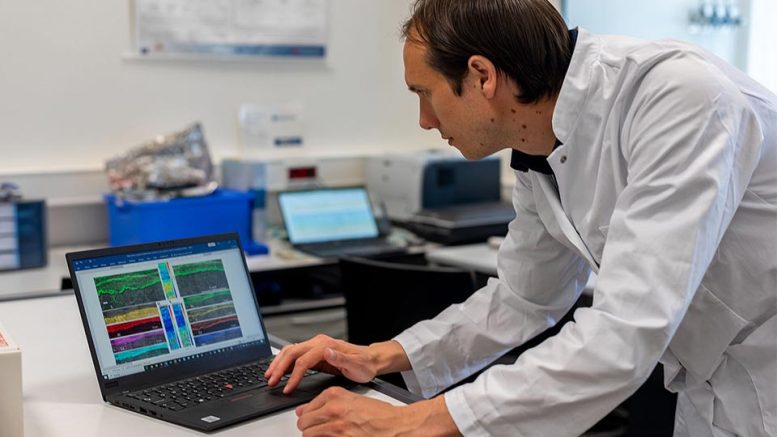
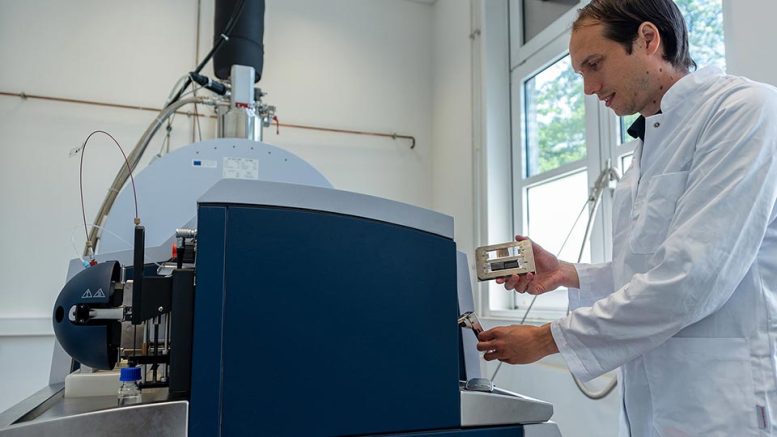
“Earth was a microbial world for much of its history and left few traces,” Nettersheim concludes. Research at ANU, MARUM and GFZ continues to pursue tracing the roots of our existence – the discovery of protosterols now brings us one step closer to understanding how our earliest ancestors lived and evolved. Shooting at the ancient rocks with a laser coupled to an ultra-high resolution mass spectrometer in MARUM’s globally unique Geobiomolecular Imaging Laboratory, Dr. Nettersheim and his international collaborators aim at zooming into the cradle of eukaryotic life in unprecedented resolution to further improve our understanding of our early ancestors in the future.
For more on this research:
Reference: “Lost world of complex life and the late rise of the eukaryotic crown” by Jochen J. Brocks, Benjamin J. Nettersheim, Pierre Adam, Philippe Schaeffer, Amber J. M. Jarrett, Nur Güneli, Tharika Liyanage, Lennart M. van Maldegem, Christian Hallmann and Janet M. Hope, 7 June 2023, Nature.
DOI: 10.1038/s41586-023-06170-w
Participating Institutions:
- Research School of Earth Sciences, The Australian National University, Canberra, Australia
- MARUM – Center for Marine Environmental Sciences, University of Bremen, Bremen, Germany
- Faculty of Geosciences, University of Bremen, Bremen, Germany
- Université de Strasbourg, CNRS, Institut de Chimie de Strasbourg, Strasbourg, France
- Northern Territory Geological Survey, Darwin, Australia
- German Research Center for Geosciences (GFZ), Potsdam, Germany
MARUM produces fundamental scientific knowledge about the role of the ocean and the ocean floor in the total Earth system. The dynamics of the ocean and the ocean floor significantly impact the entire Earth system through the interaction of geological, physical, biological and chemical processes. These influence both the climate and the global carbon cycle, and create unique biological systems. MARUM is committed to fundamental and unbiased research in the interests of society and the marine environment, and in accordance with the Sustainable Development Goals of the United Nations. It publishes its quality-assured scientific data and makes it publicly available. MARUM informs the public about new discoveries in the marine environment and provides practical knowledge through its dialogue with society. MARUM cooperates with commercial and industrial partners in accordance with its goal of protecting the marine environment.
Never miss a breakthrough: Join the SciTechDaily newsletter.
Follow us on Google and Google News.