
Close Menu
    Facebook X (Twitter) Instagram
    SciTechDaily
    • Biology
    • Chemistry
    • Earth
    • Health
    • Physics
    • Science
    • Space
    • Technology
    Facebook X (Twitter) Pinterest YouTube RSS
    SciTechDaily
    Home»Technology»Scientists Develop “Super Sapphire” That Resists Scratches, Glare, Fog, and More
    Technology

    Scientists Develop “Super Sapphire” That Resists Scratches, Glare, Fog, and More

    By University of Texas at AustinMarch 24, 2025No Comments4 Mins Read
    Facebook Twitter Pinterest Telegram LinkedIn WhatsApp Email Reddit
    Share
    Facebook Twitter LinkedIn Pinterest Telegram Email Reddit
    Blue Sapphire
    Researchers at UT Austin have developed durable sapphire nanostructures that repel glare, dust, and fog, potentially revolutionizing phone screens, glasses, and windshields. Inspired by moth eyes and lotus leaves, the structures are both tough and multifunctional, ideal for harsh environments like space and defense.

    New sapphire nanostructures created at UT Austin repel dust, glare, and fog while staying durable. Inspired by nature, these surfaces could be used in electronics, optics, space, and defense, and are being developed for real-world applications.

    Imagine a phone screen that stays flawless no matter how many times you drop it, glasses that eliminate glare, or a windshield that doesn’t get dusty. These could soon become a reality, thanks to a new method for producing sapphire.

    Researchers at The University of Texas at Austin have developed innovative techniques to bestow superpowers upon sapphire, a material often seen as just a gemstone but valued in industries ranging from defense to consumer electronics. Its exceptional hardness makes it nearly impossible to scratch, making it ideal for high-performance applications.

    “Sapphire is a high-value material because of its hardness and many other beneficial properties,” said Chih-Hao Chang, associate professor in the Walker Department of Mechanical Engineering and lead researcher on the project. “But those same properties also make it very difficult to manufacture at small scales.”

    Engineered Sapphire Sample
    A sample of the sapphire. Credit: The University of Texas at Austin

    Record-Breaking Sapphire Nanostructures

    Chang and his team hope to ease this challenge with new sapphire-based nanostructures as documented in Materials Horizons. The nanostructures show the highest aspect ratio yet for this material, which enables its superpowers without completely losing its stiffness and hardness.

    The research: While not quite as scratch-resistant as traditional bulk sapphire – the nanostructures are comparable to tungsten or traditional glass in that way – these new sapphire nanostructures repel fog, dust, and glare with self-cleaning capabilities.
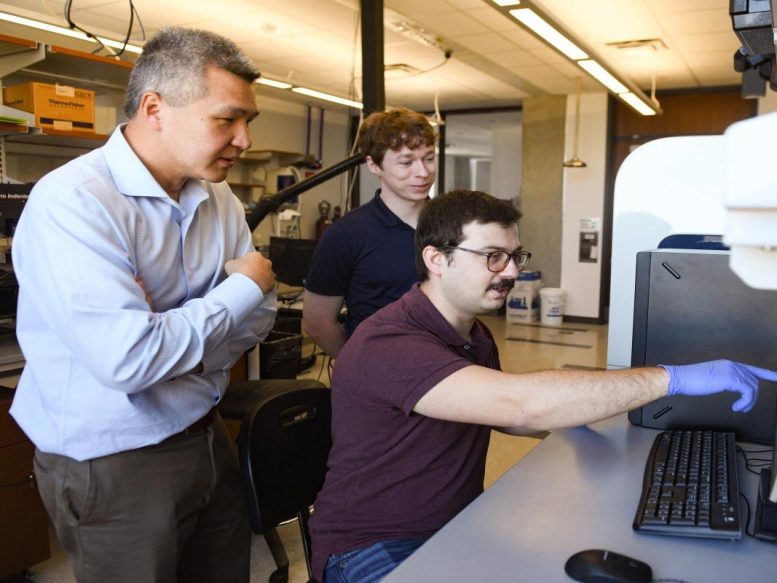
    Professor Chih Hao Chang With Mehmet Kepenekci and Andrew Tunell
    Professor Chih-Hao Chang with Mehmet Kepenekci and Andrew Tunell, members of his lab. Credit: The University of Texas at Austin

    “This is very exciting since nanostructures are traditionally seen as being fragile, but making them in sapphire can solve this problem,” said Kun-Chieh Chien, a recent Ph.D. graduate from Chang’s lab and one of the lead authors.

    Nature-Inspired, Self-Cleaning Design

    Inspired by the moth eye, the tapered profile of the sapphire nanostructures enhance light transmission and reduce glare. The nanostructures’ high surface energy and aspect ratio create a superhydrophilic surface to prevent fog. The structures can also be treated to be a superhydrophobic surface to allow water droplets to roll off the surface, mimicking the lotus leaf effect.

    “Our sapphire nanostructures are not only multifunctional but also mechanically robust, making them ideal for applications where durability and performance are critical,” said Mehmet Kepenekci, a graduate student in Chang’s lab and one of the lead authors.

    Why it matters: This technology has a wide variety of benefits. For consumers, it could lead to smartphones that are easier to read in challenging lighting conditions, lenses and windows that don’t fog up, cameras that aren’t prone to glare and hardy windshields that don’t get dusty.

    The Nanostructures, Plus Anti Fog and Glare Capabilities.
    The nanostructures, plus anti-fog and glare capabilities. Credit: The University of Texas at Austin

    As we embark on the next generation of space travel, the anti-dust properties could ensure mission-critical equipment doesn’t get caked in dust during landing missions on other planets, for example. It could lead to the creation of stronger infrared sensors and protective windows in defense applications.

    “Our self-cleaning sapphire surfaces can maintain 98.7% dust-free area using gravity alone,” said Andrew Tunell, the student who conducted the dust adhesion experiments. “This is a significant improvement over existing dust-mitigation technologies and is particularly beneficial for applications in space, where water is not readily available for cleaning.”

    What’s next: The researchers aim to bring this technology to life, and they’re looking to improve it several ways. They’re scaling up fabrication to apply these nanostructures over larger samples, improving mechanical and chemical properties to enhance their abilities and exploring even more real-world applications.

    Reference: “Scratch-resistant sapphire nanostructures with anti-glare, anti-fogging, and anti-dust properties” by Kun-Chieh Chien, Mehmet Kepenekci, Andrew Tunell and Chih-Hao Chang, 11 February 2025, Materials Horizons.
    DOI: 10.1039/D4MH01844C

    Never miss a breakthrough: Join the SciTechDaily newsletter.
    Follow us on Google and Google News.

    Materials Science Mechanical Engineering Nanostructures Nanotechnology University of Texas at Austin
    Share. Facebook Twitter Pinterest LinkedIn Email Reddit

    Related Articles

    Unique Property Found in Complex Nanostructures for the First Time

    New Nanomaterial Resists Projectile Impact Better Than Kevlar

    Growing “Metallic Wood” to New Heights: Radically Decreasing a Material’s Density Without Sacrificing Strength

    Tougher Than Kevlar and Steel: Ultralight Material Withstands Supersonic Microparticle Impacts

    Meringue-Like Graphene-Based Aerogel Material Could Make Aircraft As Quiet as a Hairdryer

    Engineers Creates New Ultralightweight, Crush-Resistant Tensegrity Metamaterials

    Plant-Based Nanowire Spray Could Be Used to Improve N95 Mask Filters, Energy Harvesters

    “Stronger Than Diamonds” Carbon Nanostructure Designed – Reaches Theoretical Limit of Performance

    Yale Engineers Create a New Kind of Metallic Glass

    Leave A Reply Cancel Reply

    • Facebook
    • Twitter
    • Pinterest
    • YouTube

    Don't Miss a Discovery

    Subscribe for the Latest in Science & Tech!

    Trending News

    Scientists May Have Found the Key to Jupiter and Saturn’s Moon Mystery

    Scientists Uncover Brain Changes That Link Pain to Depression

    Saunas May Do More Than Raise Body Temperature – They Activate Your Immune System

    Exercise in a Pill? Metformin Shows Surprising Effects in Cancer Patients

    Hidden Oceans of Magma Could Be Protecting Alien Life

    New Study Challenges Alzheimer’s Theories: It’s Not Just About Plaques

    Artificial Sweeteners May Harm Future Generations, Study Suggests

    Splashdown! NASA Artemis II Returns From Record-Breaking Moon Mission

    Follow SciTechDaily
    • Facebook
    • Twitter
    • YouTube
    • Pinterest
    • Newsletter
    • RSS
    SciTech News
    • Biology News
    • Chemistry News
    • Earth News
    • Health News
    • Physics News
    • Science News
    • Space News
    • Technology News
    Recent Posts
    • Ancient DNA Reveals Irish Goats Have a 3,000-Year-Old Lineage Still Alive Today
    • Historians Reveal Secrets of the Strange Hat Wars That Shook Early Modern England
    • “A Plague Is Upon Us”: The Mass Death That Changed an Ancient City Forever
    • This Strange Material Can Turn Superconductivity on and off Like a Switch
    • Scientists Discover Game-Changing New Way To Treat High Cholesterol
    Copyright © 1998 - 2026 SciTechDaily. All Rights Reserved.
    • Science News
    • About
    • Contact
    • Editorial Board
    • Privacy Policy
    • Terms of Use

    Type above and press Enter to search. Press Esc to cancel.