
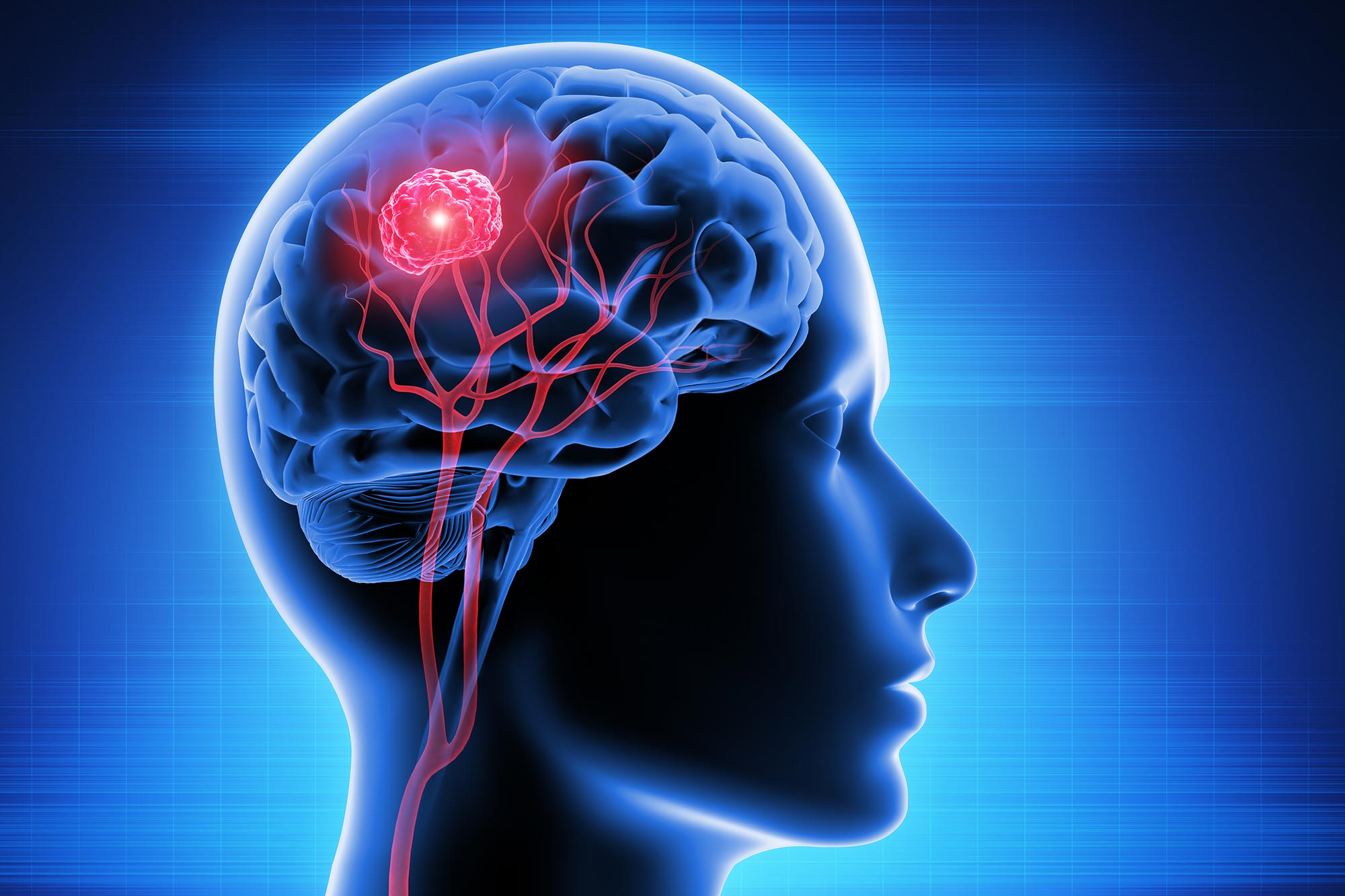
New research reveals that certain brain tumors may originate silently within normal brain cells long before a tumor forms.
IDH-mutant glioma is a malignant brain cancer linked to changes in a single gene (IDH), and it is the most common malignant brain tumor in adults younger than 50. Doctors often struggle to control it because it has a high chance of coming back after treatment. For years, care has centered on removing the tumor mass that can be identified.
A Korean research team now reports a key shift in that picture. They found that the first IDH mutation can arise in brain cells that still look normal, and those altered cells can spread through the cortex well before a tumor becomes visible and before additional cancer mutations accumulate. The finding suggests new opportunities to detect the disease earlier and develop approaches aimed at reducing recurrence.
According to the study, normal brain cells can acquire the initial IDH mutation and slowly spread throughout the cerebral cortex. Only later do these cells accumulate additional cancer-related mutations that lead to the formation of a detectable tumor mass. This discovery highlights new opportunities for diagnosing the disease earlier and developing treatments aimed at preventing recurrence.
The Korea Advanced Institute of Science and Technology recently announced that a joint research team led by Professor Jeong Ho Lee of the Graduate School of Medical Science and Engineering and Professor Seok-Gu Kang of the Department of Neurosurgery at Yonsei University Severance Hospital had identified the cellular origin of IDH-mutant gliomas. The team found that these tumors arise from Glial Progenitor Cells (GPCs) that already exist within otherwise normal brain tissue.
GPCs are a type of cell found in the healthy brain that can give rise to malignant brain tumors when genetic mutations occur.
Mutations Hidden Within Normal-Looking Brain Tissue
By closely examining tumor samples collected during extensive resection surgery, along with nearby tissue from the normal cerebral cortex, the researchers identified “cells of origin” carrying the IDH mutation in areas that appeared normal to the naked eye.
This provides the first evidence that these malignant brain tumors are not sudden events that appear at a single moment. Instead, they may begin within an otherwise normal brain and develop gradually over a long period.
To verify the identity and location of these early mutated cells, the team used “spatial transcriptomics”, a technology that reveals which genes are active and where in the tissue. The analysis showed that the mutation-bearing origin cells were Glial Progenitor Cells (GPCs) situated in the cerebral cortex.
The researchers also recreated this early disease process in an animal model. By introducing the same genetic “driver mutation” seen in patients into the GPCs of mice, they were able to reproduce key steps in brain tumor development.
Distinct Origins of Different Brain Tumor Types
This study is a significant expansion of previous research identifying the “origin” of IDH wildtype malignant brain tumors. In 2018, the joint research team led a paradigm shift in brain tumor research by revealing that IDH wildtype glioblastoma, a representative malignant brain tumor, originates not from the tumor body itself, but from neural stem cells in the subventricular zone—the source of new brain cells in the adult brain (Lee et al., Nature, 2018).
The current study clarifies that even though “IDH wildtype glioblastoma” and “IDH-mutant glioma” are both types of brain cancer, their starting cells and points of origin are entirely different, proving that different types of brain tumors have fundamentally different developmental processes.
Professor Seok-Gu Kang (Co-Corresponding Author) stated, “Brain tumors may not start exactly where the tumor mass is visible. A target approach focused on the origin cells and the site of origin according to the brain tumor subtype will serve as a crucial clue to changing the paradigm of early diagnosis and recurrence suppression treatment.”
Based on these research results, Sovagen Co., Ltd, a faculty startup from KAIST, is developing an innovative RNA-based drug to suppress the evolution and recurrence of IDH-mutant malignant brain tumors. Additionally, Severance Hospital is pursuing the development of technologies to detect and control early mutant cells in refractory brain tumors through the Korea-US Innovative Result Creation R&D project.
Dr. Jung Won Park (Postdoctoral Researcher at KAIST Graduate School of Medical Science and Engineering), a neurosurgeon and the sole first author of the study, said, “This achievement was made possible by combining KAIST’s world-class basic science research capabilities with the clinical expertise of Yonsei Severance Hospital. The question I kept asking while treating patients—’Where does this tumor originate?’—was the starting point of this research.”
Reference: “IDH-mutant gliomas arise from glial progenitor cells harboring the initial driver mutation” by Jung Won Park, Jiehoon Kwak, Keon-Woo Kim, Saehoon Jung, Chang Hyun Nam, Hyun Jung Kim, Sang Mee Lee, Chanho Choi, Yongjin Ahn, Ji-Hyung Park, Jihwan Yoo, Jin-Kyoung Shim, Hye Joung Cho, Eui-Hyun Kim, Chungyeul Kim, Sangjeong Ahn, Stefan Pusch, Andreas von Deimling, Jong Hee Chang, Se Hoon Kim, Hoon Kim, Young Seok Ju, Seok-Gu Kang and Jeong Ho Lee, 8 January 2026, Science.
DOI: 10.1126/science.adt0559
This research was conducted with support from the Suh Kyung-bae Science Foundation, the National Research Foundation of Korea, the Ministry of Science and ICT, the Ministry of Health and Welfare, and the Korea Health Industry Development Institute (Physician-Scientist Training Program).
Never miss a breakthrough: Join the SciTechDaily newsletter.
Follow us on Google and Google News.