
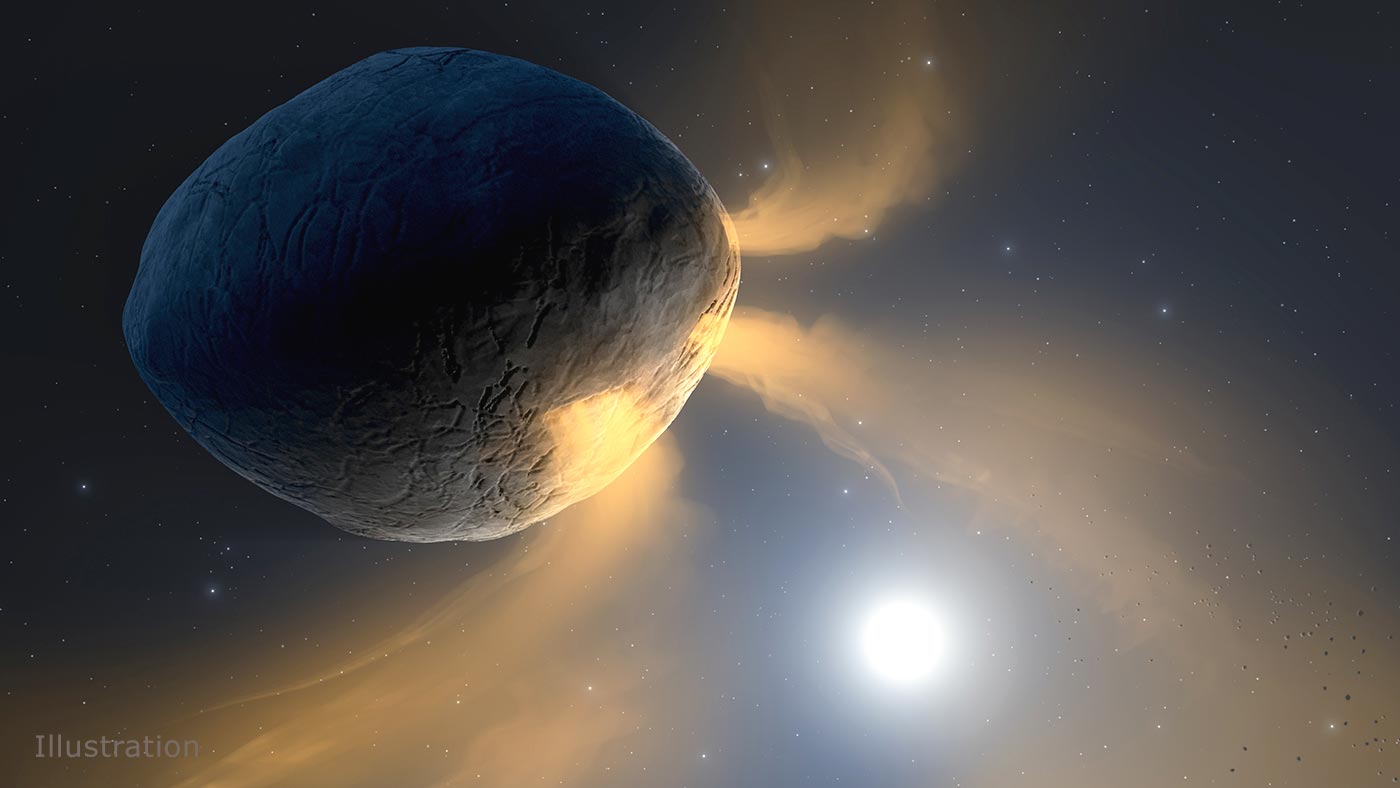
Scientists discovered that asteroid Phaethon, the source of the Geminid meteor shower, has a tail made of sodium, not dust. This finding challenges 14 years of understanding about the object and raises questions about the nature of some comets. The origin of the Geminid meteor shower’s material remains a mystery, with further answers expected from an upcoming JAXA mission, DESTINY+.
Asteroids, which are mostly rocky, do not usually form tails when they approach the Sun. Comets, however, are a mix of ice and rock, and typically do form tails as the Sun vaporizes their ice, blasting material off their surfaces and leaving a trail along their orbits. When Earth passes through a debris trail, those cometary bits burn up in our atmosphere and produce a swarm of shooting stars – a meteor shower.
After astronomers discovered Phaethon in 1983, they realized that the asteroid’s orbit matched that of the Geminid meteors. This pointed to Phaethon as the source of the annual meteor shower, even though Phaethon was an asteroid and not a comet.

The Mystery of Phaethon’s Tail
In 2009, NASA’s Solar Terrestrial Relations Observatory (STEREO) spotted a short tail extending from Phaethon as the asteroid reached its closest point to the Sun (or “perihelion”) along its 524-day orbit. Regular telescopes hadn’t seen the tail before because it only forms when Phaethon is too close to the Sun to observe, except with solar observatories. STEREO also saw Phaethon’s tail develop on later solar approaches in 2012 and 2016. The tail’s appearance supported the idea that dust was escaping the asteroid’s surface when heated by the Sun.
However, in 2018, another solar mission imaged part of the Geminid debris trail and found a surprise. Observations from NASA’s Parker Solar Probe showed that the trail contained far more material than Phaethon could possibly shed during its close approaches to the Sun.
Zhang’s team wondered whether something else, other than dust, was behind Phaethon’s comet-like behavior. “Comets often glow brilliantly by sodium emission when very near the Sun, so we suspected sodium could likewise serve a key role in Phaethon’s brightening,” Zhang said.
An earlier study, based on models and lab tests, suggested that the Sun’s intense heat during Phaethon’s close solar approaches could indeed vaporize sodium within the asteroid and drive comet-like activity.
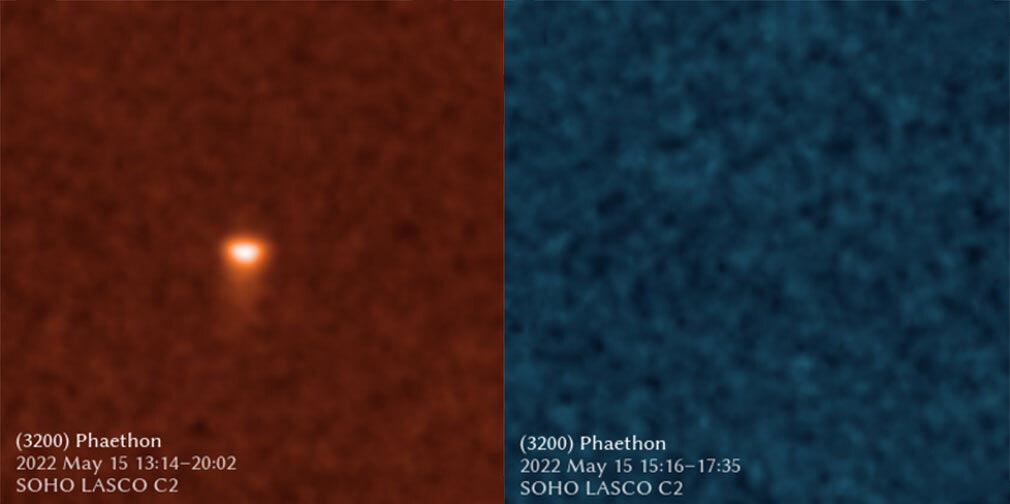
Hoping to find out what the tail is really made of, Zhang looked for it again during Phaethon’s latest perihelion in 2022. He used the Solar and Heliospheric Observatory (SOHO) spacecraft — a joint mission between NASA and the European Space Agency (ESA) – which has color filters that can detect sodium and dust. Zhang’s team also searched archival images from STEREO and SOHO, finding the tail during 18 of Phaethon’s close solar approaches between 1997 and 2022.
In SOHO’s observations, the asteroid’s tail appeared bright in the filter that detects sodium, but it did not appear in the filter that detects dust. In addition, the shape of the tail and the way it brightened as Phaethon passed the Sun matched exactly what scientists would expect if it were made of sodium, but not if it were made of dust.
This evidence indicates that Phaethon’s tail is made of sodium, not dust.
“Not only do we have a really cool result that kind of upends 14 years of thinking about a well-scrutinized object,” said team member Karl Battams of the Naval Research Laboratory, “but we also did this using data from two heliophysics spacecraft – SOHO and STEREO – that were not at all intended to study phenomena like this.”
Zhang and his colleagues now wonder whether some comets discovered by SOHO – and by citizen scientists studying SOHO images as part of the Sungrazer Project – are not comets at all.
“A lot of those other sunskirting ‘comets’ may also not be ‘comets’ in the usual, icy body sense, but may instead be rocky asteroids like Phaethon heated up by the Sun,” Zhang explained.
The Origin of the Geminid Meteor Shower
Still, one important question remains: If Phaethon doesn’t shed much dust, how does the asteroid supply the material for the Geminid meteor shower we see each December?
Zhang’s team suspects that some sort of disruptive event a few thousand years ago – perhaps a piece of the asteroid breaking apart under the stresses of Phaethon’s rotation – caused Phaethon to eject the billion tons of material estimated to make up the Geminid debris stream. But what that event was remains a mystery.
More answers may come from an upcoming Japan Aerospace Exploration Agency (JAXA) mission called DESTINY+ (short for Demonstration and Experiment of Space Technology for Interplanetary voyage Phaethon fLyby and dUst Science). Later this decade, the DESTINY+ spacecraft is expected to fly past Phaethon, imaging its rocky surface and studying any dust that might exist around this enigmatic asteroid.
Reference: “Sodium Brightening of (3200) Phaethon near Perihelion” by Qicheng Zhang, Karl Battams, Quanzhi Ye, Matthew M. Knight and Carl A. Schmidt, 25 April 2023, The Planetary Science Journal.
DOI: 10.3847/PSJ/acc866
Never miss a breakthrough: Join the SciTechDaily newsletter.
Follow us on Google and Google News.
1 Comment
Elemental sodium, or a compound like sodium chloride?