
Close Menu
    Facebook X (Twitter) Instagram
    SciTechDaily
    • Biology
    • Chemistry
    • Earth
    • Health
    • Physics
    • Science
    • Space
    • Technology
    Facebook X (Twitter) Pinterest YouTube RSS
    SciTechDaily
    Home»Space»Solar Wind Samples Suggest New Physics of Mysterious Coronal Mass Ejections
    Space

    Solar Wind Samples Suggest New Physics of Mysterious Coronal Mass Ejections

    By University of Hawaii at ManoaFebruary 16, 2020No Comments3 Mins Read
    Facebook Twitter Pinterest Telegram LinkedIn WhatsApp Email Reddit
    Share
    Facebook Twitter LinkedIn Pinterest Telegram Email Reddit
    Active Sun SDO
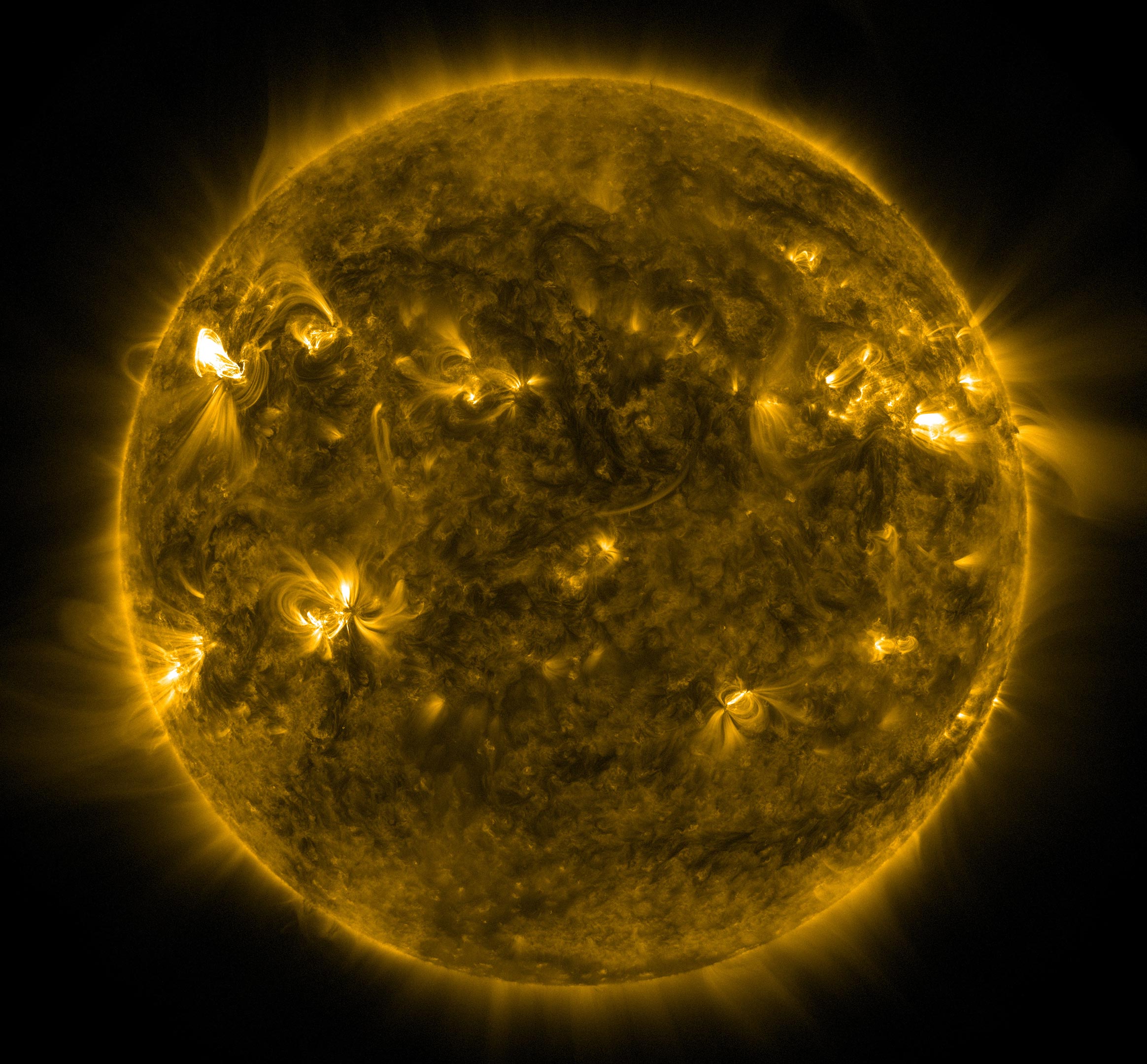
    An image of active regions on the Sun from NASA’s Solar Dynamics Observatory. The glowing hot gas traces out the twists and loops of the Sun’s magnetic field lines. Credit: NASA Solar Dynamics Observatory/ AIA

    A new study led by the University of Hawai‘i (UH) at Mānoa has helped refine understanding of the amount of hydrogen, helium and other elements present in violent outbursts from the Sun, and other types of solar “wind,” a stream of ionized atoms ejected from the Sun.

    Coronal mass ejections (CME) are giant plasma bursts that erupt from the sun, heading out into the solar system at speeds as fast as 2 million miles per hour. Like the sun itself, the majority of a CME’s atoms are hydrogen. When these particles interact with Earth’s atmosphere, they lead to the brilliant multicolored lights of the Aurora Borealis. They also have the potential to knock out communications, bringing modern civilization to a standstill.

    And their cause is pretty much a mystery.

    UH Manoa School of Ocean and Earth Science and Technology (SOEST) researcher Gary Huss led a team of scientists in investigating a sample of solar wind collected by NASA’s Genesis mission.

    Most of our understanding of the composition of the sun, which makes up 99.8% of the mass of the Solar System, has come from astronomical observations and measurements of a rare type of meteorite. In 2001, the Genesis probe headed to space to gather samples of solar wind in pure materials, and bring the material back to Earth to be studied in a lab. Those samples represented particles gathered from different sources of solar wind, including those thrown off by CMEs.

    The Genesis samples allowed for a more accurate assessment of the hydrogen abundance in CMEs and other components of the solar wind. About 91% of the Sun’s atoms are hydrogen, so everything that happens in the solar wind plasma is influenced by hydrogen.

    However, measuring hydrogen in the Genesis samples proved to be a challenge. An important component of the recent work was to develop appropriate standards using terrestrial minerals with known amounts of hydrogen, implanted with hydrogen by a laboratory accelerator.

    A precise determination of the amount of hydrogen in the solar wind allowed researchers to discern small differences in the amount of neon and helium relative to hydrogen ejected by these massive solar ejections. Helium and neon, both noble gases, are difficult to ionize. The new measurements of hydrogen showed that helium and neon were both enriched in coronal mass ejections, providing clues to the underlying physics in the Sun that causes the coronal mass ejections.

    In the very energetic event, “the ejected material appears to be enriched almost systematically in atoms that require the most energy to ionize,” said Ryan Ogliore, co-author and assistant professor of physics at Washington University in St. Louis. “That tells us a lot about the physics involved in the first stages of the explosion on the Sun.”

    This finding brings researchers one step closer to understanding the origins of these particular solar events.

    Reference: “Hydrogen fluence in Genesis collectors: Implications for acceleration of solar wind and for solar metallicity” by Gary R. Huss, Elizabeth Koeman‐Shields, Amy J. G. Jurewicz, Donald S. Burnett, Kazuhide Nagashima, Ryan Ogliore and Chad T. Olinger,19 December 2019, Meteoritics & Planetary Science.
    DOI: 10.1111/maps.13420

    Never miss a breakthrough: Join the SciTechDaily newsletter.
    Follow us on Google and Google News.

    Astrophysics Popular Sun University of Hawaii at Manoa
    Share. Facebook Twitter Pinterest LinkedIn Email Reddit

    Related Articles

    Brighter Than a Thousand Suns: Scientists Unravel Physics Behind Unusual Behavior of Stars’ Super Flares

    Mysteries of Sun’s Corona Illuminated by Eclipse Data

    Magnetic Explosions Observed on Sun – Unlike Anything Seen Before [Video]

    5 Astonishing New Discoveries From NASA’s Parker Solar Probe [Video]

    Groundbreaking New Images Peel Away Layers of a Stellar Mystery

    Scientists Thought It Was Physically Impossible: Magnetic Instability Discovered in Sun’s Rotating Plasma

    The Sun Won’t Become a Black Hole – Here’s Why

    Astronomers Predict What Will Happen When Our Sun Dies

    New Observations Help Astronomers Learn How Young Stars Accrete Material and Grow

    Leave A Reply Cancel Reply

    • Facebook
    • Twitter
    • Pinterest
    • YouTube

    Don't Miss a Discovery

    Subscribe for the Latest in Science & Tech!

    Trending News

    289-Million-Year-Old Reptile Mummy Reveals Origin of Human Breathing System

    New Brain Discovery Challenges Long-Held Theory of Teenage Brain Development

    Scientists Discover Plants “Scream” – We Just Couldn’t Hear Them Until Now

    Scientists Discover a Surprising Reason Intermittent Fasting Extends Life

    This Simple Fruit Wash Could Make Produce Safer and Last Days Longer

    Scientists Say Adding This Unusual Seafood to Your Diet Could Reverse Signs of Aging

    Scientists Say a Hidden Structure May Exist Inside Earth’s Core

    Doctors Surprised by the Power of a Simple Drug Against Colon Cancer

    Follow SciTechDaily
    • Facebook
    • Twitter
    • YouTube
    • Pinterest
    • Newsletter
    • RSS
    SciTech News
    • Biology News
    • Chemistry News
    • Earth News
    • Health News
    • Physics News
    • Science News
    • Space News
    • Technology News
    Recent Posts
    • Scientists Finally Solved One of Water’s Biggest Mysteries
    • 7,000-Year-Old DNA Rewrites the Story of the “Neolithic Revolution”
    • Missing Medieval Relic of Legendary English King Found After Being Missing for 40 Years
    • New Study Challenges Long-Held Assumptions About Cancer and Aging
    • Major Review Finds Alzheimer’s Amyloid Drugs Offer No Real Benefit
    Copyright © 1998 - 2026 SciTechDaily. All Rights Reserved.
    • Science News
    • About
    • Contact
    • Editorial Board
    • Privacy Policy
    • Terms of Use

    Type above and press Enter to search. Press Esc to cancel.