
Close Menu
    Facebook X (Twitter) Instagram
    SciTechDaily
    • Biology
    • Chemistry
    • Earth
    • Health
    • Physics
    • Science
    • Space
    • Technology
    Facebook X (Twitter) Pinterest YouTube RSS
    SciTechDaily
    Home»Space»Star Cluster NGC 3532 – A Colorful Gathering of Middle-Aged Stars
    Space

    Star Cluster NGC 3532 – A Colorful Gathering of Middle-Aged Stars

    By European Southern ObservatoryNovember 26, 2014No Comments3 Mins Read
    Facebook Twitter Pinterest Telegram LinkedIn WhatsApp Email Reddit
    Share
    Facebook Twitter LinkedIn Pinterest Telegram Email Reddit
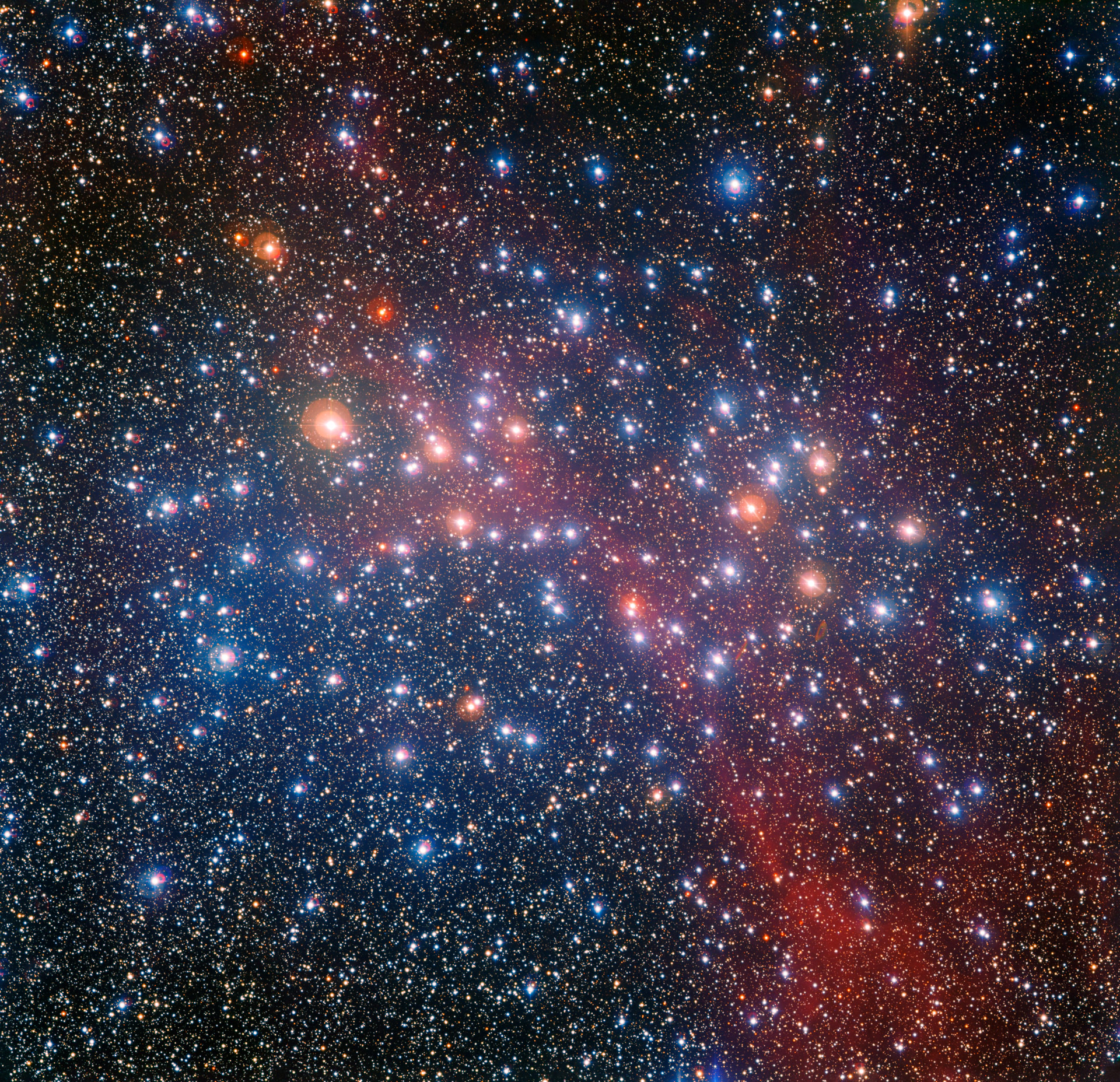
    ESO Views Bright Star Cluster NGC 3532
    The MPG/ESO 2.2-meter telescope at ESO’s La Silla Observatory in Chile captured this richly colorful view of the bright star cluster NGC 3532. Some of the stars still shine with a hot bluish color, but many of the more massive ones have become red giants and glow with a rich orange hue. Credit: ESO/G. Beccari

    This new ESO image shows bright star cluster NGC 3532, which is located roughly 1,300 light-years away.

    NGC 3532 is a bright open cluster located some 1,300 light-years away in the constellation of Carina (The Keel of the ship Argo). It is informally known as the Wishing Well Cluster, as it resembles scattered silver coins which have been dropped into a well. It is also referred to as the Football Cluster, although how appropriate this is depends on which side of the Atlantic you live. It acquired the name because of its oval shape, which citizens of rugby-playing nations might see as resembling a rugby ball.

    This very bright star cluster is easily seen with the naked eye from the southern hemisphere. It was discovered by French astronomer Nicolas Louis de Lacaille whilst observing from South Africa in 1752 and was cataloged three years later in 1755. It is one of the most spectacular open star clusters in the whole sky.

    NGC 3532 covers an area of the sky that is almost twice the size of the full Moon. It was described as a binary-rich cluster by John Herschel who observed “several elegant double stars” here during his stay in southern Africa in the 1830s. Of additional, much more recent, historical relevance, NGC 3532 was the first target to be observed by the NASA/ESA Hubble Space Telescope, on 20 May 1990.

    This grouping of stars is about 300 million years old. This makes it middle-aged by open star cluster standards [1]. The cluster stars that started off with moderate masses are still shining brightly with blue-white colors, but the more massive ones have already exhausted their supplies of hydrogen fuel and have become red giant stars. As a result the cluster appears rich in both blue and orange stars. The most massive stars in the original cluster will have already run through their brief but brilliant lives and exploded as supernovae long ago. There are also numerous less conspicuous fainter stars of lower mass that have longer lives and shine with yellow or red hues. NGC 3532 consists of around 400 stars in total.

    The background sky here in a rich part of the Milky Way is very crowded with stars. Some glowing red gas is also apparent, as well as subtle lanes of dust that block the view of more distant stars. These are probably not connected to the cluster itself, which is old enough to have cleared away any material in its surroundings long ago.

    This image of NGC 3532 was captured by the Wide Field Imager instrument at ESO’s La Silla Observatory in February 2013.

    Notes

    1. Stars with masses many times greater than the Sun have lives of just a few million years, the Sun is expected to live for about ten billion years and low-mass stars have expected lives of hundreds of billions of years — much greater than the current age of the Universe.

    Never miss a breakthrough: Join the SciTechDaily newsletter.
    Follow us on Google and Google News.

    Astronomy Astrophysics European Southern Observatory Popular
    Share. Facebook Twitter Pinterest LinkedIn Email Reddit

    Related Articles

    “We Found Something Never Seen Before” – Mysterious Shock Wave Around Dead Star Surprises Astronomers

    Astronomers Captured a Star’s Final Explosion in Stunning Detail

    New Finding Challenges Theories of How Rocky, Earth-Scale Planets Form

    Scientists Discover the Most Powerful Quasar Outflow Ever

    Astronomers Discover a Probable Free-Floating Planet, CFBDSIR2149

    Planetary Nebula Fleming 1 Likely Has Two White Dwarfs Circling Each Other at Its Center

    Centaurus a Hides a Gaseous Spiral at Its Core

    Cosmic Spiral Around Red Giant Star R Sculptoris Could Elucidate Stellar Evolution

    Sugar Molecules Found in Gas Surrounding Sun-Like Star

    Leave A Reply Cancel Reply

    • Facebook
    • Twitter
    • Pinterest
    • YouTube

    Don't Miss a Discovery

    Subscribe for the Latest in Science & Tech!

    Trending News

    New Study Reveals Why Ozempic Works Better for Some People Than Others

    Climate Change Is Altering a Key Greenhouse Gas in a Way Scientists Didn’t Expect

    New Study Suggests Gravitational Waves May Have Created Dark Matter

    Scientists Discover Why the Brain Gets Stuck in Schizophrenia

    Scientists Engineer “Tumor-Eating” Bacteria That Devour Cancer From Within

    Even “Failed” Diets May Deliver Long-Term Health Gains, Study Finds

    NIH Scientists Discover Powerful New Opioid That Relieves Pain Without Dangerous Side Effects

    Collapsing Plasma May Hold the Key to Cosmic Magnetism

    Follow SciTechDaily
    • Facebook
    • Twitter
    • YouTube
    • Pinterest
    • Newsletter
    • RSS
    SciTech News
    • Biology News
    • Chemistry News
    • Earth News
    • Health News
    • Physics News
    • Science News
    • Space News
    • Technology News
    Recent Posts
    • “Pretty Close to Home”: The Hidden Earthquake Threat Beneath Seattle
    • The Surprising Reason You Might Want To Sleep Without a Pillow
    • Household Cats Could Hold the Secret to Fighting Breast Cancer
    • Scientists Say This Natural Hormone Reverses Obesity by Targeting the Brain
    • This 15,000-Year-Old Discovery Changes What We Know About Early Human Creativity
    Copyright © 1998 - 2026 SciTechDaily. All Rights Reserved.
    • Science News
    • About
    • Contact
    • Editorial Board
    • Privacy Policy
    • Terms of Use

    Type above and press Enter to search. Press Esc to cancel.