

Research supports the Younger Dryas Impact hypothesis, suggesting a comet fragment caused significant climatic changes and species extinctions 12,800 years ago through high-pressure, high-temperature airbursts, evidenced by materials like platinum and shocked quartz found across the eastern U.S.
Researchers are uncovering more evidence to support the Younger Dryas Impact hypothesis, which suggests that a fragmented comet entered Earth’s atmosphere 12,800 years ago. This event triggered a dramatic climatic shift, abruptly halting the planet’s warming trend and plunging it into the near-glacial conditions of the Younger Dryas period.
Evidence of Cosmic Airbursts in the Eastern United States
University of California, Santa Barbara emeritus professor James Kennett and his team have identified materials—known as impact proxies—linked to a cosmic airburst at multiple sites in the eastern United States, including New Jersey, Maryland, and South Carolina. These materials, such as platinum, microspherules, meltglass, and shock-fractured quartz, point to the extreme pressures and temperatures generated by the event. Their findings were recently published in ScienceOpen’s journal Airbursts and Cratering.
“What we’ve found is that the pressures and temperatures were not characteristic of major crater-forming impacts but were consistent with so-called ‘touchdown’ airbursts that don’t form much in the way of craters,” Kennett said.
Comparing Celestial Impacts: From Tunguska to Younger Dryas
The Earth is bombarded every day by tons of celestial debris, in the form of tiny dust particles. On the other end of the scale are the extremely rare and cataclysmic impacts like the Chicxulub event that 65 million years ago caused the extinction of dinosaurs and other species. Its 150-kilometer-wide (93 miles) impact crater can be found in the Yucatán Peninsula in Mexico.
Somewhere in between are the impacts that don’t leave craters on the Earth’s surface but are nevertheless destructive. The shockwave from the 1908 Tunguska event knocked down 2,150 square kilometers (830 square miles) of forest, as the roughly 40-meter (130 ft) diameter asteroid collided with the atmosphere almost 10 kilometers (6 miles) above the Siberian taiga.
The comet thought to be responsible for the Younger Dryas cooling episode is estimated to have been 100 kilometers wide (62 miles) — much larger than the Tunguska object, and fragmented into thousands of pieces. The sediment layer associated with the airburst stretches across much of the northern hemisphere, but can also be found in locations south of the equator. This layer contains unusually high levels of rare materials associated with cosmic impacts, such as iridium and platinum, and materials formed under high pressures and temperatures, such as magnetic microspherules (cooled-down metallic droplets), meltglass, and nanodiamonds.
Shocked Quartz and Amorphous Silica
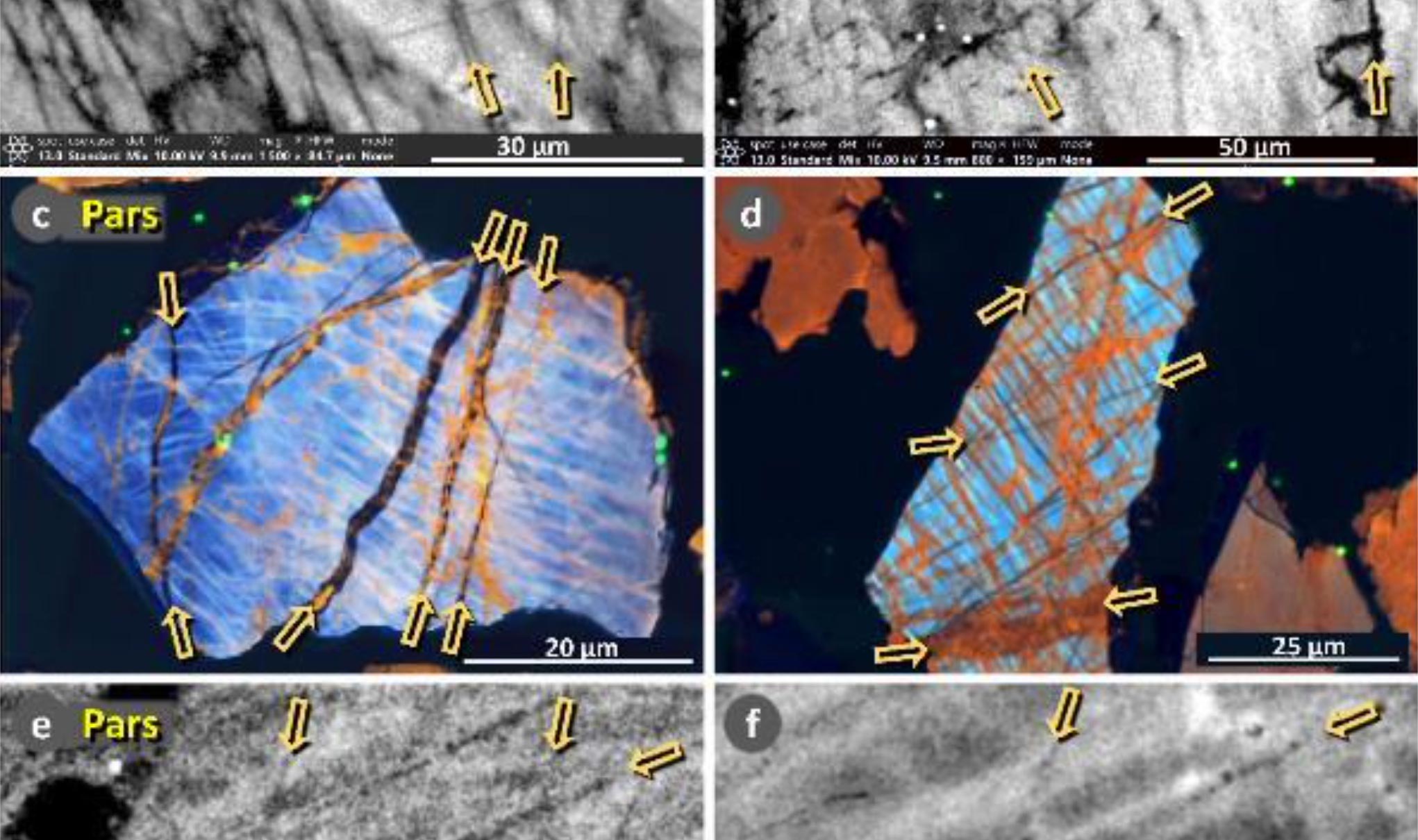
The researchers are particularly interested in the presence of shocked quartz, indicated by a pattern of lines, called lamellae, that shows stress great enough to deform the crystal structure of quartz, a very hard material. This “crème de la crème” of cosmic impact evidence is present in impact craters, however, linking shocked quartz to cosmic airbursts has proven to be more of a challenge.
“In the extreme form, such as when an asteroid hammers into the Earth’s surface, all the fractures are very parallel,” Kennett explained. In the realm of cosmic airbursts, different variables are present in the realm of cosmic airbursts. “When you think about it, the pressures and temperatures that produce these fractures will vary depending on the density, entry angle, altitude of the impact, and the impactor’s size.
“What we found — and this is what is characteristic of the impact layer, called the Younger Dryas Boundary — is that although we do occasionally see in the quartz grains examples of the ‘traditional’ shocked quartz with parallel fractures, we mostly see grains that are not parallel,” he said. These fractures are seen in an irregular, web-like pattern of intersecting, meandering lines and surface and subsurface fissures, in contrast to the parallel and planar deformations of impact-associated shocked quartz found at craters. These subparallel and subplanar deformations are due in large part to the relatively lower pressures caused by explosions that occur above the ground, the researchers assert, as opposed to impacts that make contact with the Earth.
What these sediments do share with the shocked quartz at crater sites is the presence of amorphous silica — melted glass — in these fractures. And that, the researchers say, is evidence of the combination of pressure and high temperatures (greater than 2000 degrees Celsius) that could have come from a low-altitude bolide airburst. Similarly fractured quartz grains and meltglass have been found in more present-day samples of above ground explosions, such as at the Trinity atomic bomb test site in New Mexico. The roughly 20-kiloton bomb was detonated atop a 30.5-meter (100-foot) tower.
These lower-pressure shocked quartz grains join a growing suite of impact proxies that together make a case for a fragmented comet that not only caused widespread burning, but also abrupt climatic change that resulted in the extinctions of 35 genera of megafauna in North America, such as the mammoths and giant ground sloths, and led to the collapse of a flourishing human culture called Clovis, according to the researchers.
Impact Proxies and Their Geological Significance
“There’s a whole range of different shocked quartz, so we have to make a well-documented case that they are indeed significant for interpreting cosmic impact, even though they’re not reflecting a traditional major crater-forming event,” Kennett said. “These are from very-low-altitude ‘touchdown’ airbursts almost certainly associated with cometary impact.”
Reference: “Platinum, shock-fractured quartz, microspherules, and meltglass widely distributed in Eastern USA at the Younger Dryas onset (12.8 ka)” by Christopher R. Moore, Malcolm A. LeCompte, James P. Kennett, Mark J. Brooks, Richard B. Firestone, Andrew H. Ivester, Terry A. Ferguson, Chad S. Lane, Kimberly A. Duernberger, James K. Feathers, Charles B. Mooney, Victor Adedeji, Dale Batchelor, Michael Salmon, Kurt A. Langworthy, Joshua J. Razink, Valerie Brogden, Brian van Devener, Jesus Paulo Perez, Randy Polson, Michael Martínez-Colón, Barrett N. Rock, Marc D. Young, Gunther Kletetschka, Ted E. Bunch and Allen West, 8 May 2024, Airbursts and Cratering.
DOI: 10.14293/ACI.2024.0003
Never miss a breakthrough: Join the SciTechDaily newsletter.
Follow us on Google and Google News.
3 Comments
Sonia, this is a very nicely written article. This comet hypothesis has been around a long time and has gotten a lot of hype. However, it could be worth letting your readers know that the topic is highly controversial to say the least. See:
https://en.wikipedia.org/wiki/Younger_Dryas_impact_hypothesis
In that light, readers should know that this new work was published in an obscure journal whose editors include three of the study authors, including the first author and senior author. And there is no sign that this scientific paper was put through normal peer review scrutiny.
I would argue this makes the story more interesting- but maybe more as a cautionary tale. As a non-expert in this field, this only my 2c. Cheers, and keep up the good work!
Perhaps we should consider ourselves lucky that peer review wasn’t as ‘mature’ when Einstein was alive, as it is now.
Comet air bursts would have caused a meltwater event, altered ocean currents, and contributed to the abrupt cooling trend.