

V Sagittae’s violent mass transfer hints at an imminent nova—and a future supernova visible from Earth.
Binary star systems are fairly common in the universe, as are pairs where one star is a compact remnant, such as a white dwarf or neutron star, and the other remains on the main sequence.
In these systems, the dense stellar remnant can pull matter from its companion, leading to dramatic events. For instance, if the remnant is a white dwarf, this process can trigger a powerful Type Ia supernova, while a neutron star accreting material produces intense x-ray emissions.
Studying the strange system V Sagittae
In a recent study, astronomers closely examined the cataclysmic variable binary star system V Sagittae (V Sge). Its unusually high brightness suggests that the accreting star is siphoning a massive amount of material from its companion, which accumulates on the accretor’s surface before periodically igniting in bright outbursts. The findings are detailed in a paper recently published in the Monthly Notices of the Royal Astronomical Society, led by Pasi Hakala of the Finnish Centre for Astronomy with ESO.
V Sagittae’s donor star is a main sequence star with roughly 3.3 times the mass of the Sun. Its companion—the accretor—was long assumed to be a white dwarf, but newer observations suggest it may actually be a Wolf-Rayet star, a class of stellar remnants closely related to white dwarfs. This peculiar pairing has intrigued and challenged astronomers for decades due to its extraordinary properties.
“V Sagittae is no ordinary star system – it’s the brightest of its kind and has baffled experts since it was first discovered in 1902,” said Professor Phil Charles from Southampton University, who was involved with the study. “Our study shows that this extreme brightness is down to the white dwarf sucking the life out of its companion star, using the accreted matter to turn it into a blazing inferno. It’s a process so intense that it’s going thermonuclear on the white dwarf’s surface, shining like a beacon in the night sky.”
Detecting the mysterious circumbinary ring
Its optical emissions are highly variable and extremely complex. Astrophysicists have struggled to interpret its characteristics, and they’ve been observing the star for a long time. However, the new observations in this work revealed a circumbinary ring that helps explain what’s going on.
The circumbinary ring wasn’t captured visually. The researchers gather spectra of V Sge with the X-Shooter, a powerful spectrograph on the ESO’s Very Large Telescope in Chile. The emission lines they observed, including the velocities they revealed, can’t be explained by the stars themselves. “More importantly, (a) this feature does not vary with orbital phase, and (b) is centered at the systemic velocity, meaning that *these emission features do not follow the motion of either stellar component*,” the authors write. “We believe the only plausible explanation for this behavior is that they originate from a circumbinary ring or disc of matter that has escaped the binary.”
Simulating the escaping gas
To test their idea, the researchers took the spectra and modeled it. “Our simulations show that, as matter escapes from the WD’s Roche lobe, it forms a ring or rings around the binary, with a radius of roughly 2–4 binary separations,” the authors write. The Roche lobe is a region around a star or binary pair where gas and dust are gravitationally bound to the stars.
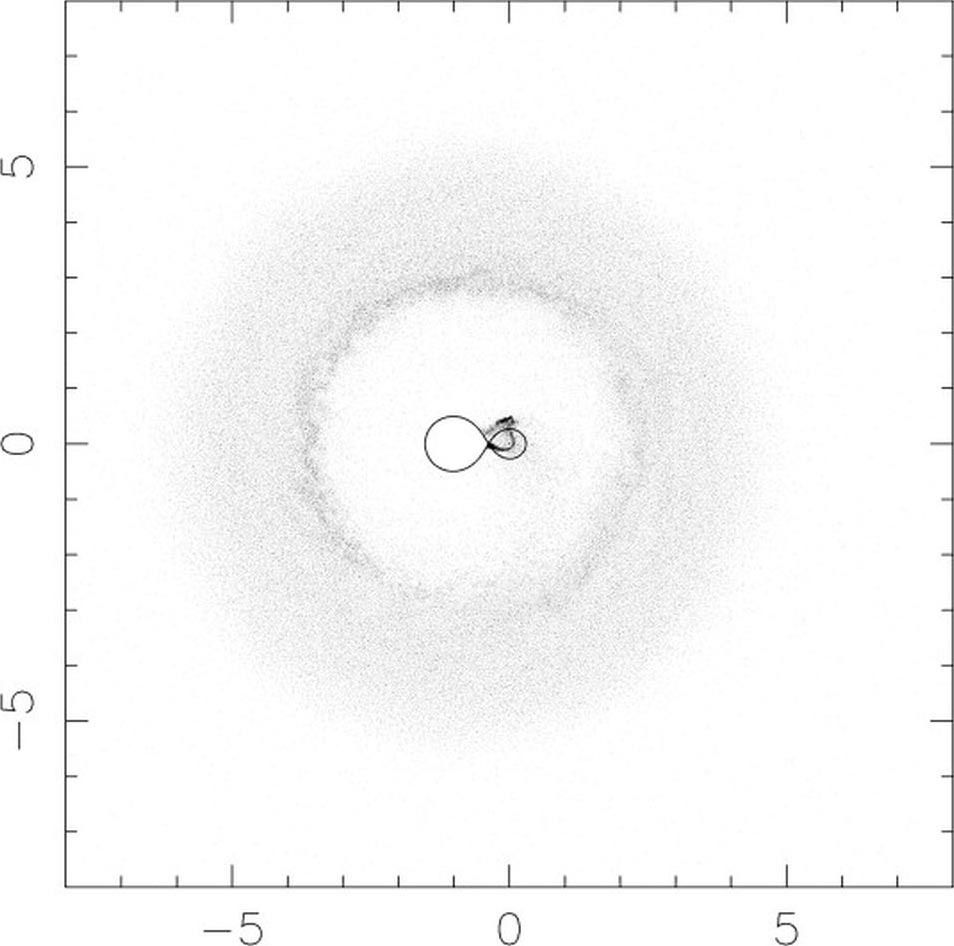
In order for the gas to form the ring, the accretor star must be drawing an extremely large amount of material from the donor star. Most of it flows to the accretor’s accretion disk, but not all. “This unexpected ring, formed from the debris of the messy feast, gives us a clue that could change what we know about how stars live and die,” said lead author Hakala.
“The white dwarf cannot consume all the mass being transferred from its hot star twin, so it creates this bright cosmic ring,” Hakala explained.
Unraveling V Sge’s chaotic behavior
There’ve been several competing explanations for V Sge’s unusual features. Some researchers thought it was a pair of very hot stars, and that the brightness wasn’t a ring, but the result of hot winds from both stars colliding. But that can’t explain the system’s short-term or long-term variability, according to the authors. The authors think that the circumbinary disk best explains V Sge, and that the variability is due to “the chaotic behavior of the inner accretion disc under intense irradiation,” they write.
They think the inner accretion disk around the accreting star has two tilt modes that it flips back and forth from chaotically. “The same tilt can then persist for an extended interval (from days to years) before the next “flipping” event takes place,” the authors explain.
“The speed at which this doomed stellar system is lurching wildly, likely due to the extreme brightness, is a frantic sign of its imminent, violent end,” Hakala explained.
A violent future and eventual explosion
Many of these types of binaries can be stable for billions of years, as long as the mass transfer between them is low and stable. In that case, the accretor star repeatedly gathers a layer of gas from the donor star on its surface. Eventually, when the mass builds up, it explodes as a nova, and the cycle can start again.
Study co-author Dr Rodríguez-Gil from Spain’s Instituto de Astrofisica de Canarias explained: “The matter accumulating on the white dwarf is likely to produce a nova outburst in the coming years, during which V Sagittae would become visible with the naked eye.” But the nova is just the beginning of the end.
In some of these binary arrangements, the stars eventually collide with one another. That can happen if the donor star evolves into a giant, making the system unstable and leading to a collision. A collision can also occur if the donor star becomes a white dwarf. In that case, the pair of stars could enter a common envelope and spiral into one another, eventually exploding.
“But when the two stars finally smash into each other and explode, this would be a supernova explosion so bright it’ll be visible from Earth even in the daytime,” Rodriguez-Gil concluded.
Reference: “V Sge: supersoft source or exotic hot binary? – I. An X-Shooter campaign in the high state” by Pasi Hakala, Phil Charles and Pablo Rodríguez-Gil, 13 August 2025, Monthly Notices of the Royal Astronomical Society.
DOI: 10.1093/mnras/staf1284
PR-G acknowledges support by the Spanish Agencia Estatal de Investigación del Ministerio de Ciencia e Innovación (MCIN/AEI) and the European Regional Development Fund (ERDF) under grant PID2021–124879NB–I00.
Never miss a breakthrough: Join the SciTechDaily newsletter.
Follow us on Google and Google News.