
Astronomers have uncovered the violent secret of V Sagittae, a white dwarf star consuming its companion in a spectacular feeding frenzy.
This cosmic dance not only makes the system burn with unusual brilliance but also creates a massive gas halo, signaling its turbulent and doomed future. Scientists believe this frenzied interaction will eventually erupt in a dazzling supernova, visible even in broad daylight from Earth.
A Star’s Deadly Appetite
A nearby white dwarf star is consuming its closest stellar partner at a pace that has never been observed before, according to astronomers.
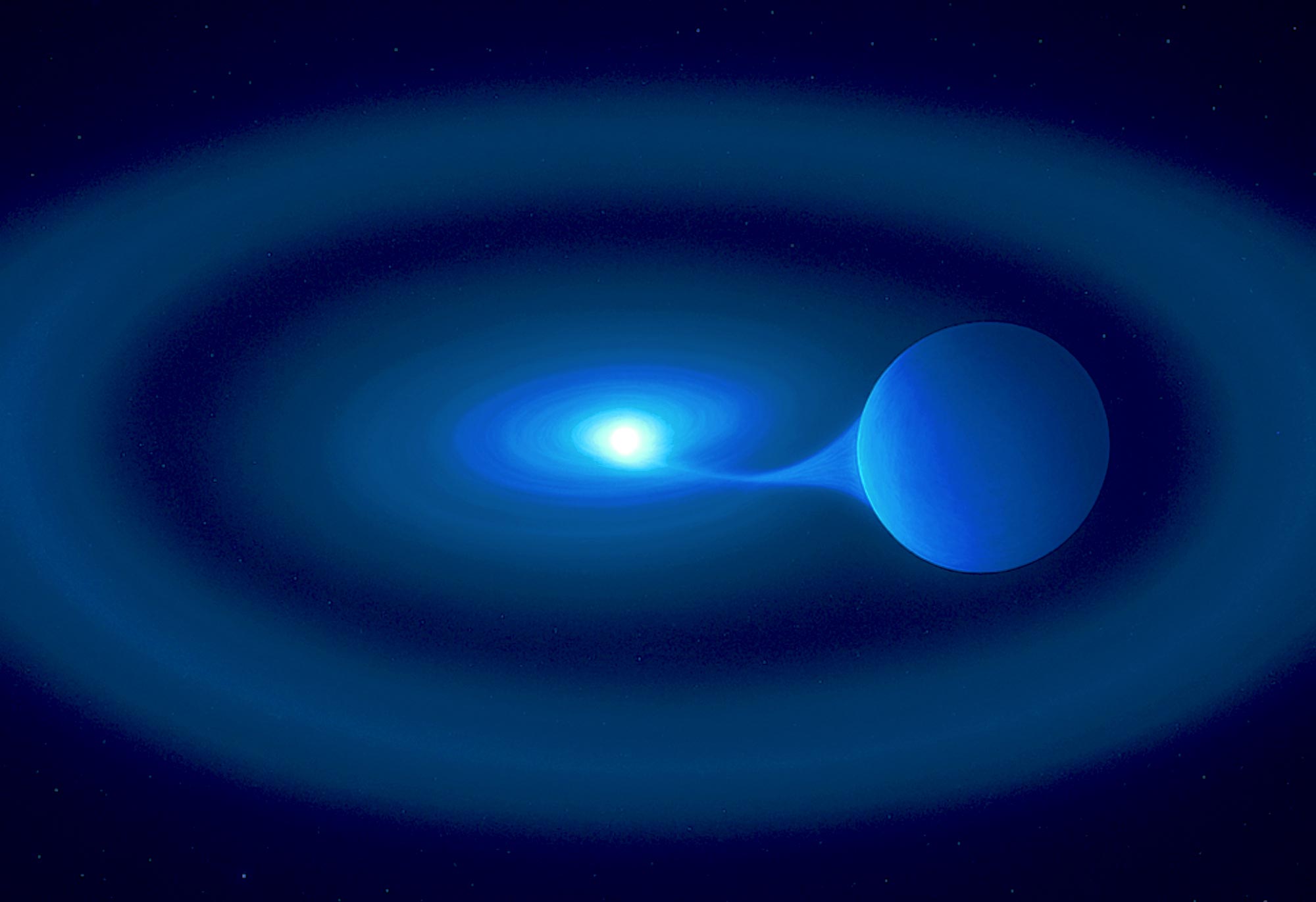
The pair of stars, known as V Sagittae, shines with unusual intensity as the compact white dwarf draws in matter from its larger companion in a dramatic cosmic feast.
Researchers explain that the two stars are orbiting one another every 12.3 hours, a relentless gravitational dance that is steadily bringing them closer together.
This process may eventually trigger a spectacular explosion so luminous that it would be visible to the naked eye from Earth, even from 10,000 light-years away.
Cracking a Century-Old Mystery
The discovery comes from an international collaboration led by Dr. Pasi Hakala of the University of Turku in Finland, working with Dr. Pablo Rodríguez Gil of the Instituto de Astrofisica de Canarias and University of La Laguna in Spain, and Professor Phil Charles of the University of Southampton.
Professor Charles explained that their findings finally solve a puzzle that has confounded scientists for over a hundred years.
He added: “V Sagittae is no ordinary star system – it’s the brightest of its kind and has baffled experts since it was first discovered in 1902.
A Blazing Beacon in the Sky
“Our study shows that this extreme brightness is down to the white dwarf sucking the life out of its companion star, using the accreted matter to turn it into a blazing inferno.
“It’s a process so intense that it’s going thermonuclear on the white dwarf’s surface, shining like a beacon in the night sky.”
Capturing Cosmic Carnage
The new study was published in the Monthly Notices of the Royal Astronomical Society.
Researchers captured the cosmic carnage using the powerful European Southern Observatory’s Very Large Telescope in Chile – and made another discovery.
They found a ring of gas, like a giant halo, is encircling both stars, a consequence of the huge amounts of energy being generated by the hungry white dwarf.
A Ring of Gas and Clues to Stellar Life
This unexpected ring, formed from the debris of the messy feast, gives us a clue that could change what we know about how stars live and die, said lead author Dr. Pasi Hakala from the University of Turku.
He added, “The white dwarf cannot consume all the mass being transferred from its hot star twin, so it creates this bright cosmic ring.
“The speed at which this doomed stellar system is lurching wildly, likely due to the extreme brightness, is a frantic sign of its imminent, violent end.”
Countdown to a Supernova Spectacle
Dr. Rodríguez-Gil from Spain’s Instituto de Astrofisica de Canarias added: “The matter accumulating on the white dwarf is likely to produce a nova outburst in the coming years, during which V Sagittae would become visible with the naked eye.
“But when the two stars finally smash into each other and explode, this would be a supernova explosion so bright it’ll be visible from Earth even in the daytime.”
Reference: “V Sge: Supersoft Source or Exotic Hot Binary? I. An X-Shooter campaign in the high state” by Pasi Hakala, Phil Charles and Pablo Rodríguez-Gil, 13 August 2025, Monthly Notices of the Royal Astronomical Society.
DOI: 10.1093/mnras/staf1284
Never miss a breakthrough: Join the SciTechDaily newsletter.
Follow us on Google and Google News.