
Close Menu
    Facebook X (Twitter) Instagram
    SciTechDaily
    • Biology
    • Chemistry
    • Earth
    • Health
    • Physics
    • Science
    • Space
    • Technology
    Facebook X (Twitter) Pinterest YouTube RSS
    SciTechDaily
    Home»Biology»Vanishing Pollinators: Unraveling the Decline of Bees and Butterflies
    Biology

    Vanishing Pollinators: Unraveling the Decline of Bees and Butterflies

    By PLOSMay 15, 2024No Comments4 Mins Read
    Facebook Twitter Pinterest Telegram LinkedIn WhatsApp Email Reddit
    Share
    Facebook Twitter LinkedIn Pinterest Telegram Email Reddit
    Bee Cactus Flower
    Bee and butterfly populations are declining in North America due to environmental changes, with significant research gaps hindering conservation efforts.

    Bee and butterfly populations are declining in North America due to environmental changes. A study highlights regional trends and calls for improved monitoring and conservation efforts to address research gaps and protect pollinators.

    In major regions of North America, bee and butterfly populations are in decline due to ongoing environmental change. Our ability to protect these species is limited by significant gaps in pollinator research. This is according to a study published today (May 15, 2024) in the open-access journal PLOS ONE by Sara Souther of Northern Arizona University, US, and colleagues.

    Alarming Declines and Research Gaps

    Recent research has detected declines in populations of pollinator species, sparking alarm from scientists and policymakers concerned about negative impacts on ecosystems and agriculture. These declines have been linked to various factors including climate change, habitat loss, and invasive species, but reports are often limited to well-studied species in easily accessible regions.

    In this study, Souther and colleagues used data compiled on four major families of bees and butterflies to construct species distribution models, enabling them to assess changes over time and space across North America.
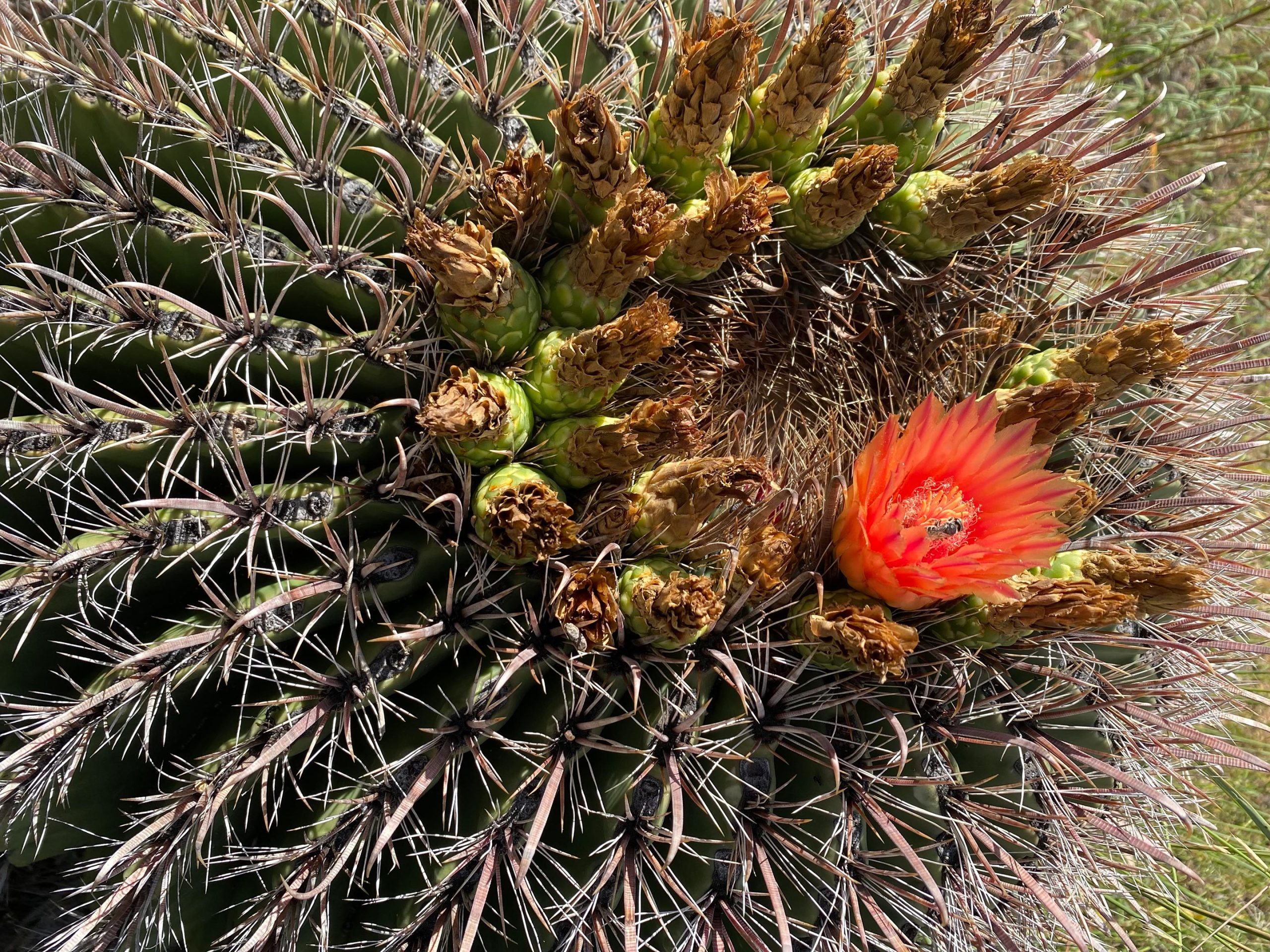
    Flowering Fishhook Barrel Cactus (Ferocactus wislizenii)
    A flowering fishhook barrel cactus (Ferocactus wislizenii) receiving a visit from a native bee in Arizona, USA. This study found evidence of declining pollinator occurrence in the western US over the past several decades. Credit: Sara Souther, CC-BY 4.0

    Regional Trends and Climate Impact

    The highest species richness was found along North America’s West Coast, especially California and the Rocky Mountains. However, the models revealed declining species richness in all four families over the past century in western North America. In contrast, there were disproportionate increases in eastern North America. The authors also assessed similar data for a broader sample of potential pollinator species, including both invertebrate and vertebrate species of conservation concern, and found similar trends.

    Comparisons with climate data indicate that these population changes are at least partly related to the impacts of recent climate change – such as prolonged drought and habitat degradation – and regions experiencing apparent population declines have also been heavily impacted by anthropogenic land use. The authors note too that the apparent increases in the eastern U.S. may partly reflect increased detections in these populous areas, given an increase in citizen science and similar data collection efforts.
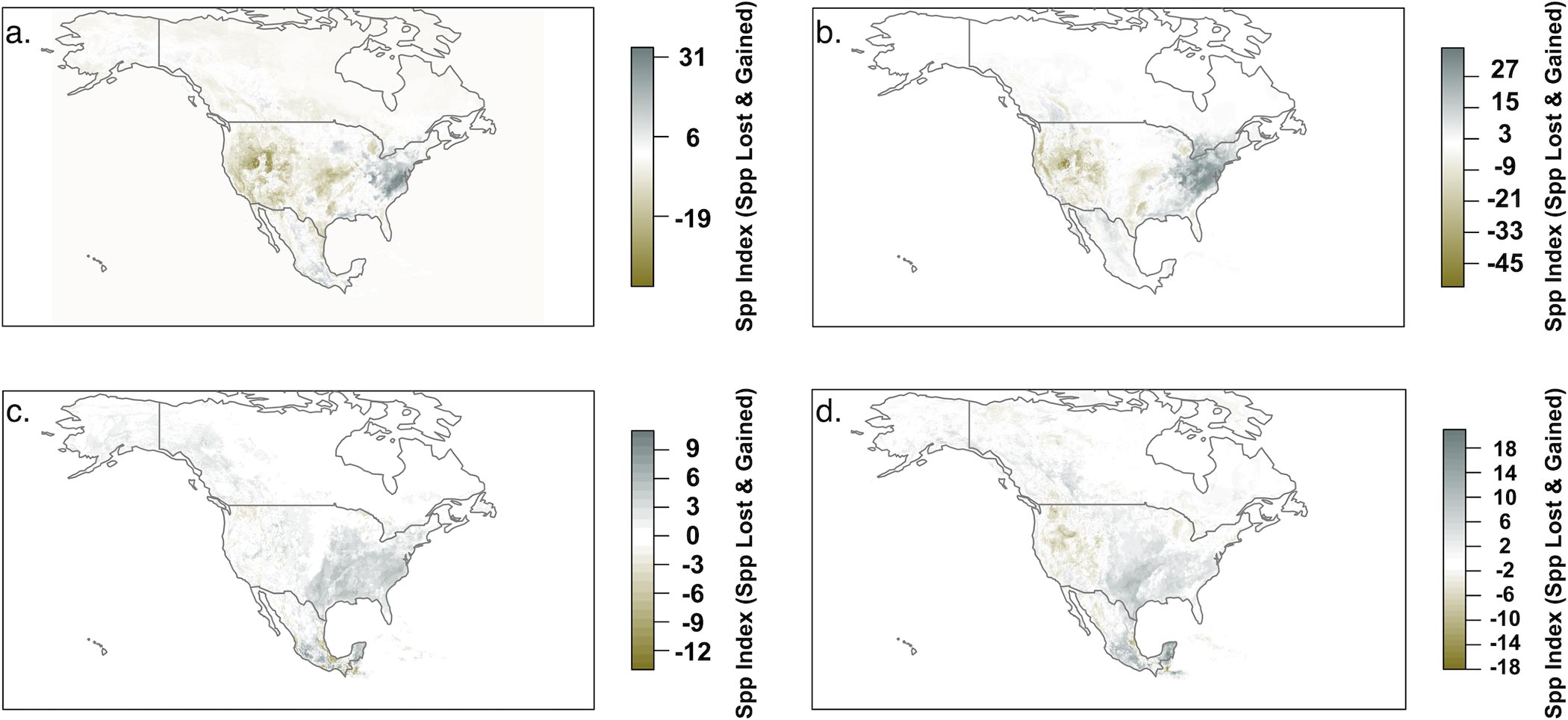
    Bee and Butterfly Records Indicate Diversity Losses in Western and Southern North America
    Maps of (a) Apidae, (b) Megachilidae, (c) Papilionidae, and (d) Pieridae species gains and losses within projected species distributions between 1980–2020 and 1939–1979. Thresholded species distribution model outputs from 1939–1979 were subtracted from those from 1980–2020 for all species, resulting in a map of a species distribution with three possible values: -1 (species projected in a given area in 1939–1979 but not 1980–2020), 0 (species projected in a given area in both time periods), and 1 (species projected in a given area in 1980–2020 but not 1939–1979). Each map is the result of the summation of these difference rasters for all species within each family. Areas displayed in gold represent locations where high numbers of species were projected to be lost from the first time period to the second. Dark gray areas represent locations where high numbers of species were projected to be gained from the first time period to the second. Credit: Souther et al., 2024, PLOS ONE, CC-BY 4.0

    Implications for Conservation

    Overall, this study detects broad trends of population changes in bees and butterflies, as well as other potential pollinators. These results help to identify regions of declining populations where researchers and policymakers can prioritize conservation efforts. This study also identifies gaps in existing knowledge of pollinators, including regions that are more poorly sampled and species that are less well studied, limitations that might be overcome by improved monitoring methods and enhanced citizen science efforts.

    The authors add: “Existing records of North American pollinators suggest that diversity has broadly declined in the western US and southern Mexico in recent decades. Losses are consistent with changes in climate and suggest a need for increased monitoring to inform conservation and mitigation actions.”

    Reference: “Bee and butterfly records indicate diversity losses in western and southern North America, but extensive knowledge gaps remain” by Sara K. Souther, Manette E. Sandor, Martha Sample, Sara Gabrielson and Clare E. Aslan, 15 May 2024, PLOS ONE.
    DOI: 10.1371/journal.pone.0289742

    Never miss a breakthrough: Join the SciTechDaily newsletter.
    Follow us on Google and Google News.

    Bees Butterflies Climate Science PLOS
    Share. Facebook Twitter Pinterest LinkedIn Email Reddit

    Related Articles

    A Tiny Brain Tweak Sparks Rapid Evolution in Butterfly Romance

    Breaking Barriers in Biology: Universal Equation Links Wingbeats of Whales to Mosquitoes

    Researchers Capture Rare Honey Bee Behavior From Within the Hive

    Female Butterflies Prefer Flashier Mates

    Butterfly Research Reveals Genetic Sharing from Hybridization

    Imidacloprid, A Major Factor in Colony Collapse Disorder

    Behavior in Curious Honeybees Similar to Humans

    Airborne Insecticide Emission From Pneumatic Drilling Machines Linked to Honeybee Death

    Using Bees To Ease Tensions Between People And Elephants

    Leave A Reply Cancel Reply

    • Facebook
    • Twitter
    • Pinterest
    • YouTube

    Don't Miss a Discovery

    Subscribe for the Latest in Science & Tech!

    Trending News

    Scientists Uncover Potential Brain Risks of Popular Fish Oil Supplements

    Scientists Discover a Surprising Way To Make Bread Healthier and More Nutritious

    After 60 Years, Scientists Uncover Unexpected Brain Effects of Popular Diabetes Drug Metformin

    New Research Uncovers Hidden Side Effects of Popular Weight-Loss Drugs

    Scientists Rethink Extreme Warming After Surprising Ocean Discovery

    Landmark Study Links Never Marrying to Significantly Higher Cancer Risk

    Researchers Discover Unknown Beetle Species Just Steps From Their Lab

    Largest-Ever Study Finds Medicinal Cannabis Ineffective for Anxiety, Depression, PTSD

    Follow SciTechDaily
    • Facebook
    • Twitter
    • YouTube
    • Pinterest
    • Newsletter
    • RSS
    SciTech News
    • Biology News
    • Chemistry News
    • Earth News
    • Health News
    • Physics News
    • Science News
    • Space News
    • Technology News
    Recent Posts
    • Powerful Lasers Reveal How Matter Becomes Plasma in Trillionths of a Second
    • A Simpler Path to Super-Resolution: Scientists Reinvent Microscopy
    • Scientists Uncover Hidden Genetic Cause of Diabetes in Babies
    • Amazonian Chocolate Could Become the Next Superfood, Scientists Say
    • Challenging the Narrative: New Study Shows U.S. Life Expectancy Is Rising Across All States
    Copyright © 1998 - 2026 SciTechDaily. All Rights Reserved.
    • Science News
    • About
    • Contact
    • Editorial Board
    • Privacy Policy
    • Terms of Use

    Type above and press Enter to search. Press Esc to cancel.