
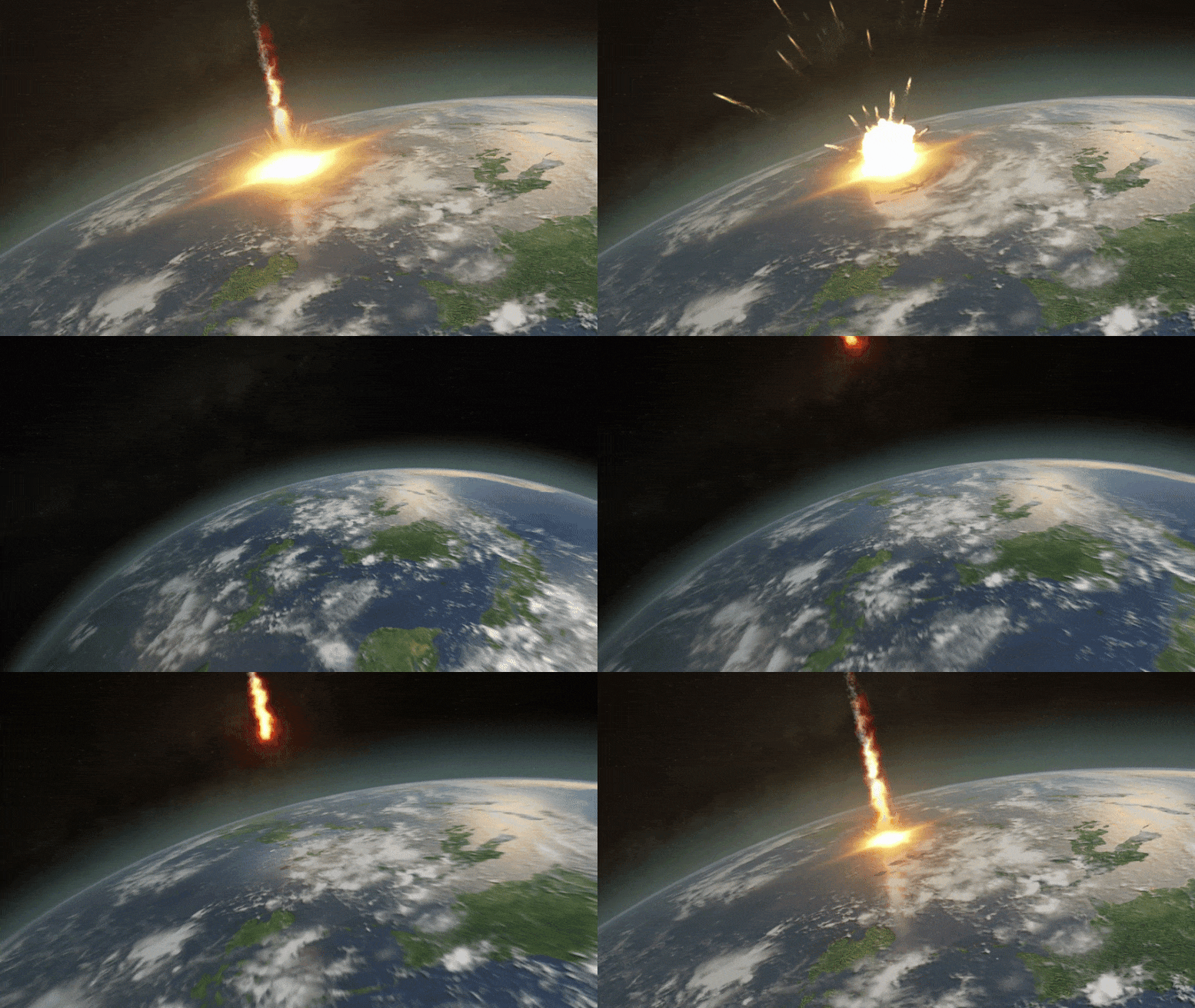
When was the last time an asteroid hit Earth? Today! But it was almost definitely very small. Small asteroids and other tiny dust and particles bombard our planet daily. It’s the big ones we need to worry about. Scientists like Marina Brozovic are keeping their eyes to the sky.
Well, the answer depends on whether you’re asking about small or large impacts. Because Earth gets hit all the time. But luckily for us, the vast majority of these impactors are small and they just burn in the atmosphere.
The most significant fireball event in over 100 years occurred over Russia in 2013. We actually got hit by an asteroid that was the size of a small building and that one disintegrated about 20 kilometers (12 miles) above the city of Chelyabinsk. And it deposited a fair number of meteorites in the ground and I happen to have a piece of the Chelyabinsk impactor right here in my hand.
But what about big impacts, the ones that leave craters tens of kilometers wide and cause huge amounts of devastation?
We have to go far back in time for such an event and those old craters are not easy to spot because by now they’re heavily eroded, they’re filled with sediments, or they can be at the bottom of the ocean.
But to keep the long story short, small impacts, they happen all the time, especially given that about 15,000 tons of space dust hit Earth every year. And large impacts are rare, and we’re talking millions of years rare.
So, when was the last time an asteroid hit Earth? Probably today, but the odds are it was very small and just burned in the atmosphere.
We Asked a NASA Expert Video Series
- Why is Venus Called Earth’s Evil Twin?
- Is NASA Really Crashing a Spacecraft Into an Asteroid?
- Is NASA Aware of Any Earth-Threatening Asteroids?
- When Was the Last Time an Asteroid Hit Earth?
- How Did Perseverance Mars Rover Pick Its Landing Spot?
- What if an Asteroid Was Going To Hit Earth?
- Did Mars Ever Look Like Earth?
- What Are Lagrange Points?
- What Are the Trojan Asteroids?
- Is There Oxygen on Mars?
- Does NASA Know About All the Asteroids?
- Do Aliens Exist?
- Is There Weather on Mars?
- Will an Asteroid Ever Hit Earth?
- Is Mars Habitable?
- Could Microbes Survive a Trip to Mars?
Never miss a breakthrough: Join the SciTechDaily newsletter.
Follow us on Google and Google News.
29 Comments
Save thinking time when composing the text for a science article. Write, word for word, the dialogue in the attached video.
Well that’s strange that is odd we never actually got to find out when a real big asteroid hit earth. 😐😳…i know it said 2013 in russia but the one b4 hand we never found out. 😐
Younger Dryas event, roughly 12,500 years ago. Wiped out Atlantis and pretty much every other civilization.
Chelyabinsk in 2013 had 33 times the explosive force of the nuke we dropped on Hiroshima. It was only 18 meters wide. The Tunguska event was another airburst even during the peak of the summer Taurids in 1908. But that was between 50 and 100 meters in diameter and exploded with 1000x the force of the Hiroshima bomb, or 15 Megatons, the same as the largest nuclear weapon that the US ever tested. Luckily it happened over Siberia so not many people died. But if it happened over London it would have killed every person in the city instantly
Locknadar crater … Now thats a crater! But that was on the normandy France battlefields when a ton of bombs all went off at the same time. 😐
Merry Christmas All You Asteroid Watchers out there! 🎅👍
Have often wondered. If we receive 15,000 tons of space dust each year does that not add to our planetary weight over time. Any future impact from that? Poles reversing and such
not really… compare the mass of Earth to the mass gained through impact I doubt that its gonna matter enough to be noticed. We’ll be long gone by then anyway. this star has what about 7B of life remaining? Well we better be doing something positive about propagating our species because with 300 eggs being released by every female on the planet in her lifetime something needs to be done to curtail that. Look around.. way too many people already.
From what I’ve read the poles reverse pretty regularly in approximately 12,000 year cycles
I was here 65 million years ago it was a bitch
There was a fairly large airburst like Chelyabinsk in 1908, also in Russia, in a place called Tunguska, and flattened 18 million trees in an area around the size of Atlanta, Georgia
80 million trees, not 18. Over 2000 square km. Had it happened over London it would have killed every single person in the city instantly
Happy holidays, MERRY CHRISTMAS all sky watchers remember as you go thru
life “LOVE IS THE THING” peace to all
I just cannot grasp that rocks bashing into each other can clump together to form a planet. Doesn’t the opposite happen.. rocks shatter each other and scatter?
Prehistoric extinction
The last large strike was roughly 12,500 years ago. The Younger Dryas event. People like Randall Carlson say that this strike was the cause of the great flood which is in almost every ancient text.
Came here to say this. More and more evidence is coming to light that supports the Younger-Dryas impact hypothesis. It also appears to have come from the Taurid Meteor Stream and we’ll be going through the densest part of the swarm in both 2032 and 2036
Eric Williams,that was funny lol
I’m sure without our beautiful atmosphere that protects the earth, we all should be dead by now, not even scientists will save us. God creation is Great
Thanks for the Information, but hahaha the land that asteroid hit in the Gif Animation looks like our country, PHILIPPINES hehehe, looks like hit between southern Luzon and Mindoro of our Country hehe
The only asteroid that is of consequence and that people are interested in would be the one that occurred 65 million years ago which caused the mass extinction on the earth. The way Biden is going, he’s going to make that look like a bad rain shower
Wow that question was perfectly evaded. What about the crater in Arizona between Winslow and Flagstaff?
Considering the earth has more area of sea and ice than land, we have only seen evidence of 70% of impacts.
30% my typo.
Which is why I don’t understand why scientists feel the need to spend millions on making and sending a space gun into outer space to blow up the next threatening asteroid heading towards earth. I mean you pretty much summed it up in the video…my maths isnt great but the chances of a big enough asteroid hitting earth is 1 in a few million years. But then again scientists have now found out that space is speeding up and not slowing down as originally thought, I think scientists may know something we dont!😉
Tungsten 1908 I think Russia
Were you pissed when you wrote that?!
The answer to the question is 65 million years ago!!!
Chicxulub!! This impactor hit the Yucatan peninsula in Mexico which effectively wiped out the Dinosaurs
If we are talking Major impactors, the Tunguska event wasn’t the result of a Major impactor but rather a meteor about the same size as the Chelyabinsk bolide that exploded in the sky.